|
| Design of the de Havilland DHC-2
Beaver light transport was started in Toronto during late 1946. The concept behind this first of de Havilland Canada's line of effective STOL transports was influenced by the specific requirements of the Ontario Department of Lands and Forests. The resulting aircraft also suited the exacting requirements of 'bush' pilots in North America and elsewhere for an effective, rugged and reliable STOL utility transport.
The prototype was flown for the first time on 16 August 1947, and the type was certificated in Canada during March 1948. Large-scale production had already begun, and the Beaver I was soon in service, powered by the Pratt & Whitney R-985 radial. Of the 1,657 Beaver Is built, no fewer than 980 went to the US forces (YL-20 service test, L-20A and L-20B production aircraft, redesignated U-6 in 1962) and 46 to the British Army. There followed a single Beaver II with the Alvis Leonides radial and, in 1964, a few 10-passenger Turbo-Beaver III powered by the 431kW United Aircraft of Canada Ltd (later Pratt & Whitney Aircraft of Canada) PT6A-6 or -20 turboprop. Most of the Turbo-Beavers were used by civil operators. In New Zealand one Beaver had an AiResearch TPE331 turboprop engine installed. Production ended in the mid-1960s as de Havilland Canada concentrated on the development of more ambitious projects and products.
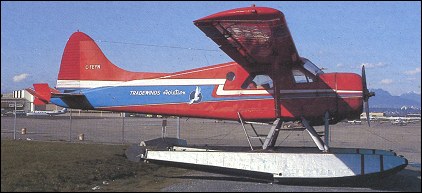
At the height of its career, the Beaver was to be found in some 50 countries, where it won universal acclaim for performance, ground stability conferred by wide-track tailwheel landing gear, and versatility. Basic accommodation was provided for a pilot and seven passengers, the latter replaceable by up to 680kg of freight. Great flexibility was bestowed on the Beaver by its ability to operate on wheel, ski, float or amphibious float landing gears.
Airtech Canada of Peterborough, Ontario, has converted a number of Beavers to take the 447kW Polish PZL-3S seven-cylinder air-cooled radial piston engine driving a PZL four-bladed propeller.
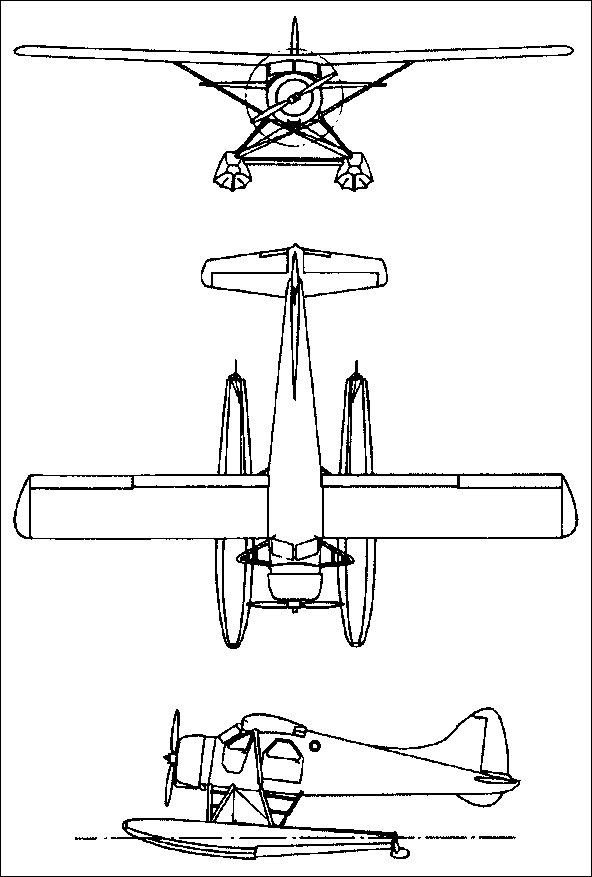
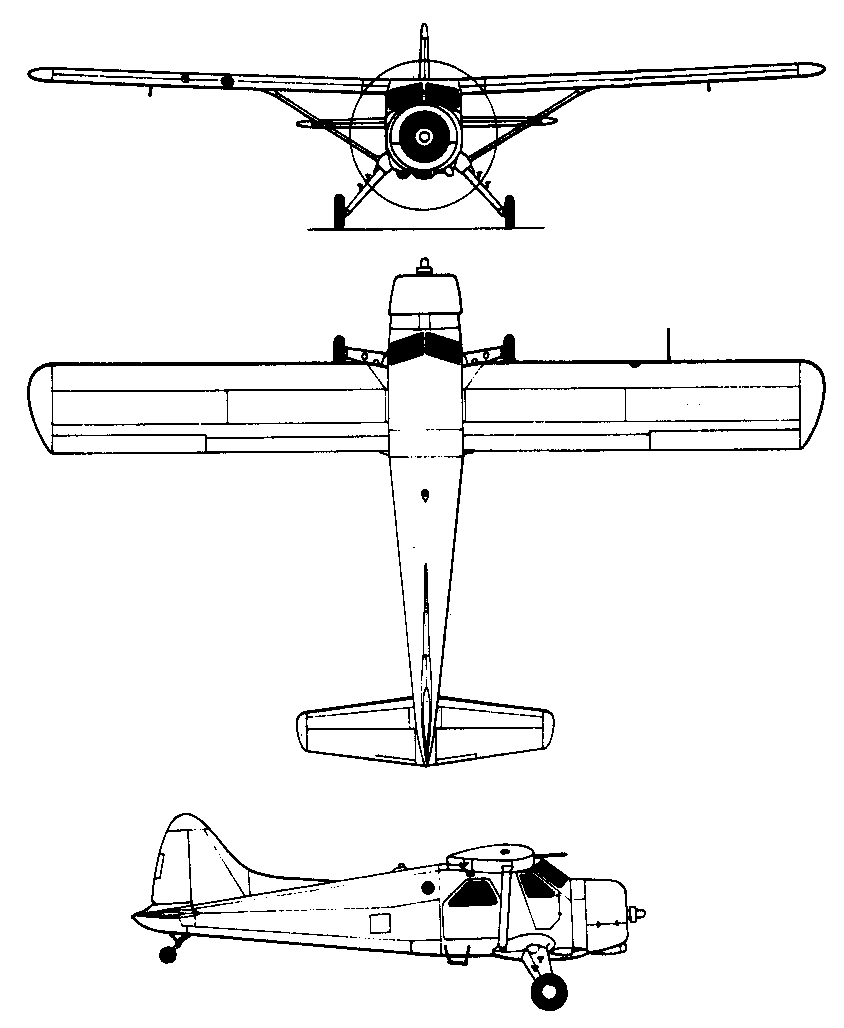
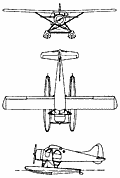 | A three-view drawing (592 x 877) |
| MODEL | DHC-2 Beaver I |
| ENGINE | 1 x Pratt & Whitney R-985 Wasp Junior radial piston engine, 336kW |
| WEIGHTS |
| Take-off weight | 2313 kg | 5099 lb |
| Empty weight | 1293 kg | 2851 lb |
| DIMENSIONS |
| Wingspan | 14.63 m | 48 ft 0 in |
| Length | 9.22 m | 30 ft 3 in |
| Height | 2.74 m | 9 ft 0 in |
| Wing area | 23.23 m2 | 250.05 sq ft |
| PERFORMANCE |
| Max. speed | 262 km/h | 163 mph |
| Cruise speed | 230 km/h | 143 mph |
| Ceiling | 5485 m | 18000 ft |
| Range | 1180 km | 733 miles |
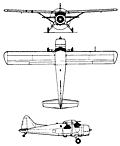 | A three-view drawing (844 x 1028) |
| S Jordan, e-mail, 30.01.2012 19:25 Ontario Ministry of Natural Resources bought registration # 2 of the line as well as many others. This Beaver was restored and to my knowledge still flies. It is equiped with Roll tanks for forest fire suppression mounted on the floats. While the original beaver was before my time with MNR it was a pleasure to hear many good stories from thos old firefighter about this fantastic aircraft. reply | | Scott Boyd, e-mail, 23.01.2012 06:40 I flew a Beaver on floats to Anchorage with a friend that owned it, he signed off my rating and I flew his other airplane back to Seattle. Nothing better then a round engine and like the 185 if you could get it in it would fly. reply | | Terry Davis, e-mail, 22.01.2012 22:50 I am a plastic modeler that has been building kits for many years and would
> now like to add a Beaver to my collection. Some time ago I obtained two
> kits of a 1 /24 scale Beaver on floats. The kits are very basic, about 25
> pieces total. What I would like to do is build one of the kits with fixed
> gear. My problem is that in the many sites that I have visited on the
> Internet, I have not been able to find any information regarding the
> dimensions /measurements for the fixed gear. I will be scratchbuilding the
> gear so it is very important that I have the correct measurements. If you
> could provide any information such as drawings, schematics, etc., I would
> appreciated the effort.
>
> Also, the aircraft that I intend on representing is 50-26105 USAF Alaska
> Air
> Command, Elmendorf AFB Alaska, 1964.
> If by chance you have some information on this bird, I would be interested
> in that, too. Thank you for your time. reply | | Barry Courtney, e-mail, 22.05.2011 14:00 I flew Beavers in Borneo from 1964 to 1967 and I do not remember Barrie Davies. I flew with 130 flt RCT. Who else flew Beavers? Just very curious. It is always intriguing to find out what you missed. Please let me know. I totally agree with his assessment of the Beaver. She picked me up when I had a fuel problem and took me home. She flew on limited panel when things were really traumatic and you knew she would always respond.My boss Major John Riggall,now, I believe, became Lt Col John Riggall must remember that. I left the Army and went into civil flying, and for the last 18 years of them as a Captain with BOAC /British Airways. I will never forget that beautiful Beaver that was part of you. You thought it to do and it did. The VC10 and the Tristar were so similar. Barry Courtney. reply |
|
| | John Doe, e-mail, 22.04.2011 15:59 I am doing a project on this aircraft reply |
| Mike Anderson, e-mail, 06.04.2011 06:12 I retied from the USAF. Never flew or even sat on this plane. I sure wished I could have. Spent many hours being flown across Europe on most every plane we had there. But I wished it could have been on this one. It looks so great - what a plane should look like. reply | | Frank Haynes, e-mail, 24.03.2011 00:21 Beavers arrived in Ghane in packing cases in 1960 and we RAF men on secondment to the Ghana Air Force built them up in no time. Flying under the bridge on the Volta River was good fun. reply | | Kurt M Johnson, e-mail, 07.03.2011 04:37 I worked (crewchief)on a L-20 Beaver when I was in Germany fron 1959 to 1961. I was stationed with the 30th Transportation Co. at Fleigerhorst Kaserne in Langendiebach, outside of Hanau. The last three numbers were 921. Anybody know what happened to that aircraft? It was a great plane. I still have the P /W medallion from the oil tank. They went fast! Love to hear from someone who knows.
Regards,
Kurt reply | | Everett A Smith, e-mail, 06.03.2011 20:48 Flew the L-20 in Japan,Korea, USA,Libya, Colombia, and Iran Agreat AC reply | | Roger Pile, e-mail, 05.03.2011 00:19 Flew the L-20 at Scott AFB with the 85th FIS from 56-59. We used for parts pick-up and personnel movement. In 1970-71, got recurrent in it (now called the U-6) at Luke AFB where it was used to transport fighter pilots to the gunnery ranges as safety monitors, landing at unattended airstrips in the desert. Flew one of them to the boneyard at Davis-Monthan AFB on its last flight. Have fond memories of my hours in the Beaver, despite being primarily an F86D, F101B and F102 pilot. reply | | Stan Svihla, e-mail, 23.01.2011 05:22 I worked at de Havilland Canada. Put in over 20 years at the plant. Started in 1952 Lancaster Overhaul,onto Beavers then Otters. Left DH for a number of years to return to work on Dash-7, Buffalo and last group of Twin Otters and on to the Dash-8. Heard many stories from operators about Beavers, Otters and Twin Otters and what they were capable of doing. Beaver truly deserves the credit it gets for doing what most planes only hope they can do. The only plane that can replace the Beaver is another Beaver. The Viking Twin Otter is doing that now so it's time to replace the Beaver. At the annual "Wings and Wheels" at the old DH plant many a highly modified and up-dated Beaver worth into the seven figures all of 60+ years old gets admiring glances. Not bad for an old work horse that was considered too expensive at the time of it's introduction selling at $24,000.00. After starring in a movie featuring a Beaver Harrison Ford went and bought one and flies it regularly. There are many stories I heard of the Beaver's capability but the best one I remember of a Northern operator showing me a photo of a heavily loaded Beaver on floats sitting in the water level to the top of the rear of the floats. I enquired if that was risky? His reply was." That if it still floats its safe to take off". There is a pride at de Havilland to build the best product possible and even now as in the Bombardier family the tradition still goes on. reply | | Fawad Butt, e-mail, 29.11.2010 10:20 Hello my company have 05 DHC-2 with R-985 Engines we are facing lots of problem regarding the spares like fuel content gauges, fuel content Tx and Tech Generators because of there 5year life can you help me in this matter. We are also interested to convert our these aircraft in to Tube Beaver can we do this? reply | | Paul Tanner, e-mail, 25.11.2010 20:48 I flew the Beaver in 'Nam '69-'70 123rd Avn Bn - ChuLai and FRG - Frankfurt '70 - seperation racking up a bit over 1,100 hours in it. I loved the bird and wish I had been privy to the end of war auctions. Went to Alaska a few years back and was happy to see all the U-6's flying in that neck of the woods. reply | | Robert Wilson, e-mail, 11.11.2010 19:59 I was mechanic on the beaver for a tour in Korea easy to work on, cold in the winter and hot in the summer my a /c n numbers 770 & 442 wonder whhat happened to them. 15th av.bat first cav. reply | |
| | stan schroder, e-mail, 20.10.2010 10:46 The DHC should be so proud of themselves. no other aircraft manufacturer in the world can have the bragging rights that DHC has.We build aircraft to last and aircraft that everyone could only dream about building ,Boeing,had to buy the company to get the bragging rights and the Canadian goverment can only sit back and wonder what the hell were we thinking when we sold DHC.Good on all those Canadians that were involved in building the D H C Beaver They make the best,they last,their reliable,and best of all their Canadian reply |
| Biggs, e-mail, 29.09.2010 10:01 When Viking purchased the rite to manufacture the Beaver from the original plans I could hear a cheer around the world.
Living here on the Canadian Pacific coast they are part of our daily experience and we love every time we see one.
Viking thanks. reply | | Biggs, e-mail, 29.09.2010 09:55 When Viking purchased the rite to manufacture the Beaver from the original plans I could hear a cheer around the world.
Living here on the Canadian Pacific coast they are part of our daily experience and we love every time we see one.
Viking thanks. reply | | Bill Scharff, e-mail, 23.09.2010 20:08 What a fun plane to fly. Flew Army Beavers in Vietnam and Germany. During my year flying OV-1's in Vietnam our Beaver was the only airplane I took combat damage in. reply |
| Bob Pedigo, e-mail, 18.09.2010 00:21 I took instrument training in the L-20 /U-6 at Ft Rucker, AL and it was love forever after. I went on to Europe and flew it for three years in some terrible weather conditions and it always came through. I agree that you could always seem to get one more bag on board and if you could get it on board, you could get it off the ground. I've gone into a lot of unimproved field strips and it is terrible to say even one thng bad about the Beaver but the crosswind component of 20 knots was too high. The wind would blow those boxy sides into the bushes unless you could drag the upwind wing on the ground, land it on one main gear, slowly lower the tailwheel to get some control and then lower the downwind wheel to the surface. reply | | Ron Susi, e-mail, 23.08.2010 22:34 Flew the U-6 in Thailand in 1966 from NKP. I will testify that you can fly it into the side of a mountain and walk away. Did it on the Thai Cambodian border. reply |
|
Do you have any comments?
|
| 
COMPANY
PROFILE
All the World's Rotorcraft
|


 ubaTaeCJ

20
reply