|
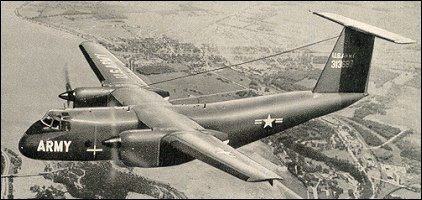
| Developed from the DHC-4 Caribou, being an enlarged fuselage version of that aircraft, the de Havilland Canada DHC-5 Buffalo was known originally as the Caribou II. Four were ordered for evaluation by the US Army, their development cost shared by the US Army, together with the Canadian government and de Havilland Canada; the first of these transports made its maiden flight on 9 April 1964. The DHC-5 had been developed to meet the requirements of the US Army for a transport that would be able to carry loads such as the Pershing missile, a 105-mm howitzer or 3/4-ton truck.
No further orders resulted from US Army evaluation of the DHC-5 (designated originally YAC-2 by the US Army, and later C-8A), but the Canadian Armed Forces acquired 15 of the DHC-5A which it designated CC-115: six were converted subsequently for deployment in a maritime patrol role. Following delivery of 24 to the Brazilian air force and 16 to the Peruvian air force, the production line was closed down. In 1974 the company realised there was a continuing demand for the Buffalo and production of an improved DHC-5D Buffalo was initiated. This had more powerful engines which permitted operation at higher gross weights, and offered improved all-round performance. Production of the Buffalo ended in 1982, but the last of 122 aircraft built was not delivered until April 1985. DHC-5Ds were bought by the armed forces of Abu Dhabi (5), Cameroun (3), Chile (1), Ecuador (3), Egypt (10), Kenya (8), Mauritania (1), Mexico (3), Sudan (4), Tanzania (6), Togo (2), Zaire (3) and Zambia (7). With some interest being shown by civil operators, DH Canada developed the DHC-5E Transporter, certificated in Canada in 1981. Generally similar to the military Buffalo, it could seat 44 passengers in a standard layout but with quick-change passenger/cargo and VIP/executive interior. Two were acquired by Ethiopian Airlines.
VARIANTS
DHC-5B: designation of proposed version with General Electric CT64-P4C engines, not built.
DHC-5C: designation of proposed version with Rolls-Royce Dart RDa.12 engines, not built.
NASA/DITC XC-8A: designation of C-8A following conversion for use as an augmentor wing research aircraft; extensively modified, it has clipped wings, fixed landing gear, two Rolls-Royce Spey engines with vectored nozzles complementing the augmentor wings.
XC-8A ACLS: redesignation of C-8A following conversion for use as an Air-Cushion Landing System research aircraft; instead of conventional landing gear it has an inflatable but perforated rubber air cushion which permits operation from and to almost any type of surface, including ice, rough airfields, soft soils, snow, swamps and water.
NASA/Boeing QSRA: redesignation of C-8A following conversion for use as a Quiet Short-haul Research Aircraft; this aircraft has a new wing incorporating upper-surface blowing and boundary-layer control; engines are four Avco Lycoming F102 turbofans.
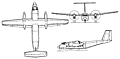 | A three-view drawing (1000 x 492) |
| MODEL | DHC-5D |
| CREW | 2 |
| PASSENGERS | 44 |
| ENGINE | 2 x General Electric CT64-820-4 turboprop, 2336kW |
| WEIGHTS |
| Take-off weight | 22317 kg | 49201 lb |
| Empty weight | 11412 kg | 25159 lb |
| DIMENSIONS |
| Wingspan | 29.26 m | 96 ft 0 in |
| Length | 24.08 m | 79 ft 0 in |
| Height | 8.76 m | 29 ft 9 in |
| Wing area | 87.79 m2 | 944.96 sq ft |
| PERFORMANCE |
| Cruise speed | 420 km/h | 261 mph |
| Ceiling | 7620 m | 25000 ft |
| Range w/max.fuel | 3280 km | 2038 miles |
| Range w/max payload | 416 km | 258 miles |
| HAIDAR USUP, e-mail, 28.01.2026 19:31 I HAVE 2 ASSY PROPELLER GEARBOX IN NS CONDITION FOR THE BUFFALO DHC5 , PLEASE LET ME KNOW IF THERE IS ANY INTEREST. reply | | lxbfYeaa, e-mail, 17.01.2026 20:38 20 reply | | ubaTaeCJ, e-mail, 21.02.2025 16:26 20 reply |
| Alain TENE, e-mail, 02.09.2015 13:49 Hello All
How can we get the DHC5 Buffalo for ACMI in Africaz? We are really impressed and mtivated to operate these aircraft
thanks reply |
|
| | David Larson, e-mail, 09.04.2015 16:30 Has Ottawa come to a decision regarding the C-115 planes still in service? It would seem [to this uneducated United Statian] to be sensible to replace them with the familiar DHC-5NG, putting the emphasis on new sensors and electronics rather than a new and unfamiliar airframe. reply |
| roland, e-mail, 29.12.2014 00:45 May 18 2010 we at ASC had a prop strike no 1 eng C-GASY Sn. 108 near Borden island Nunavut.I flew out of Resoulute for 380 nautical miles with a twin otter to assess the damage. No 1 eng had dug in a snowbank at about 3000 hp and the the primary blade that dug in was bent back about a foot and the trailing edge was in the feather position Holly crap i said to my self this don't look good.So i popped the cowl doors for further investigation and found the accessory drive on the compressor had broke right off the compressor case and hit the lower engine deck and snapped the apu nacell mounts, Now its time to sat phone the DOM and report the damage, all i said to him was the propulsion system was FUBAR everything from the firewall to the prop spinner. Twenty one days later ASY was back at headquarters in Yellowknife. The DHC 5 had a remarkable design engineering team because of them the nacell structure had very little damage and it took 3 days of sheet metal work. The design was made so the engine would dissipate the energy not the airframe. This job was a remarkable feat to get it off the ice before it sank. So that being said, if you buff operators have a big or small problem i can be of your service email me reply | | Frank Sagi, e-mail, 02.05.2014 22:48 Oh ! I also remember when the Buffalo used for the air cushion testing came back to us afterwards if I recall correctly it was CC115451
Saw at the CFB Trenton air show the one with the boundary air blown over the wings. It was impressive. But can't recall to much. reply |
| Frank Sagi, e-mail, 30.04.2014 19:29 I spent most of my career in the Canadian Forces as an aero engine technician and did two tours at CFB Trenton and a UN tour in Ismailia Egypt with 116 ATU working on the Buffalo.
I have many memories and will share a few things.
The Canadian Warplane Heritage Museum (CWH)restored a static Buffalo for display in the colours of Buffalo 461 a Canadian UN Buffalo that was hot down by the Syrians with the loss of 9 Canadians and other UN Nationalities. In Canada 9 August is Peacekeepers Day as the aircraft was shot down on 9 Aug. I was of one of those honoured to be invited to a 116 ATU reunion dinner in the CWH hanger and the dedication the next day. The restoration was fantastic and I only had one negative observation - I had never seen a Buffalo so clean.
There was a photo going around after one of the Buffaloes came back from Egypt. Non Destructive testing had x-rayed a wing and there was the body of a large bird in it, think a stork. Plus stories about how much sand was vacuumed out of the aircraft.
While at CFB Trenton the Buffalo was utilized by 426 Suadron which was a training squadron which taught the Buffalo, Boeing 707, Hercules and Cosmopolitan at the time.
The Buffalo took a fair amount of punishment with all the touch and goes plus the students being very diligent in finding problems with the aircraft as being under scrutiny. When in Egypt with the aircraft doing long scheduled flights there were very minimal serviceability problems compared to what I was accustomed to. The squadron did long range trainers at the end of the course. I was lucky to go along with some. The only problem was bringing appropriate clothes. As may go to Tuscon AZ. and then up to Yellowknife Northwest territories to a raging blizzard.
CFB Trenton also had 424 Sqn which was the main Buffalo user. It was used in a Search and Rescue (SAR) and light transport role. The one down fall of the two roles was having to reconfigure the interiors for each role as if the SAR standby aircraft could not be repaired in x amount of time we would have to reconfigure a serviceable aircraft.
I spent a lot of time away on searches. Always a white aircraft lost in a snow storm at Christmas. My new wife's 1st Christmas in Trenton when I was posted there the second time spent it alone and it was her 1st away from a large Newfoundland family. But I loved the role.
In the light transport role I remember working out of Winnipeg as the Ministry of Transport was working on runways in the Artic. I think they were utilizing military engineers. The Buffalo ferried equipment and supplies up until the runway was long enough to handle Hercules aircraft.
I remember hauling a gravel crusher up in the Buffalo. Because the Buffalo broke down in Churchill Manitoba and we had to position two Buffaloes tail to tail with a flat bed trailer between them and by hand move the gravel crusher out of the unserviceable aircraft to the serviceable one. The loadmasters did a fabulous job as it went so smooth.
Also was involved in a long range ferry trip the first week of January from Trenton to Lahr Germany. By way of Arctic; Greenland; Iceland; and Scotland. It was so cold in the aircraft everything froze and the condensation from the oxygen masks as we flew over Greenland. Fun trip - really.
For those who may not know Canadian Buffaloes were ferried to Rhodesion for the elections at the end of white rule when it became Zimbabwe. The Buffalo flew into remote areas to collect ballot boxes. During the ferry flight Hercules were used at some stops to transfer fuel over to the Buffalo.
I had a friend that went with an ex Canadian Buffalo that was purchased by a civilian company in Zimbabwe. I was to late for the job as they had an aero engine tech but still needed an airframe tech.
The U.S. Navy had a Buffalo at China lake Naval Weapons Testing Centre. It had belonged to another US department and had glass in the floor to photograph coastline erosion. The reason I know this is I was sent to China Lake to change an FCU when the first got it. Remember the gauges were in rpm and not in percent so had to do some calculations. had a great time there.
The Buffaloes that went to Mexico my supervisors were asked by DeHavilland to be tech rep. They suggested me as I was young and single at the time. I couldn't be released from the military soon enough for DeHavilland. But I remember that one of the things was we would have had to transport some race horses on the aircraft to Mexico for some General.
Think Indonesian navy also had some Buffaloes because once I had retired I received a phone call from a person I was Egypt with asking if I wanted to go work there.
Remember Tanzanian Air Force coming to Trenton to learn about the Buffalo as they were getting them and an older friend being head hunted by DeHavilland to work over there
for them.
It was a great career and have many memories working on the Buffalo. We never did have t ... reply | | Barry Hubbard, e-mail, 06.06.2013 17:27 Dug out my AFM and the ceiling is not 25000' BUT 31500'. We used to go to 32000 for test purposes.I got the "bends" once and hypoxic once so I know we've been there.Did a world tour in 1976 as well covering mainly Africa and the Middle East on that occasion and the Farnborough Air Show in 1976 as well. A great a /c to fly !! reply | | Barry Hubbard, e-mail, 06.06.2013 17:12 The original 4 DHC 5 Buffalos were known as the CV-7A and then C-8A when they went USAF..they became CC-115's in the RCAF and C-115's for Brazil and Peru...Buffalo s /n 60 reg'n C-GBUF set 6 time to climb records in Feb 1976- 3000M, 6000M and 9000M in class C1h group 2 turboprops and C1 group 2 turboprops previously held by a P-3C Orion. A little trivia to the history.. reply | | wuryono, e-mail, 05.04.2013 07:43 I would like to know the fuel consumption per flight hour and the TOD of DHC-5 Buffalo with GE turbo engine.would appreciate if I can have an acces where I can buy the performance section of this aircraft. reply | | Peter Maisiba, e-mail, 04.12.2012 06:59 Quiz: How can I solve a problem of the landing gear doors flapping when the aircraft is in flight and the gears are up and locked?If possible please post me the schematic diagnostic diagram. reply |
| Gordon, e-mail, 03.03.2012 09:12 I should say I flew in the back seat of a buf for many hours as a civilian PEP volenteer during visual searches in Northern BC. I will never forget one day returning to the Prince George airport from our seach grid, the crew decided a close look at the banks of the Fraser River would be in order. They got down low over the water and threw that big beast through every twist and turn that river makes. We were banked over so hard on one turn my partner was looking straight down at the river bank and all I could see was the tops of trees growing above the cliff.
Flying over a straight bit I felt myself sitting very heavy for a second, followed by what felt like a little 0g. We had pop'd up over a power transmission line and dropped right back down to watch the banks.
If I ever have my own plane, it will be painted Orange with a red stripe. reply |
| Gordon Seiter, e-mail, 03.03.2012 08:55 Jean-Paul, jeanpaulgilbert=lycos.com, 08.02.2010
@G I Wonder,
the only 4 engine turbo-prop the canadian army has is the DASH-7, a close relative of the Buffalo and the DASH-8.
G I wonder, c=nada.ca, 04.02.2010
I thought the Buffalo was a 4 engine (turbo prop) I say this because I saw one at Cold lake 1977. So what did I see then?
The Canadian Forces does have some Hurks.
"Canada's fleet of CC-130s (E and H models) range in age from 11 to 43 years and are some of the oldest and highest flight time C-130s in the world — 60% are more than 30 years old. The current fleet has accumulated over a million flying hours, with almost all E-models each having more than 40,000 flight hours. Four of Canada's more recently acquired H-model Hercs are assessed to have the same Estimated Life Expectancy as the E-models: 2010." Taken from cc130J web site. reply | |
| | Koin, e-mail, 19.02.2012 15:18 Does anyone know where i can get the fireproof .Buffalo upholstry for the transport type aircraft? reply | | paidui, 21.06.2011 04:51 flew her first post rebuild test flight serviceable, with the exception of one of the nacelle doors blowing off inflight due to a faulty hinge and latch. reply | | Aviator44, e-mail, 05.05.2011 13:47 Superb aircraf. It was my favorite between several others I have flown in my 30 years in Air Force (Brazilian Air Force). I flew 3.000h without any significative accident. Now I'm retired and the Buffalo too, replaced by Casa C-295. reply |
| Jim Stewart, e-mail, 03.05.2011 05:07 The picture above is a Caribou. When our crew was shot down in Syria in August, 1974, the first reports were that a Caribou had been shot down and that is how we knew it was actually a Buffalo. reply |
| Jim Stewart, e-mail, 03.05.2011 05:05 A great aircraft. I flew it with 424 Squadron, Trenton and 116 ATU, Cairo /Ismailia, Egypt. This was before they put an autopilot in it. The Buffalo hauled a load and was able to land and takeoff from anywhere. We sued to go out of Trenton and do pilot training on a grass strip with one hell of a slope, just north of the base. Flew it into cane fields in Jamaica and gravel strips in the Arctic, all of which were less than 1200 feet. Keith Levia and I took one into Resolution Island one day to carry up listening antenna. Keith approach the runway lip from below and when he stopped on the runway, the ground asked him to move forward as they could not get the forklift between the ramp at the back and the edge of the cliff. I was also on the first flight into the Golan Heights in 1974 and when we landed and opened the ramp and unloaded the Israeli's eyes were bugged out with envy at the load and the aircraft performance. Stable and once it was airborne hardly anything broke. Before airborne thought the sophisticated systems could be troublesome. reply | | khaled, e-mail, 22.02.2011 19:05 it is hard worker aircraft and mor safty reply |
|
Do you have any comments?
|
| 
COMPANY
PROFILE
All the World's Rotorcraft
|


 Alain TENE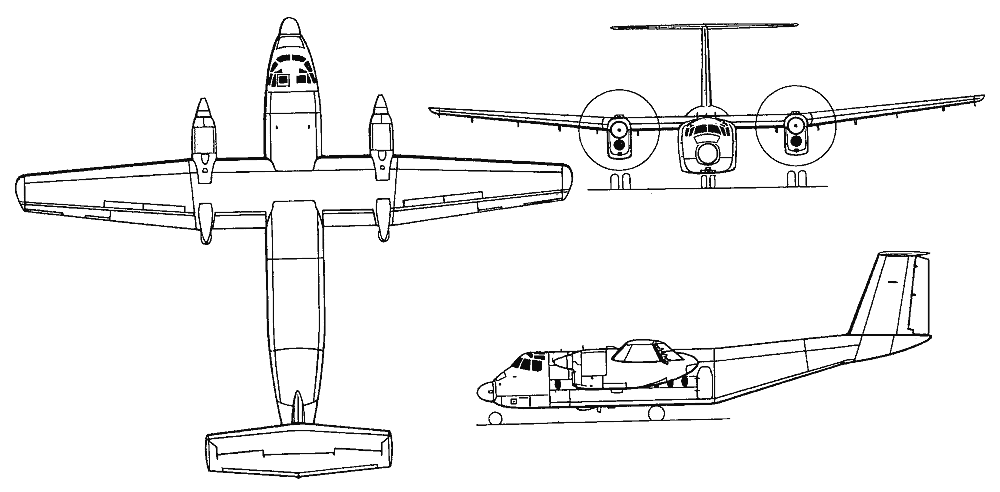


20
reply