|
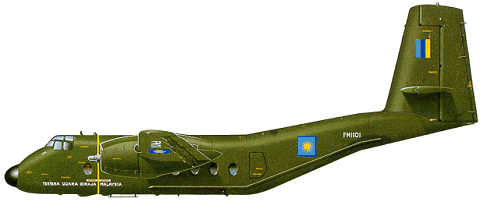
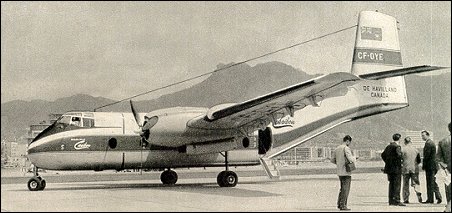
| The decision to build the de Havilland Canada DHC-4 Caribou was taken in 1956, the object being to develop an aircraft combining the load-carrying capability of the Douglas DC-3 with the STOL performance of the Beaver and Otter. The Canadian army placed an order for two and the US Army followed with five, the US Secretary of Defense waiving a restriction which limited the US Army to fixed-wing aircraft with an empty weight less than 2268kg.
The prototype flew in July 1958, its high wing having a characteristic centre-section with marked anhedral. The rear door was designed as a ramp for items weighing up to 3048kg. In the trooping role up to 32 soldiers could be carried. The Caribou served with the RCAF as the CC-108 and with the US Army as the AC-1 (1962 designation CV-2A). As a result of its evaluation of the first five aircraft the US Army adopted the Caribou as standard equipment and placed orders for 159.
The second batch of aircraft was designated CV-2B. Following tension on the border between China and India, the US Army handed over two Caribous to the Indian Air Force in early 1963. In January 1967 the 134 Caribous still in service with the US Army were transferred to US Air Force charge as C-7A and C-7B transports. The aircraft was a general sales success and examples flew not only with air forces throughout the world, but also with civil operators. In Canadian service the Caribou was replaced by the DHC-5 Buffalo and surplus examples were sold to a number of nations including Colombia, Oman and Tanzania. Many of the Canadian aircraft had been loaned to the United Nations, seeing extensive international service. Production ended in 1973. The DHC-4A model supplanted the DHC-4 on the production line from aircraft no. 24: the two models are very similar apart from the later model's increase in weight, maximum take-off weight of the DHC-4 being 11793kg. Total production was 307.
| MODEL | DHC-4A Caribou |
| CREW | 2 |
| PASSENGERS | 32 |
| ENGINE | 2 x Pratt & Whitney R-2000-7M Twin Wasp, 1081kW |
| WEIGHTS |
| Take-off weight | 12927 kg | 28499 lb |
| Empty weight | 8283 kg | 18261 lb |
| DIMENSIONS |
| Wingspan | 29.15 m | 96 ft 8 in |
| Length | 22.12 m | 73 ft 7 in |
| Height | 9.68 m | 32 ft 9 in |
| Wing area | 84.72 m2 | 911.92 sq ft |
| PERFORMANCE |
| Max. speed | 348 km/h | 216 mph |
| Cruise speed | 293 km/h | 182 mph |
| Ceiling | 7560 m | 24800 ft |
| Range w/max payload | 389 km | 242 miles |
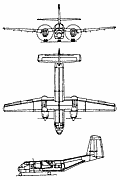 | A three-view drawing (592 x 887) |
| lxbfYeaa, e-mail, 07.11.2025 03:57 20 reply | | ubaTaeCJ, e-mail, 21.02.2025 17:38 20 reply | | lxbfYeaa, e-mail, 14.03.2024 05:42 20 reply | | David Hague, e-mail, 01.09.2022 19:21 Ladies and gents. There is a lot of history, knowledge and skill in this thread. Kudos to you all.
I need to know if anyone knows of any flying DHC4 Caribous, non turbine, or any that are potentially for sale?
Regards
David reply | |
| | Shawn Giefing, e-mail, 06.03.2016 07:13 My papaw was also one of the survivors of the C7 tail wing 63-9751 crash on HK mountain. His name was Elmer Dale Bass. Any other survivors or people who remember his name feel free to contact me. He passed away March of 2015 I've been trying to contact and friends that served with him to hear stories of my papaw and the brave men he served beside. God Bless our troops and welcome home. To the ones who have fallen may they forever rest in piece as the heroes they are. reply |
| Mark Erickson, e-mail, 18.03.2015 13:19 Flew the Caribou @ Cam Ranh Bay, RVN, 1969-70. Great airplane for short field and airdrop work. As a new USAF pilot, learned a lot about basic flying, worked with some great Flight Engineers, and never had a serious problem with the aircraft in 1115 flt hrs! reply |
| SP 5 Robert Carroll, e-mail, 02.03.2015 18:18 Always loved this aircraft. Upon arriving at Qui Nhon airfield VN I was assigned to 540th Trans Co in Oct 1966 my first job was to prep the last several non-airworthy Caribous and load them on barges on the beach to be shipped back to the US to be repaired and turned over to the AF. reply | | James Ebinger, e-mail, 08.01.2015 20:14 I jumped this aircraft when I was in Tennessee and loved it my goodness the oldies are fantastic reply | | Andrea Webster, e-mail, 17.10.2014 21:32 Mr. Joseph Tedeschi, my grandfather was also aboard that plane when it crashed. It has been years since your post but my father and I would love to get in touch with you! Please email us if you can at andrea.wbstr@gmail.com reply |
| jabbrn@aol.com, 23.03.2014 19:46 I loved flying this plane, flew it across the ocean and throughout VN 1966 with the 135th . reply | | Jerry Allen, e-mail, 25.10.2013 02:00 I flew the Bou for the US Army in VN during 1966. My replacement were AF crews. I was sad to lose the Bou. It was a great airplane. The shortest strip I flew it in /out of was only 844 feet long...I paced it off. It got the job done.
I was with the 135th AVN CO. reply | | Old Grunt, e-mail, 04.05.2013 03:56 Was with 310Ranchhands love to watch the Bou fly backwards in high wind on landing in nam reply |
| Buddy, e-mail, 28.10.2012 03:24 My father was 1Sgt Charles Wright, crew chief on a Caribou, 1963-66 at ft Bennington- 11th AA reply | | DC Bhardwaj, e-mail, 07.05.2012 10:43 A wonderful aircraft with very nice STOL characteristics, ideal for shortfield prepared /unprepared operations.Full Flaps approach & landings was the beauty of this aircraft.I was one of the fortunate pilot to fly this machine while in the Indian Air Force (IAF).This aircraft did wonderful service to the IAF for nearly 25 yrs.and was the back bone of Air maintainance for the troops & civil population in the far flung areas.I am and will always be proud of this aircraft. Thanks De Haviland. reply | |
| | henry pribadi, e-mail, 29.04.2012 15:05 Dear sirs,
I need help and information. I want to buy DHC 4 Caribou with turbo engine for cargo for operating at south asia.
Could anyone help me to find the seller of DHC 4 Caribou.
Thank and regards
Henry Pribadi reply | | A.Razak Hassan, e-mail, 17.04.2012 15:28 Hallo!I was very suprised to discover the Royal Malaysian Air Force Caribou shown with the serial nr. FM 1101 because I was flying with this Aircraft as a Crew Chief in the 60ties in Borneo, Malaysia. This Aircraft was one of four FM1100 to FM 1103 given as a gift from the Canadian Goverment to Malaysia in 1962.Unfortunately this particular Aircraft crashed into the jungle of Sarawak,Borneo after experiencing an engine failure and was written off. The Co-pilot was killed in this crash and the Captain as well as myself were injured. This crash happened in 1964.Before that, I was trained in Australia with No.38 Caribou Sqn in RAAF Richmond.The last RMAF Caribou was retired about 10 years ago and about eight or ten Aircrafts are still stored in RMAF Base Kuching,Borneo.I send my best regards to all ex-Caribou crew members. reply | | Bob Neal, e-mail, 12.03.2012 18:01 Flew the Caribou out of Vung Tau and Cam Rahn Bay 70-71. Had never landed on a runway less than 8000' until then. In training looking down at a 1500' runway looked impossibily short. In country there were 5 or 6 that were less than 1000'. In a strong headwind and with full flaps you could almost hover. reply |
| W CALAME, e-mail, 24.02.2012 21:03 Have a question, but first Thank You all for your service. I was a crewchief on a Caribo up at Fort Richardson Alaska in 1966, 12th Aviation, They were a great ship.My question is when they were transfered to the Air force how were they transported to v
Vietnam and the route and fuel stops to get their. Thank You reply |
| Charlie Dexter, e-mail, 10.01.2012 18:11 Sorry my earlier comment has a typo. The 1st Avn Co(FWLT)flew 18 Caribou to SE Asia, not 16. We flew in three flights of 6 each. Big Moose One, Two and Three. reply | | Charlie Dexter, e-mail, 10.01.2012 17:23 I was assigned to the 1st Avn Co (FWLT)in 1962 /63 that flew 16 Caribou from Ft. Benning, GA over the ice cap, through Europe, and the middle east when we deployed to South East Asia in suport of the Vietnam War. As a 1 /LT and new aviator this was a great experience flying this super aircraft half way arond the world and then throughout Thailand and Vietnam. I also was assigend to the 224th Avn Bn later on my second Vietnam tour and became the comand pilot of "Pathfinder" (62-4147)an electronic intelligence gathering modified RCV-2B shortly after she was repaired following being shot down up along the DMZ. I then became the last Army Aviator to fly the Caribou in Vietnam as 62-4147 was turned over to the USAF in Apr 1967. reply |
|
Do you have any comments?
|
| 
COMPANY
PROFILE
All the World's Rotorcraft
|


 Andrea Webster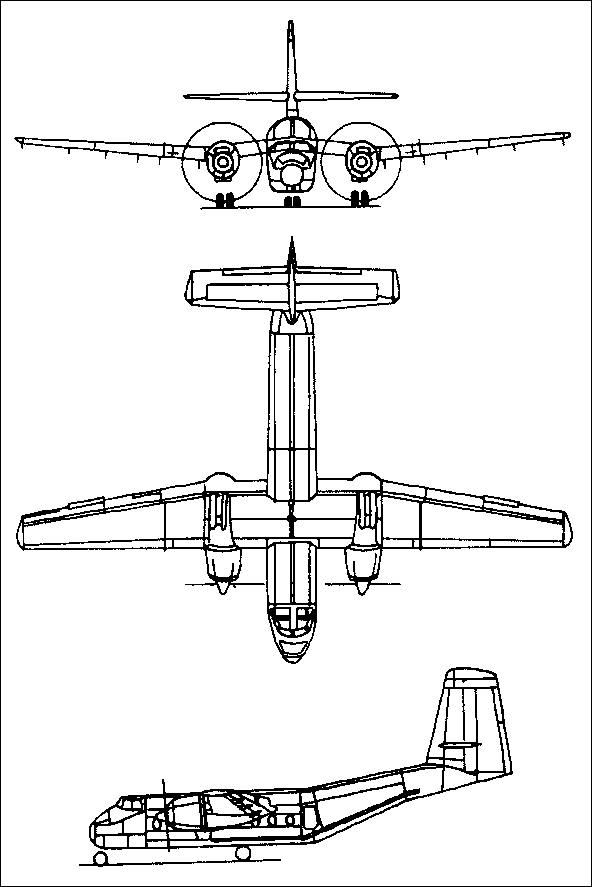


Hi Shawn, I'm so sorry I did not follow up my comment back in 2011, and to look for comments in reply. Just to find another name of a person also in the crash and survived it is so rewarding. I send my sincere condolences on the loss of your papaw. I would have liked to have known him and to contact him to get his story. I'm in the process of writing an account of the crash, and I have names of 5 of the people who survived the crash. Please try to contact me, even after 4 years since you posted your comment. My e-mail is tedeschij@verizon.net, phone 609-953-5524. I've gathered a large amount of material concerning the crash which I would be happy to share with you.
reply