|
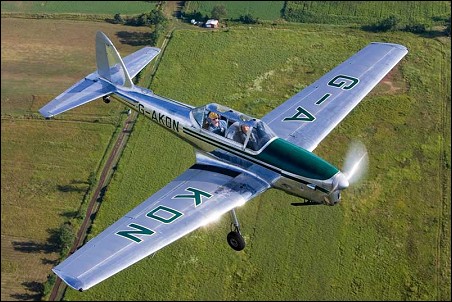
| The de Havilland Canada DHC-1
Chipmunk was designed to succeed
de Havilland's classic Tiger Moth biplane
trainer. Flying for the first time at Downsview,
Toronto on 22 May 1946, the tandem-
seat stressed-skin monoplane was
the first indigenous design of de Havilland
Aircraft of Canada Ltd. The prototype,
put through its paces by Pat Fillingham
from the parent company at
Hatfield, was powered by a 108kW de Havilland Gipsy Major 1C.
Chipmunks built to the prototype's
specification were designated
DHC-1B-1, while those with a Gipsy
Major 10-3 were designated DHC-1 B-2.
Most Canadian-built Chipmunks had a
bubble canopy.
Downsview built 218 Chipmunks, the
last in 1951. Two were evaluated by the
Aeroplane and Armament Experimental
Establishment at Boscombe Down. As a
result, the fully-aerobatic Chipmunk was
ordered from Hatfield and Chester to
Specification 8/48 as an ab initio trainer
for the RAF.
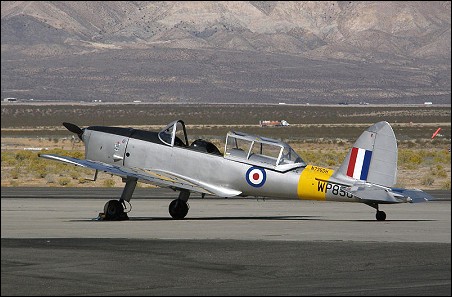
The RAF received 735 Chipmunks out
of 1,014 manufactured in the UK. The
first to wear RAF roundels were flown by
the Oxford University Air Squadron from
February 1950; thereafter, the type replaced
the Tiger Moth with all 17 university
air squadrons, as well as equipping
many RAF Volunteer Reserve flying
schools in the early 1950s. National service
pilots underwent their initial training
on the 'Chip', which served intermittently
at the RAF College, Cranwell.
A few Chipmunks of No. 114 Squadron
were pressed into service in Cyprus on
internal security flights during the
troubles of 1958.
Under an agreement concluded between
de Havilland and the General
Aeronautical Material Workshops
(OGMA) of Portugal 60 Chipmunks were
licence-manufactured from 1955 for the
Portuguese air force, and the type was
still being operated by this service until
replaced in 1989. Other users included
Burma, Ceylon, Chile, Colombia, Denmark,
Egypt, Eire, Iraq, Jordan, Lebanon,
Malaya, Saudi Arabia, Syria, Thailand and
Uruguay.
External links
| MODEL | Chipmunk T.Mk 10 |
| ENGINE | 1 x De Havilland Gipsy 8, 108kW |
| WEIGHTS |
| Take-off weight | 914 kg | 2015 lb |
| Empty weight | 646 kg | 1424 lb |
| DIMENSIONS |
| Wingspan | 10.46 m | 34 ft 4 in |
| Length | 7.75 m | 25 ft 5 in |
| Height | 2.13 m | 7 ft 0 in |
| Wing area | 15.97 m2 | 171.90 sq ft |
| PERFORMANCE |
| Max. speed | 222 km/h | 138 mph |
| Cruise speed | 187 km/h | 116 mph |
| Ceiling | 4815 m | 15800 ft |
| Range | 451 km | 280 miles |
| Mick Skinner, e-mail, 09.03.2011 10:29 I learned to fly in a Chipmunk at RAF Coltishall in 1966 when we were giving ATC cadets air experience flights,my instructor was a Lightening Squadron pilot and we did an hour of solid aerobatics one day,fantastic stuff.For my 60th my family bought me an extreme aerobatic flight in an Extra 300 and my pilot was an ex Lightening and Red Arrows guy, I got to fly all the routines of display shows, did +5g & -2g great stuff must do it again. reply |
| fred thompson, e-mail, 25.12.2010 23:03 i have checked my logs and my aircraft dhc-1-82-85
serial no. 190 /228 was actually manufactured in 1956 reply | | fred thompson, e-mail, 24.12.2010 21:24 i believe my chhipmunk airforce number 052 was manufactured in 54 or 55..i will check log books and advise you. reply |
| Peter Gunthorpe, e-mail, 15.05.2010 17:26 I was in the first batch of regular u /t pilots to train at RAF Thornhill S Rhodesia Jan 1952. all our brand new Chippies were Without spinners, Rumour had it that the CO put the first one to arrive onto it's nose and as no spares were available all the others had their spinners removed, to save him embarrassment!!I saw the last regular pilots to solo on Tigers and was the 1st to get the chop on a Chippy reply | |
| | Ray Hollands, e-mail, 20.07.2009 05:34 You say that the last Chipmunk was built in 1951. My Canadian Chipmunk, serial # 18065, was built in 1956. If you would like a proper photo of a representative model, I'll gladly supply one. reply |
| Jock Williams, e-mail, 19.04.2009 23:15 You have to get a picture of the trainer model with the Gipsy engine. The one you show lacks all beauty and grace!
The Chipmunk was the metal covered monoplane follow-on to the Tiger Moth -and an excellent offspring it was indeed!
With its wide track gear, bubble canopy and a vast reduction in drag compared to the Tiger it was a magnificent trainer. They could have made it a foot longer and given some more room in the cockpit -and of course a few hundred more horsepower and retractable gear would have almost made it a fighter -but the point is -it could be put back into production today and a lot of flying schools and air forces could make excellent use of it.
How many 1946 vintage aircraft can you say THAT about?
Jock Williams Yogi 13 reply |
| ismail, e-mail, 02.02.2009 16:21 for a drawing try this website- wp.scn.ru
look for trainer aircraft reply |
| Bill Flannery, e-mail, 12.01.2009 20:40 Does anyone know where there are 3 view drawings of the Canadian Trainer model? reply |
| Charles F. Holleman, e-mail, 22.08.2008 17:18 Why did you pick a duster aircraft for your illustration? It is the aircraft which least represents the typical . reply | | Rod Brown, e-mail, 13.11.2006 04:40 Sorry ... but your production figures are all wrong.
Total = 1283, Canada = 217, UK =1000 Portugal = 66
RAF = 740 reply |
|
Do you have any comments?
|
| 
COMPANY
PROFILE
All the World's Rotorcraft
|

 fred thompson

20
reply