|
| The political ambition of the East German politburo and the cancellation of the Alekseyev 150 Soviet bomber project led to the return to East Germany in 1953 of a group of German engineers and scientists deported to Russia in 1945. They were sponsored to proceed with one of the many commercial designs that they had
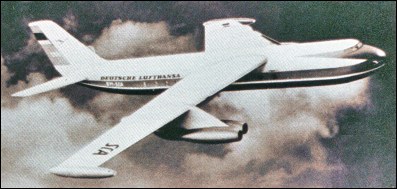
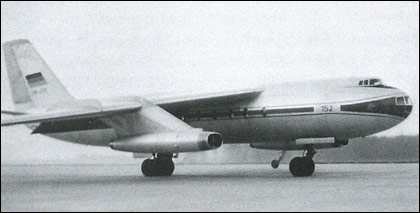
formulated while in Russia. One of these was the 152 airliner, which was based on their experience with the Alekseyev 150 and would be powered by a development of the Junkers Jumo turbojet engine named Pirna 014. The prototype had a glazed nose and an unusual undercarriage arrangement featuring a single central gear assisted by wingtip pod-mounted outriggers. Late availability of the Pirna engines meant the prototype first flew with Tumansky Rd-9b engines. On its second flight, while rehearsing for the Leipzig trade fair, the prototype 152 crashed due to pressure equalization problems between the multifarious tanks and the inadequate engines. The second heavily modified (152A) model (with modified tanks, conventional undercarriage and a glazed nose) flew twice more before the project was cancelled in 1961 due to national economic crises which were exacerbated by the defection of key design team members.
FACTS AND FIGURES © The lack of space, poor engines
and the bomber's wing meant
small payloads and short ranges as
well as a low speed for a jetliner. © The Model 150 bomber had
two large Lyul'ka engines, but
the VEB 152 had four much
weaker engines (a version of that
used in the MiG-19), which
gave poor thrust for their weight
and high fuel consumption. © The potential baggage space was
reduced by the main landing gear
wells and the cabin ceiling was
obstructed by the large wing box. © With its bicycle main gear and outrigger wheels
the 152 needed to be landed very precisely.
| MODEL | VEB 152 |
| CREW | 4-5 |
| PASSENGERS | 58 |
| ENGINE | 4 x 3165kg VDL Pirna 014A-1 turbojets |
| WEIGHTS |
| Take-off weight | 46500 kg | 102515 lb |
| DIMENSIONS |
| Wingspan | 25.40 m | 83 ft 4 in |
| Length | 31.30 m | 103 ft 8 in |
| Height | 9.70 m | 32 ft 10 in |
| PERFORMANCE |
| Max. speed | 920 km/h | 572 mph |
| Range | 2500 km | 1553 miles |
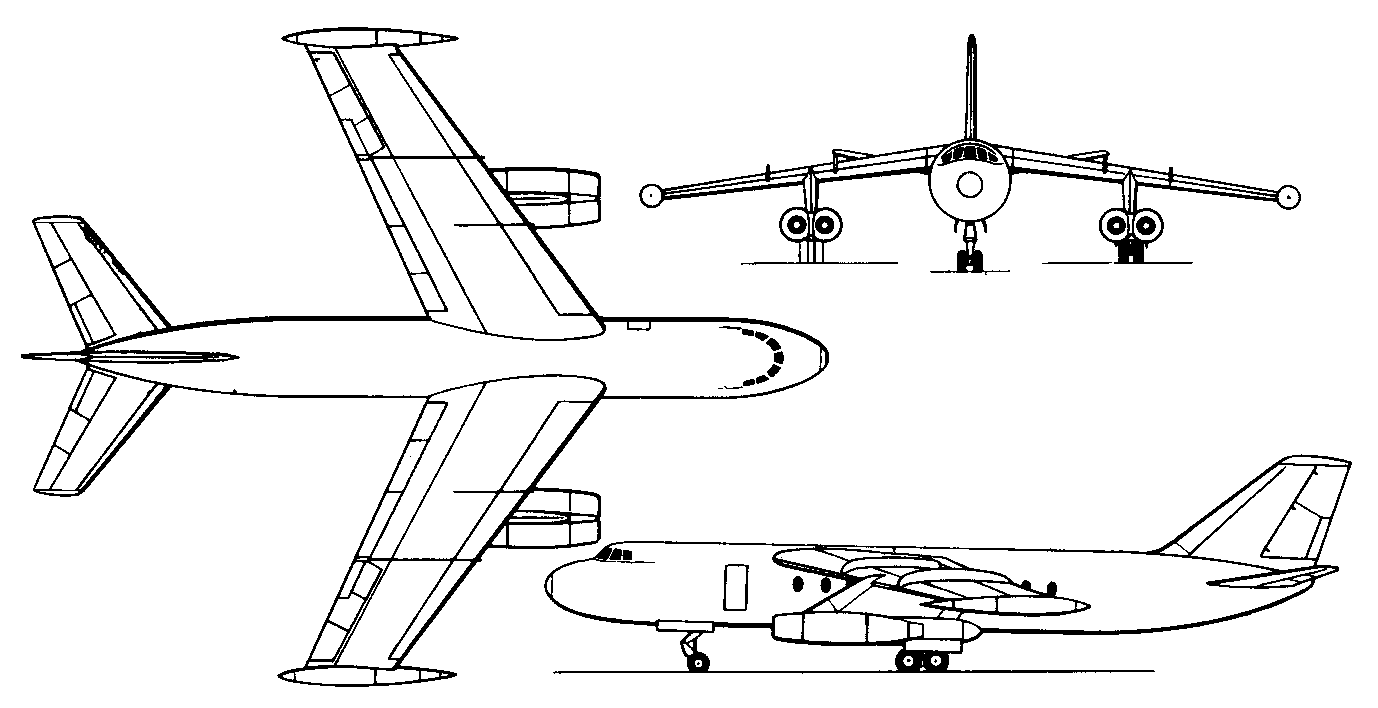
 | A three-view drawing (1378 x 708) |
| lxbfYeaa, e-mail, 15.11.2025 13:39 20 reply | | lxbfYeaa, e-mail, 07.11.2025 01:45 20 reply | | ubaTaeCJ, e-mail, 21.02.2025 19:57 20 reply | | lxbfYeaa, e-mail, 14.03.2024 04:16 20 reply | |
| | papichuo68, e-mail, 27.07.2017 02:04 Thank God most East Germans don't read this because they are actually proud of their only jet aircraft and generally assume it was the Soviet Big Brother's fault it was not produced.
But I must say, through all its oddity and chancelessness it resembles a "Comic-Strip-Aeroplane" and is therefore not without futuristic traits. reply | | Vulcanman, 19.03.2014 05:28 @Barry- I do not disagree with you about the aircraft, but I just wanted to point out that when it was unveiled, the 747's engines did not function either. As for the Baade, it is best left to the realm of radio control models. reply | | Barry, 08.01.2014 12:10 This was one awful aeroplane, only a centralised autocratic regime like the DDR could come up with this abomination. The first example crashed as rightly noted due to pressure equalization problems in the fuel tanks, but the administration at the time blamed it on pilot error suppressing the accident investigation report as soon as it was published. The second example flew twice and that was that. The government of Walter Ulbrich terminated the manufacture of all aircraft and the specially built factory at Dresden was converted into warehouseing and at one point was used for the manufacture of potato harvesters. As an aside it is worth noting that at the roll out of this plane, with all the pomp and brass bands that the state could muster, the aircraft itself was engine less! reply | | Kocsis János, e-mail, 02.06.2013 23:13 Nekem van egy műszaki rajz gyűjtő brossúra erről a gépről amit csak reprezentációs célokra használtak és adtak. Megtalálhatóak a Facebook fotóalbumjaim egyikén, feltöltve Május végén 2013-ban. Másolhatóak-kívánatra. reply | | Kocsis János, e-mail, 02.06.2013 23:12 Nekem van egy műszaki rajz gyűjtő brossúra erről a gépről amit csak reprezentációs célokra használtak és adtak. Megtalálhatóak a Facebook fotóalbumjaim egyikén, feltöltve Május végén 2013-ban. Másolhatóak-kívánatra. reply | | Clerence, 09.02.2012 05:25 The number 152 seems to be a reminiscence to the old Ju 52, wich was built in Dessau before WW II. After the end of the 152 Project, there was only a production of russian Types, for a short while, and even this stopped later. I think, even if they would make this bird fly succesfully, it would be a big question if airline companies would accept and buy it, due to its strange design. reply | | Karl Hecks, e-mail, 02.11.2011 21:29 The bicycle gear on the B-47 had the rear leg shorter than the front one. This gave the aircraft a nose-up attitude when stationaryand during the take-off run. The VEB152 had 'same height' main legs, allowing take-off in a horizontal attitudefor minimum drag. The rear leg could be shortened to rotate the aircraft nose-up at unstick speed. reply | | deaftom, e-mail, 28.02.2011 05:53 The first version built had a tandem main landing gear, with outrigger wheels in the engine pods, similar to the Boeing B-47 (except that the B-47's outriggers folded into the wing lower surface rather than engine pods). A later version was built with a tricycle gear as shown in the three-view. I suspect this second version had problems with the rigidity of its main landing gear, those engine pylons making for the equivalent of a very, very long gear strut. reply | | Bernhard Koenig, e-mail, 07.02.2011 19:49 This three-view is absolute correct. I now this plane. It is the version 4 reply | | Adolf Jaeger, e-mail, 08.12.2010 20:19 The three-view drawing is incorrect in its depiction of the main landing gear. reply | |
| | Dennis Edwards, e-mail, 28.10.2010 16:28 What a strange aircraft. There was an interesting tv programme on here last week about another strange German aeroplane. The Horten 229 was a jet powered flying wing which the Nazis wanted to destroy British radar installations on the south coast. The technology wasn't available to keep the flying wing stable & it crashed on it's 2nd flight, killing the pilot. The Horten 18 was a larger version of the 229 with a longer range. The Nazis expected to have a nuclear device by 1946 & wanted to nuke "A large city on the eastern seaboard of the USA". It never got past the design stage. reply | | Nikos J. Farsaris, e-mail, 26.07.2010 18:09 By 1960 the turbofan powered Tupolev Tu-124 was readily available, more advanced and (due to series production) much cheaper. In 1962 this was followed by even better Tu-134 rendering Baade 152 unnecessary. Anyway this had nothing to do with B-47. Baade was a chief designer at Alekseyev OKB and was the Principal designer of "150" experimental bomber (similar rather to B-66 /A-3 Skyworrior). reply |
| KenTucker, e-mail, 07.01.2010 11:51 As the late Paul Harvey would say, "Here's a strange!" Got to give those East Germans some credit, they tried to make this odd bird fly. Go onto YouTube and type Baade 152 into their search engine, then check out the two-part promotional film for the plane (and listen to the narration if you *sprachen Deutsch*). They had some ambitious plans for it. While they made sure to declare that the 152's design was based on the Alekseyev /Junkers models, to me this plane is a knockoff of the B-47 with its high wing, dual engine pods and wingtip wheels. reply |
|
Do you have any comments?
|
| 
All the World's Rotorcraft |




20
reply