|
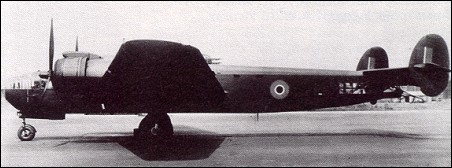
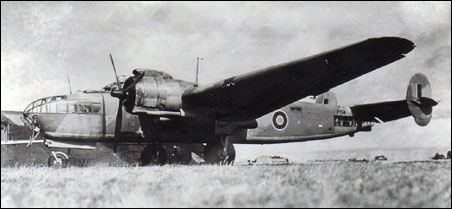
| Conceived originally by the Bristol company as a medium bomber, the design was taken over by Armstrong Whitworth and reworked into a reconnaissance-bomber. More than 40 were built before it was decided to change the role and produce subsequent aircraft either as special transports or as glider tugs. The first ST.I and GT.I entered RAF service in mid-1942 and early 1943 respectively, and subsequent versions brought the total number of Albemarles built to 600. Albemarles took part in the Sicily, Normandy and Arnhem operations.
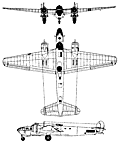 | A three-view drawing (686 x 654) |
| CREW | 4 |
| ENGINE | 2 x Bristol "Hercules", 1186kW |
| WEIGHTS |
| Take-off weight | 10251 kg | 22600 lb |
| DIMENSIONS |
| Wingspan | 23.47 m | 77 ft 0 in |
| Length | 18.26 m | 60 ft 11 in |
| Height | 4.75 m | 16 ft 7 in |
| Wing area | 74.65 m2 | 803.53 sq ft |
| PERFORMANCE |
| Max. speed | 426 km/h | 265 mph |
| Ceiling | 5485 m | 18000 ft |
| Range | 2092 km | 1300 miles |
| ARMAMENT | 2 x 7.7mm machine-guns |
| Robert Wheatman, e-mail, 21.07.2020 17:53 My great Uncle was killed in an Albermarle and to this day we don’t know really what happened.
Incredibly I have tracked down a witness in his late 90’s who still has the wheel from the plane.
I am meeting up with him and would love to be able to hear his account of what happened that fateful day. reply |
| Bilkro, e-mail, 06.07.2015 17:44 actually, that's 'contemporary'... and let us not forget that the Mitchell and Marauder were (more or less) contemporaries of the Mosquito... reply | | Andrew Weeks, e-mail, 05.05.2015 21:14 Can anyone tell me exactly where the Albemarle was built during WW2? My mother was a progress chaser at the factory. All I know is that it was near Ciencester? reply |
| VinceReeves, e-mail, 05.03.2013 20:46 A former pilot once said of the Albermarle that it had "no virtues and no vices".
Ultimately the Albemarle was a strategic success - it did much of the donkey work of towing gliders without taking up vital air industry manufacturing resources and facilities.
The purpose of a war industry is to produce the correct tool for the job - not to create aeronautical sublimity for the benefit of connoisseurs regardless of context.
Unless anyone would have preferred to see Mosquitos pulling Horsas? reply | |
| | Barry, 17.08.2012 17:14 The Air Ministry was insistent that the Albermarle be constructed from non strategic materials so it was manufactured from steel and wood. A great deal of the manufacture was outsourced to various non defense manufacturers and the assembly was completed at Gloucester by a company set up by Hawkers caled A.W.Hawkesly. No wonder it failed, it had no parent design authority or factory. reply | | Grant Newman, e-mail, 11.07.2012 04:52 "The Albemarle was the first British production airplane to have a tricycle landing gear"
No it wasn't, that honour goes to the GAL.42 Cygnet light aeroplane, which was also the first all metal stressed skin monoplane put into production in Britain. reply | | Grant Newman, e-mail, 11.07.2012 04:49 "The Albemarle was the first British production airplane to have a tricycle landing gear,"
No it wasn't that honour goes to the GAL.42 Cygnet light aeroplane, which was also the first all metal, enclosed cockpit, tricycle undercarriage aeroplane built in Britain. reply |
| Mike Bacon, e-mail, 19.01.2012 14:29 Early in 1982 a group from the RAF museum (?) started excavating an old quarry near Westnewton in West Cumbria. Some Albemarles had reputedly been dumped there after the war when some of the old bases and storage depots were cleared out. Under a layer of farm rubbish including dead sheep and cows several Albemarle airframes eventually emerged. I live a few miles away and used to take my 6 year old daughter there from time to time to follow progress. Somewhere I have a picture of her beside a pile of the airframes (stainless steel tubes) which were kept in a field a few yards from the quarry. I pretty sure they had a "Queen Mary" (WW2 aircraft transporter) there to take them back to Hendon. They said the intention was to at least partly restore one of the airframes for exhibition. One day we went to find they were abandoning the site and loading the remains onto their vehicle. They had been recalled as trouble was brewing over the Falklands. Did anything happen to the Albemarle restoration project? reply |
| Klaatu83, e-mail, 03.09.2011 00:31 The Albemarle was the first British production airplane to have a tricycle landing gear, a feature found on almost all aircraft today. reply | | damn, 21.06.2011 05:26 Sicily invasion detail him flying 4 low level bombing and strafing attacks on german troops /transport and armour in the vicinty of Salerno following the landings. reply | | bombardier, e-mail, 25.05.2011 11:51 It had almost twice the engine power of the Blenheim and it was slower. reply | | G.Shenton, e-mail, 15.12.2010 22:18 The Albermarle is always referred to as never being employed as a bomber, this is incorrect. My father was an sergant air gunnner in 296 /297 sqds from mid 1942 til Arnhem, last operation of his 50. The sqd was flying whitleys bombing and leafleting germany and france until replaced by Albermarles in april 1943.
I have his flying log books and these record several low level bombing raids on railway targets in northern France, by albermarles, and when on detachment to north africa for the Sicily invasion detail him flying 4 low level bombing and strafing attacks on german troops /transport and armour in the vicinty of Salerno following the landings.
Other than these raids and the airborne landings on Sicily,Normandy and Arnhem the majority of ops were SOE drops of agents and supplies for the rresistance in France and Italy. Cheers. reply |
| Robert Guttman, e-mail, 01.08.2010 23:50 Many negative comments have been made about this misbegotten aircraft, and they are undoubtedly justified. However, it should be understood that the original concept was to create a bomber that could be produced from non-strategic materials at facilities, and by workers, outside the normal aircraft production industry. Under those circumstances, it was therefore virtually inevitable that the resulting airframe was somewhat overweight.
In addition, the design process was begun by the design staff at one company (Bristol) and then transferred for completion to the design staff at another company (Armstrong-Whitworth). Consequently, it was hardly surprising that the result was less than stellar.
Given the handicaps under which the Albemarle was designed and developed, the wonder is that the airplane turned out as well as it did! reply | | Josh Lovegrove, e-mail, 24.08.2010 22:00 My father was an flying instructor on gliders being towed by the Albemarles. He reports many accidents with these aircraft which appeared to have a nasty habit of suddenly diving into the gound for no apparent reason. He recalls instances when on cross country flights at good airspeeds the Albemarle crew had suddenly dropped their towlines in order to try and save themselves but despite this action the aircraft were unable to recover and had simply fallen out of the sky. He has always been troubled by witnessing the deaths of many Albemarle flight crew but despite the many instances of these events there seems to be no official record of why these may have occured. In mitigation he also says the crews were on intensive training, the Albemarle crews picking up and taking off with gliders all through the day on a far more intrensive regime that was later seen in real action. reply | |
| | Art Deco, 25.10.2009 17:39 The Albemarle, while totally mediocre, was the successful culmination of an Air Ministry specification. It came exactly as ordered. It was only the private venture genius and persisting of Geoffrey De Havilland and the Mosquito that put it in perspective as a piece of crap. The Bristol Brigand etc. also suffered by comparison. It's original manufacture was understandable, but it's continued production was folly. It's service as a glider tug was serendipitous in that it performed a function and covered up stupidity. Thus, it was a true multi-role aircraft. And significantly, it was not the worst folly produced. reply | | aerophile, e-mail, 25.10.2009 13:01 You may wish to add that the poor old Albemarle was offered to the USSR in the middle years of the War and, for some weeks, one or more with Red Star markings were to be seea flying in the vicinity of Hurn airfield. The Russian opinion of this sad aircraft was no higher than our own. I'm personally glad, though, that it eventually had an important role as a glider tug in all those important airborne landings. An unfortunate and unsuccessful aircraft, perhaps, but not a heap of rubbish, thank you. reply | | JOHN ANTONY BURLS, e-mail, 13.07.2008 16:59 When staying at airfield as ATC cadet during war, forgotten which drome, watched an Albemarle come in with wheels up and crash land successfully! Then went up in Horsa behind a Halifax, switching from high tow to low very rough, think I was only one not sick! reply |
| Mick Dunne, e-mail, 29.12.2007 04:01 This heap of flying rubbish was a contempary of the Mitchel and Marauder! Say no more! Sorry! contempory... reply | | Mick Dunne, e-mail, 29.12.2007 04:00 This heap of flying rubbish was a contempary of the Mitchel and Marauder! Say no more! reply | | Mr William Lewis, e-mail, 31.08.2007 16:30 DID ANY OF THE dIFFERENT MARKS OF THIS AIRCRAFT HAVE A DOOR IN THE PORT SIDE OF THE FUSALGE FOR THE ENTRY OF PARATROOPERS, OR DID ALL AIRCRAFT HAVE THE ENTRANCE AND EXIT UNDER THE FUSALGE. reply |
|
Do you have any comments?
|
| 
COMPANY
PROFILE
All the World's Rotorcraft
|


 Andrew Weeks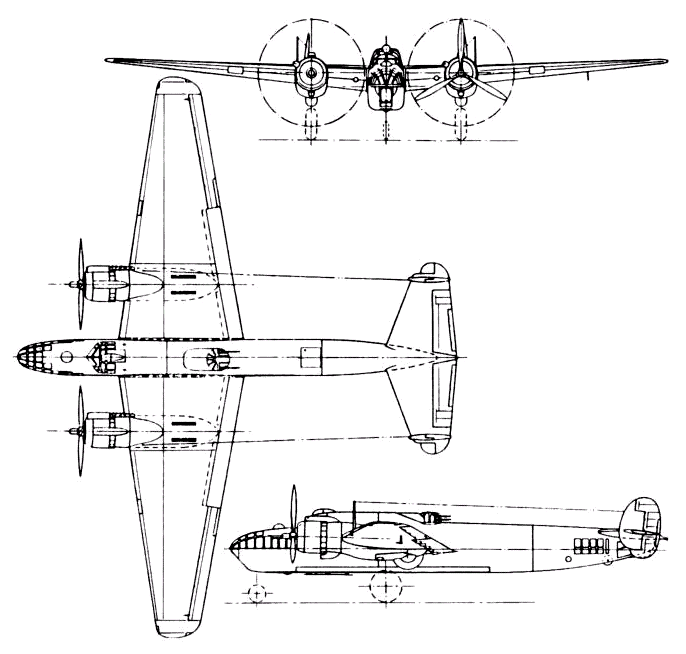


20
reply