|
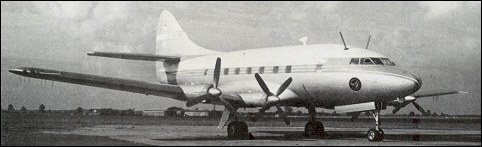
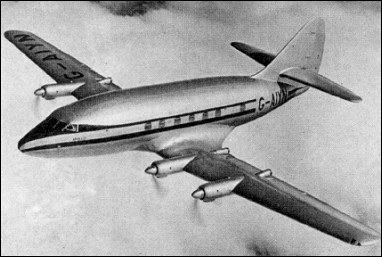
| The Armstrong Whitworth AW.55 Apollo was designed as a competitor to the Vickers Viscount in response to the requirement outlined in the wartime Brabazon Committee's Type II civil transport. It was a short- and medium-range airliner intended for operations in Europe.
Specification C.16/46 to which the Apollo was designed, called for a turboprop-powered airliner to carry between 24 and 30 passengers over a range of 1609km at 483km/h. The engine selected was the axial-flow Armstrong Siddeley Mamba, which had the advantage of commendably low frontal area compared with contemporary centrifugal-flow turboprops. However, it was of a basic type still in its design infancy, and so prone to severe teething problems. A clear example of this is seen in the case of the Mamba: in the form first used on the Apollo, the engine should have developed 1010hp plus 139kg thrust, whereas it developed only 800hp.
Right from the beginning of the design, the AW.55 (first named Achilles and Avon before finally becoming Apollo) had a span of 28.04m, but length was increased from 19.66m to 20.73m and at the production stage to 21.79m, providing accommodation for between 26 and 31 passengers seated two-abreast on each side of a central aisle.
Construction began in 1948 of two flying prototypes and a fuselage for static testing. The first prototype was given the Ministry of Supply serial VX220, and made its initial flight on April 10, 1949. Right from the beginning there were severe problems with the Mamba engines' power output and reliability, and the aircraft itself lacked longitudinal and directional stability. The control problems were remedied without undue difficulty, and the first prototype, re-registered G-AIYN, was available from October 30, 1950 for proving flights, starting with a successful flight to Paris on March 12, 1951. Finally, in July 1951, Mamba Mk 504 engines became available, but even these had severe limitations and problems. This proved the last straw, and in June 1952 further development was halted. The second prototype was subsequently completed, and both aircraft were used for a variety of experimental work for the Ministry of Supply, which had funded them. Both aircraft ended their flying lives in December 1954 when they became structural-test airframes.
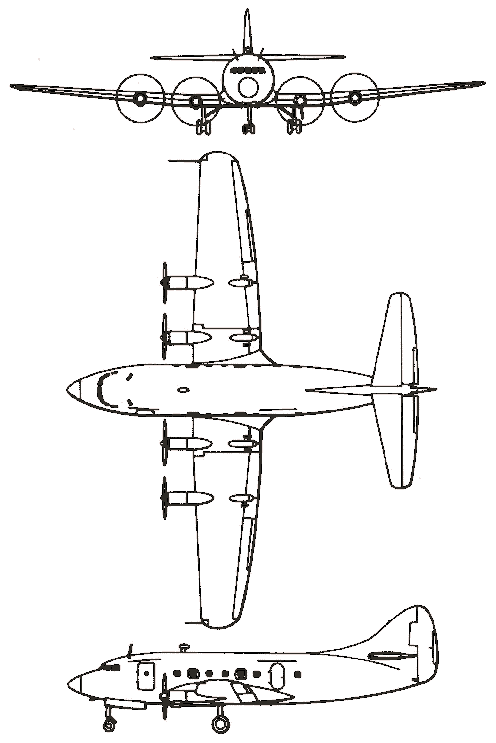
 | A three-view drawing (496 x 743) |
| CREW | 3 |
| PASSENGERS | 31 |
| ENGINE | 4 x Armstrong Siddeley Mamba Mk 504 turboprops, 750kW |
| WEIGHTS |
| Take-off weight | 20412 kg | 45001 lb |
| Empty weight | 13791 kg | 30404 lb |
| Payload | 3402 | 7500 lb |
| DIMENSIONS |
| Wingspan | 28.04 m | 92 ft 0 in |
| Length | 21.79 m | 72 ft 6 in |
| Height | 7.92 m | 26 ft 0 in |
| Wing area | 91.6 m2 | 985.97 sq ft |
| PERFORMANCE |
| Cruise speed | 444 km/h | 276 mph |
| Range | 1513 km | 940 miles |
| Ben raub, e-mail, 21.02.2026 11:11 Hello a message from the future I wonder if Armstrong whitworth could have made a better aircraft. How was your time at the company. reply | | John Sheppard, e-mail, 24.10.2014 14:07 Don't remember much of the AWA Apollo except that it was one of many aircraft my father worked on, from 1938 to 1966.I worked there at AWA Whitley and Baginton as an apprentice coppersmith starting in 1953. It was a well looking kite and shame it was let down by engines. The slogan of AWA was "PIONEERS OF PROGRESS" very British and proud to have been part of them. Aircraft apart, the Sea Dart was all theirs (ours)and hope it is still going strong. Thank you Harold ****** Wilson! reply | | huaren, 21.06.2011 05:11 competing with too many other types and none of them with a big enough market. One won...the Vickers Viscount. reply | | R.Lawton, e-mail, 06.07.2010 23:28 There is an error on my comments, made 16.02.2010 regarding the last two sentences, ie 'Nevertheless I will never forget seeing its first flight .......etc.
These were my thoughts on the Argosy, not the Apollo!! Please delete these last two sentences. reply | |
| | R. Lawton, e-mail, 16.02.2010 23:00 I remember as a schoolboy seeing the Apollo taking off from Baginton, it looked a beautiful aircraft, and spurred me to join the company when I left school. The Mamba engines weren't up to the job unfortunately as has been stated. AWA were never any good at producing their own aircraft but brilliant at producing other aircraft under contract, ie, Meteor, Seahawk, Hunter etc. Their final attempt at going it alone was of course the Argosy, which was too slow, and hit the market too late. Nevertheless I will never forget seeing it's first flight on a very cold morning in January 1959. It was a special moment for me as I had been working with many others to get it into the air. reply | | F/Lt. B.L. Potter, e-mail, 14.10.2009 15:43 I remember seeing VX220 at the 1954 Farnborough Air Show. It was static in a test area, which also included one or two Comet 1 fuselages. It appeared to be in good condition, but as far as I know, never flew again. reply | | Peter Larkham, e-mail, 13.12.2008 04:26 try flying my model of it in flightsim
lovely aircraft, too many engine problems tho reply | | Bill Griffin, e-mail, 28.09.2008 19:21 I was an apprentice at AWA in 1956.At that time the Apollo fuselage was in a water tank at Baginton It being covered in strain gauges; and was undergoing pressurisation trials associated with the DeHavilland Comet fuselage failure , due to pressurisation .The water tank was below ground level;it being constructed from a bomb shelter. reply | | D. GRIFFITHS, e-mail, 17.03.2008 00:11 I distinctly remember seeing a rather dilapidated fuselage of one APOLLO stored at AWA, Bagington ( near the Apprentice Supervisors Office) when I joined the Company as a student apprentice in August 1957. reply | | PJL Rickinson, e-mail, 26.09.2007 23:05 I remember first reading about this aircraft in an article in Air Pictorial more than 35 years ago. What an extraordinarily pretty looking plane! But another example of how directionless the UK air industry was in those early post-war years, competing with too many other types and none of them with a big enough market. One won...the Vickers Viscount. reply |
|
Do you have any comments?
|
| 
COMPANY
PROFILE
All the World's Rotorcraft
|