|
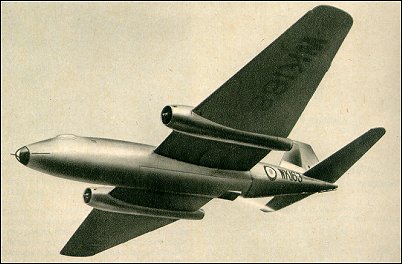
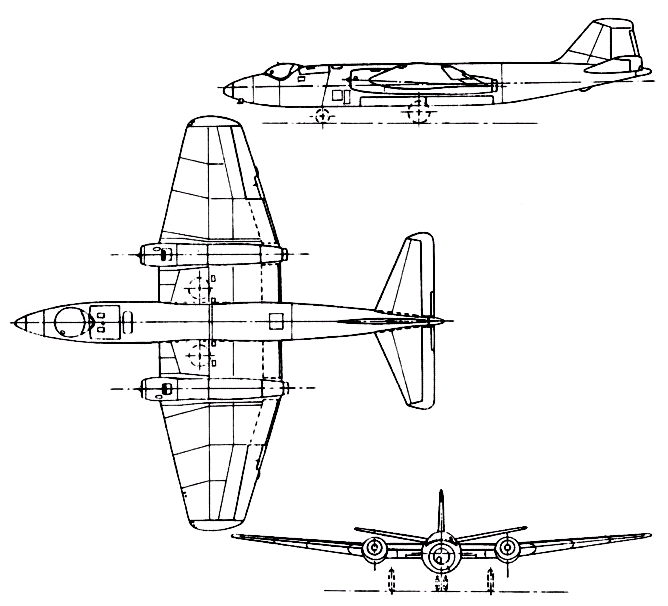
| Early developments of the turbojet engine, with then very limited power output, restricted somewhat the size and type of aircraft able to take advantage of this new power plant. Thus, it was not until Air Ministry Specification B.3/45 was issued that the English Electric Company was able to design and build Britain's first turbojet-powered bomber -the first such aircraft to serve with the RAF. A prototype flew for the first time on 13 May 1949.
The original intention had been to produce a two-crew aircraft which would rely upon radar for the accurate delivery of its bomb load. But although the four prototypes were built to this configuration, the first production Canberra B.2 carried a crew of three and were configured for visual bombing. Of mid-wing monoplane configuration, these aircraft were powered by two 28.91kN Rolls-Royce Avon 101 engines and could carry internally 2,722kg of conventional or nuclear weapons. Canberras entered RAF service with No 101 Squadron at RAF Binbrook in May 1951. These aircraft were unarmed, relying (as had the war-time de Havilland Mosquito) on being able to show their opponents a 'clean pair of heels'.
Subsequent variants included: the B.6 bomber with 32.92kN Avon 109; the B(I).6 intruder variant; B(I).8 two-seat long-range night interdictor or high-altitude bomber, built also as the B(I).58 for India and B(I).12 for New Zealand and South Africa; a conversion of the B.6 with additional underwing hardpoints for weapons, designated B.15; and a generally similar B.16 with more radar equipment. Performance was such that it was logical to develop photo-reconnaissance versions. The PR.3 (based on the B.2) first flew on 19 March 1950 and was followed by the PR.7 (similar to the B.6) and the high-altitude PR.9. Other RAF Canberras included T.4/11/17 and 19 trainers; and the target-towing TT.18.
The Canberra has been supplied to many air forces, has been licence-built in Australia, and has the distinction of being the only modern aircraft of British design to be licence-built in the USA. Under the USAF designation B-57 the Martin Company built 403. At a later date a number of these were converted by General Dynamics to serve as ultra high-altitude strategic reconnaissance aircraft. These were provided with a wing span of 37.19m, two 80kN Pratt & Whitney TF33-P-11 turbofan engines (replacing the conventional power plant), plus two 14.68kN Pratt & Whitney J60-P-9 turbojets in underwing pods, and many equipment and avionics changes to fit them for their specialised role.
 | A three-view drawing (668 x 606) |
| CREW | 2 |
| ENGINE | 2 x RR "Avon 109", 32.9kN |
| WEIGHTS |
| Take-off weight | 24925 kg | 54951 lb |
| Empty weight | 12680 kg | 27955 lb |
| DIMENSIONS |
| Wingspan | 19.5 m | 64 ft 0 in |
| Length | 20.0 m | 66 ft 7 in |
| Height | 4.8 m | 16 ft 9 in |
| Wing area | 89.2 m2 | 960.14 sq ft |
| PERFORMANCE |
| Max. speed | 827 km/h | 514 mph |
| Ceiling | 14700 m | 48250 ft |
| Range w/max.fuel | 5800 km | 3604 miles |
| Range w/max payload | 1300 km | 808 miles |
| ARMAMENT | 4 x 20mm machine-guns, bombs, missiles |
| Daniela Coleman, e-mail, 17.03.2025 19:59 Hi,
Keeping your audience engaged is essentialâ€"let’s help you do that.
We’re currently offering free articles on a range of topics and can adjust them to best fit your content needs.
Would you be open to discussing this? What would be the topic you want us to focus on?
Best wishes!
Daniela reply | | barry flewitt, e-mail, 13.10.2015 19:51 My father in law worked as draftsman for EE. He said they had nightmares with the elliptical pressure bulkhead for the cockpit. You can see the position on the line drawing. reply | | Revd Andrew MacKenzie, e-mail, 17.08.2015 11:49 Worked on Special Installation Flight, RAF Watton, on Canberras, making bracketry for black boxes. Cold War stuff of the ECM variety, which probably perplexed me more than the effect on the other side of the Iron Curtain. Got to know the innards of the airframe very well, though! reply | | Peter Jerdan, e-mail, 19.03.2015 03:21 After 60 years continuous flying both in the Service and in commercial, the Canberra was the nicest aeroplane I ever flew... reply | |
| | peter robinson, e-mail, 14.03.2014 13:18 No 2 SQN RAAF operated Canberra's at Phan Rang, South Vietnam, 1967-72. Our bomb damage assessments were many times better than the USAF who were flying the Martin B57 version from the same base. There is at least one Canberra still flying in Australia at the Temora Aviation Museum, Temora NSW. Static displays are also at Australian War Memorial, Canberra, RAAF Wagga, RAAF Museum Point Cook, RAAF Amberley reply | | J. Pay, e-mail, 11.12.2012 11:30 Check out Temora NSW; I think that they still have a flying Canberra. reply | | J. Harvey, e-mail, 24.11.2012 02:41 In 1951 I was posted to 617 Sqdn R.A.F. Binbrook as a Turret Armourer. The squadron at that time were converting from Lincoln Bombers, using Meteors for practical experience at changing from 4 engines to 2 jets. The pilots did circuits and bumps for hours (on the odd occasion getting a urgent red very flare because they had forgotten to lower the landing gear). The most wonderful sight was when Wing Commander Beaumont made a delivery of a new aircraft, his airobatics must have meant several changes of underwear for the Control Tower staff. I watched the Wing Commander put on a show on more than one occasion! When a Canberra came in without the nose wheel down, the pilot slowed the aircraft to a gentle pace before turning the nose of the plane onto the grass beside the runway, which made minimal damage by just pushing the pitot tube into the fuselarge nose. reply | | Monty Halls, e-mail, 10.11.2012 14:54 RAF Tengah 1960 - 1964 - Tough old machine and seemed to readily adapt from high level to low level role although B2 seemed to need rep;acement by B15 mid-tour. reply | | Barry, 30.08.2012 16:32 To Jerry K; don't forget the Hawk built as the T45C Goshawk in the US. reply | | John Weston, e-mail, 28.03.2012 14:10 I worked on these aircraft as an aircraft fitter in flight shed at Gov. Aircraft Factory, Avalon, Victoria Australia and used to help prepare the aircraft for flight by RAAF in preparation for return to duty. The were the most gracious of aircraft and very aerobatic, on one final test the RAAF pilot rolled it and all there were worried the wing tip and tip tank would touch the runway but the pilot knew the performance of this marvelous aeroplane, I will never forget crawling in and all over these wonderful machines. There is still one static one at Avalon and a few others around the country but sadly none flying. reply | | jerry k, e-mail, 23.03.2012 01:35 It HAD the distinction of being the only modern aircraft of British design to be license-built in the USA...until the Harrier came along, of course! reply | | Michael, e-mail, 28.04.2011 04:22 I was on the Canberra as an airframe fitter before I went flying.I did several trips at low level in this machine. PR3 and PR7 231OCU AND 31 SQUADRON. My fellow ground crew thought I was crazy as it flew at 250 feet and lower and I was on the jump seat and in the nose cone. The experience was magic and well worth it. I then went on to get an F /E licence a glider pilots licence and a pilots licence. I am a qualified Flight Engineer Officer 747 and have 18500 flight hours. I love to fly long may it continue. reply | | Kevin Morrow, e-mail, 16.04.2011 21:02 Drew Thomas I agree the Canberra was my favourite bomber but some out there remain grounded and wrecked for years....
There's a Canberra at RAF /RNAS Predannack just sitting there with no engines at all and it looks sad... reply | | PH, e-mail, 21.01.2011 13:27 As regards the question of "nose low", the nose gear as originally installed was the tail gear of the Shackleton bomber. EE obviously kept the cost down by doing this. Another point to remember is that bomb loading was by trolley from under the rear fuselage. A nose low attitude facilitated this. reply | |
| | Jeff Lemon, e-mail, 26.10.2010 17:16 NASA operated at least one highly modified B-57 Canberra as an earth resources observation plaform based at Ellington Field near the Johnson Space Center in Texas. I believe this aircraft had approximately twice the wingspan when compared with the standard Canberra. reply | | Geoff Thornber, e-mail, 28.09.2010 23:25 It used a self contained Doppler type navigation radar to get there and back. reply | | Martin W. Roberts, e-mail, 30.08.2010 03:46 I was on 13 Sqdn at Akrotiri in 1957 /8 /9 with PR 7's and did quite a bit of time in the T 4 with Neil Williams (who later became seven-time British Aerobatic Champion). The nose gear always was tucked away in what looked like a semi-retracted position - nice airplane and tough, especially when flying through waterspouts! reply | | rafman925, e-mail, 05.02.2010 19:45 A wonderful bomber. I spent my time with 32 Sqdn working on the B2 then later the B15 at RAF Akrotiri in Cyprus 1959 - 1962 any of you out there during this time get back to me. reply | | Drew Thomas, MSgt. USAF, (Ret., e-mail, 14.04.2009 18:40 I have been searching to find out why the B-57 sits at a 'nose low' attitude. Nose gear is almost halfway up into the wheel well.
There must be a logical reason, but I have yet to discover it. Would appreciate any comments, and answer.
It is indeed a beautiful airplane. I worked on one when it landed at Kincheloe AFB, Michigan in the '60s.
Keep'em flyin' reply | | P.Kunhiraman, e-mail, 21.03.2007 08:19 Indian Air Force used this aircraft extensively in different roles reply |
|
Do you have any comments?
|
| 
COMPANY
PROFILE
All the World's Rotorcraft
|