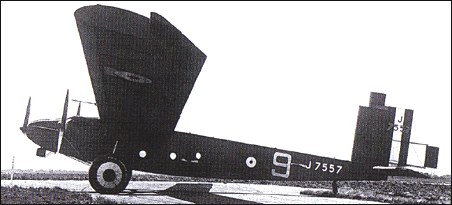
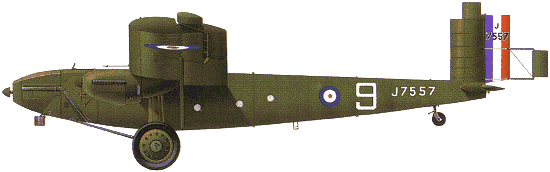
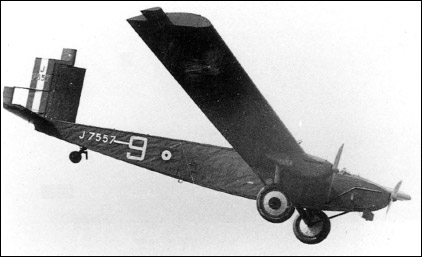
The Beardmore Company (mainly shipbuilders by the 1920s) developed
the Inflexible to demonstrate the then-innovative stressed-skin metal
construction. Unusually for 1928 it was also a mid-wing monoplane at a
time when most large aircraft were still wood and fabric biplanes. The
Inflexible's maiden flight proved what many had expected - that the aircraft
was too heavy for its three Condor engines. As author Bill Gunston put it,
'although it was incapable of serving any useful role it could at least fly'.
Within two years its flying career was over and it was dismantled to save
space, ending its days in experiments to investigate airframe corrosion. A
related design was the Beardmore Inverness, an all-metal flying boat whose
creators had such faith in its airworthiness that it was equipped with two
large masts and sails to get it home in the event of a forced water landing.
3 x 650hp Rolls-Royce Condor inline piston engines
WEIGHTS
Take-off weight
16783 kg
37000 lb
DIMENSIONS
Wingspan
48.01 m
158 ft 6 in
Length
23.01 m
76 ft 6 in
Height
6.40 m
21 ft 0 in
PERFORMANCE
Max. speed
175 km/h
109 mph
Comments
John P, e-mail, 26.10.2016 18:05
My father was also an engine fitter on this a /c. He said when it flew it sounded like a lot of tin cans! He made a small metal model of the Inflexible which resided in his mothers display cabinette, it's now in mine.
I am in the process of gathering info on this aircraft, to build a radio-controlled model of approx. 3.5 metres. Any photos, details, 3-views, etc. would be most gratefully welcomed. As mentioned in other comments - with a wing thicknesss such as is seen in various photos there would have been ample rigidity in the wing, even allowing for the materials technology that existed in the mid /late 1920's.. For handling and practical issues, my model will not have them. I have no doubt that it will fly like a motor-glider!
This aircraft was built purely for research. It was built by Beardmore at Dalmuir under great secrecy. In the air it was described as a pilot's aeroplane. In the company records it's referred to as the BERO BE for Beardmore and RO for Rohrbach. The pilots were Noakes and De Haga Haig and both were ordered never to do aerobatics in public. It was so strong that you could see the fuselage wrinkle and the young airmen used to run along the wings and fuselage. When testing was completed the fuselage was broken for paint tests then it quietly disappeared by 1933. It had the biggest wheels in a pre war aircraft and it was about the size of a 737
I'm searching for for information on the crew behind this plane as I believe my grandfather and his brother worked on it . My grandfather was Owen Joseph Brady
Hi Andrew. Not sure whether I sent you an email about 10 years ago. So, I think we are related, through my mother Anne O'Connor. My great uncle was Jo (Joseph )Brady who was involved with the Inflexible. I know he had a brother Owen, who moved to Australia. Would love to hear your news about the family. Take care. Gail
Like the Beardmore Inverness featured elsewhere on this site the Inflexible was designed by Adolf Rohrbach as the Rohrbach Ro VI.As rightly noted, the design was of suffecient integrity not to use bracing wires, however there is always someone who knows better! It is strange to think that the allied powers put all sorts of restrictions on the German goverment about what sort of aircraft they could build and yet the British goverment sponsored a German designed bomber!
th, Not sure how to add pic to site but have scanned it and mailed it to you direct. In passing would note have a full album of odd aircraft of the late 20's and 30's.
Could you scan that photo and put it online? it would be interesting to estimate how much drag those cable added. might be a reason why the performance was not outstanding. thank you,th
My father was an engine fitter on the Inflexible (fresh out of RAF apprentice school Halton) and had this to say about this aircraft: " Powered by 3 Rolls Royce Condor's and with a wingspan of 158 ft it was the biggest aircraft of it's day. However the "Boffins" and "Know-alls" of the time decided that it would never fly and if it did the wings would fold up. Therefore before being allowed to make the attempt it had to be fitted with support cables from the wing roots to nearly the wingtips. I have a photograph of the Inflexible where these can just be seen. They also decided that it would need more than the length of the existing airfield at Martlesham Heath to take off. With this in mind an extra 400 yards of heath was cleared for the initial flight. Most of the population of Ipswich and the surrounding villages turned out to watch the event. As it happened the extra 400 yards was not nearly needed and the Inflexible took off well before the end of the existing runway, no strain was evident on the cables and according to those on board, the flight was uneventful and the aircraft flew well. It was never allowed to fly without the cables, which completely ruined any chance of the Inflexible being termed a proper cantilever wing. The cables were as thick as those used to moor ships".





Hi Andrew.
Not sure whether I sent you an email about 10 years ago.
So, I think we are related, through my mother Anne O'Connor. My great uncle was Jo (Joseph )Brady who was involved with the Inflexible. I know he had a brother Owen, who moved to Australia. Would love to hear your news about the family.
Take care.
Gail
reply