|
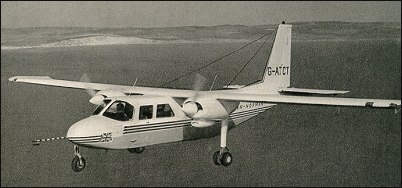
| Desmond Norman and the late John Britten had started their association in the development of crop-spraying equipment, and in 1964 began detail design work on a new lightweight feederline transport. Envisaged as a new-generation replacement for the ageing de Havil-land Dragon Rapide and other aircraft in this class, the Britten-Norman BIM-2 Islander soon attracted considerable interest, and construction of a prototype was initated in September 1964. This aircraft flew for the first time on 13 June 1965, powered by two 157kW Rolls-Royce/Continental IO-360-B engines, and with wings that spanned 13.72m. A number of changes resulted from flight testing, the most important being a 1.22m increase in wing span, and the installation of 194kW Avco Lycoming O-540-E engines, and this has remained the standard powerplant of the Islander, still being installed in production aircraft in its O-540-E4C5 version.
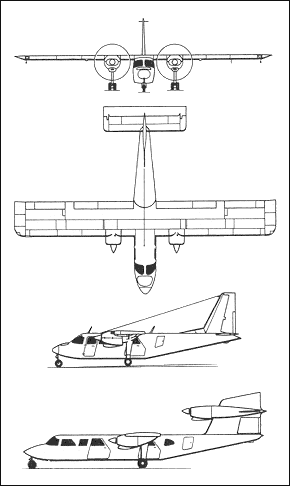
Initial production aircraft were BN-2 Islanders, of high-wing monoplane configuration with a functional rectangular-section fuselage, conventional tail unit, non-retractable tricycle-type landing gear with twin wheels on the main units, and accommodation for a pilot and nine passengers. This 'high-density' seating arrangement had been contrived in a cabin that was only 1.09m wide at its maximum by installing 'wall-to-wall' seats, with access via two doors on the port side, and one on the starboard side, making an aisle unnecessary. Exit in emergency can be made by removing the door windows. The first production example of the BN-2 made its initial flight on 24 April 1967, and the first Islander entered service less than four months later, on 13 August. The BN-2 Islander was superseded in mid-1969 by the improved BN-2A Islander, which introduced detail aerodynamic and equipment improvements, in addition to a new side-loading baggage facility. Since 1978 the standard production version has the designation BIM-2B Islander II. This differs primarily by having an increased maximum landing weight, improved internal design, and smaller diameter propellers to reduce the cabin noise level.
Various items of alternative equipment have become available over the years to extend the usefulness of the Islanders. These include 224kW Avco Lycoming IO-540-K1BS piston
engines, or 239kW Allison 250-B17C turboprop engines, and aircraft with this latter powerplant installation are designated BIM-2T Turbine Islander. Other options include an extended nose to provide an additional 0.62m3 of baggage space, raked wingtips containing auxiliary fuel tanks, and a Rajay turbocharger installation to enchance performance.
In addition to operation in a passenger-carrying capacity, the Islander can be used as a freighter with the passenger seats stored in the rear baggage bay, as an ambulance carrying three stretchers and two medical attendants, and for a variety of utility purposes when suitably equipped. Defender and Maritime Defender military versions are also available, and these can be adapted for casualty evacuation, patrol, transport, and search and rescue operations.
The success of this aircraft, which from the outset was intended to provide a low-cost reliable aircraft that could, if desired, be used in a number of differing roles, is highlighted by worldwide sales in approximately 120 countries, and
which in late 1989 were past the 1100 mark. Of this total more than 300 had been built under licence in Romania, and 35 were assembled in the Philippines from components that had been manufactured by Britten-Norman.
Financial problems for Britten-Norman during the early 1970s led to the takeover by The Fairey Group in 1972. During the following year production of the Islander was transferred from Bern-bridge to Gosselies in Belgium. But in 1977 The Fairey Group itself went into receivership, and the Britten-Norman part of the Group was bought by Pilatus, and in the form of Pilatus Britten-Norman Ltd the company continues to complete aircraft in the Isle of Wight after their basic manufacture in Romania.
| CREW | 1 |
| PASSENGERS | 9 |
| ENGINE | 2 x Lyc. O-540-E, 190kW |
| WEIGHTS |
| Take-off weight | 2360 kg | 5203 lb |
| Empty weight | 1407 kg | 3102 lb |
| DIMENSIONS |
| Wingspan | 15.0 m | 49 ft 3 in |
| Length | 10.9 m | 36 ft 9 in |
| Height | 4.1 m | 13 ft 5 in |
| Wing area | 30.9 m2 | 332.60 sq ft |
| PERFORMANCE |
| Max. speed | 272 km/h | 169 mph |
| Cruise speed | 255 km/h | 158 mph |
| Ceiling | 6750 m | 22150 ft |
| Range w/max.fuel | 1300 km | 808 miles |
| Gordon Scott, e-mail, 01.03.2022 05:12 My wife and I had the pleasure of flying between Tanna Island and Efate many years ago on one of these aircraft as passengers. Our baggage and ourselves were weighed before boarding with a few other Islanders complete with bags of fruit they were taking back to Efate. A fantastic short trip sitting behind the young pilot and a great view out of the large windows. A beautiful part of the world and the only time I have stood on top of a active volcano reply | | peter banfield, e-mail, 01.03.2015 07:27 B-N has moved to Lee on Solent, Hants, and expanded. reply | | berend, e-mail, 20.10.2014 14:20 Tango-Charlie-Tango was written of at Nov.9th 1966.
pilot, Peter Hillwood and passenger, co pilot Albert Weerda died in that crash.
passenger was my grandfather,.....is it possible to get in touch with Peter Bark..?.his Phone number or mail adres?
thx
Berend Weerda jr. reply | | Brian Goodwin, e-mail, 19.12.2013 16:32 Henry C Manuelaenry Try contacting Loganair at Glasgow Iarport they did have a number of this type of u /c leg in addittion to the Fairey ones. reply | |
| | Henry C Manuelaenry.manuela@gm, e-mail, 13.01.2013 02:03 I lookin for BN-2A-26 AIr 46200 /6--MLG AP lockheed
Britten Norman Islander Air 48280 /6 Main Landing gear looking for ASAP May you know other place arround reply | | Henry C Manuelaenry.manuela@gm, e-mail, 13.01.2013 02:03 I lookin for BN-2A-26 AIr 46200 /6--MLG AP lockheed
Britten Norman Islander Air 48280 /6 Main Landing gear looking for ASAP May you know other place arround reply | | ATHAR BUTT, e-mail, 16.09.2011 08:39 Could anyone tell me the single engine ceiling for both the 260 HP and 300 HP lycoming on the BN2A-26? reply | | maurice dyer, e-mail, 29.07.2011 13:30 Peter bark
I too recall fondly my time at BN, then FBN then PBN.
1973-1996.
Sadly, Desmond Norman has also gone to that great hangar in the sky.
I think the motto of BN in th eold days was; 'we've not made any money, but by heck, we've had a lot of fun doing it. reply | | George, e-mail, 06.03.2011 04:44 We purchased the first one in the US based in Laredo, Tx.. Did many crazy things, part 135, Mexico trips, first roll, they said, great piece of equipment. reply | | K.Cowler, e-mail, 09.02.2010 19:13 My father Henry(Harry) Ellis of the ARB /CAA was the main design surveyor for the authority on this aircraft and worked in close co operation with John Britten and Desmond Norman whom he held in great esteem, during the conception and production of this aircraft. reply | | Peter Bark, e-mail, 12.01.2010 01:06 I was part of the team that built the first Islander. She got her name from a contest among all the employees who built her.the day of the first roll-out was very exciting for all of us and then the day her wheels first left the ground had all of us cheering. John Britten and Desmond Norman were tow of the finest employers I ever had the privilege of working for. I was very pleased to learn of the companies ultimate success. That first Islanders call sign was "Tango Charlie Tango". I heard that Mr. Britten had passed away, does anyone know if Mr. Norman is still with us. reply | | Gowtam Gujadhur, e-mail, 16.08.2007 08:29 Can you please provide me with indepth information on the systems, airframe construction and the Allison 250 engine.
Thank you. reply | | Allan Wright, e-mail, 07.02.2007 11:54 The history can be further updated: (please refer to www.britten-norman.com /history / for more details.
"Pilatus sold the Britten-Norman business in 1998 to Biofarm Inc. The remaned company, Britten-Norman Ltd., went into receivership in 2000. In May 2000 the assets were purchased and a new company B-N Group was formed. B-N Group and subsidary companies Britten-Norman Aircraft and Fly BN have a thriving business based at Bembridge, Isle of Wight, and at other locations worldwide. Although aircraft production is now single figures each year, B-N Group achieves profitability through the diversity of it's business." reply |
|
Do you have any comments?
|
| 
All the World's Rotorcraft |