|
| One of the criticisms of early Fairey aircraft was aimed at their appearance, for they were frequently regarded as being numbered among the most ugly aeroplanes in the air. It was an unkind attitude in an age when it was difficult to attain the sort of performance required by a general-purpose aircraft: one which might be expected to operate from and to a ship at sea, in addition to more conventional use as a landplane or seaplane.
Fairey's IIID, first flown in prototype form in August 1920, derived from the company's F.128 experimental floatplane of 1917. This introduced the Fairey Patent Camber Gear evolved for the Hamble Baby, which was then described as a trailing-edge flap and used to increase the lift of the wings. Today we would regard these aerofoil control surfaces as drooped ailerons, for they were used as ailerons in flight, but could be drooped symmetrically to enhance the lift developed by the normal wing surface. Tested as a two-seat sea-plane, the F.128 was known as the Fairey III. With a single frontal radiator behind the propeller and the floats replaced by a wheel landing gear, the designation became Fairey IIIA.
In modified form the designation became Fairey IIIB. These had float landing gear, increased wing area, and ailerons on the upper wing in addition to the Patent Camber Gear on the lower. The IIIC which followed had a performance increase of some 14%, almost entirely due to the installation of a Rolls-Royce Eagle VIII engine. It was regarded as one of the best seaplanes of its day, but it entered service too late to be involved in World War I.
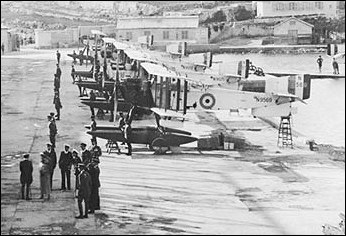
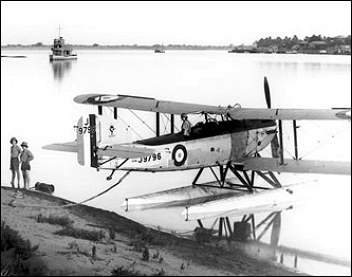
The Fairey IIID benefited from considerable experience with Fairey Ills in both RFC and RNAS use. The prototype retained the Eagle VIII engine, but of the 207 built for service with the RAF and Fleet Air Arm, 152 were powered by Napier Lion IIB, V or VA engines. A large-span two-bay biplane with constant-chord wings, the IIID was operated as a landplane from shore stations and aircraft carriers, or as a seaplane for catapult launch from warships. In fact, on 30 October 1925, a IIID became the first standard FAA seaplane to be catapulted from a ship at sea.
In landplane form, the IIID was one of the first service aircraft to have oleo-pneumatic (oil/air) shock-absorbers. It was used to record the RAF's first flight from England to South Africa and its first official long-distance formation flight. Led by Wg Cdr C. W. H. Pulford, between 1 March and 21 June 1926 IIIDs completed a flight of almost 22,530km, Cairo-Cape Town-Cairo and thence to Lee-on-Solent. At no time throughout the period of almost four months was any delay caused by mechanical failure of any of the aircraft, speaking volumes for the soundness of the basic design of both airframe and engine.
| MODEL | IIIF Mk IIIM/B |
| ENGINE | 1 x Napier Lion XIA, 425kW |
| WEIGHTS |
| Take-off weight | 2858 kg | 6301 lb |
| Empty weight | 1779 kg | 3922 lb |
| DIMENSIONS |
| Wingspan | 13.94 m | 46 ft 9 in |
| Length | 10.82 m | 36 ft 6 in |
| Height | 4.26 m | 14 ft 0 in |
| Wing area | 41.2 m2 | 443.47 sq ft |
| PERFORMANCE |
| Max. speed | 209 km/h | 130 mph |
| Ceiling | 6095 m | 20000 ft |
| ARMAMENT | 2 x 7.7mm machine-guns, 220kg of bombs |
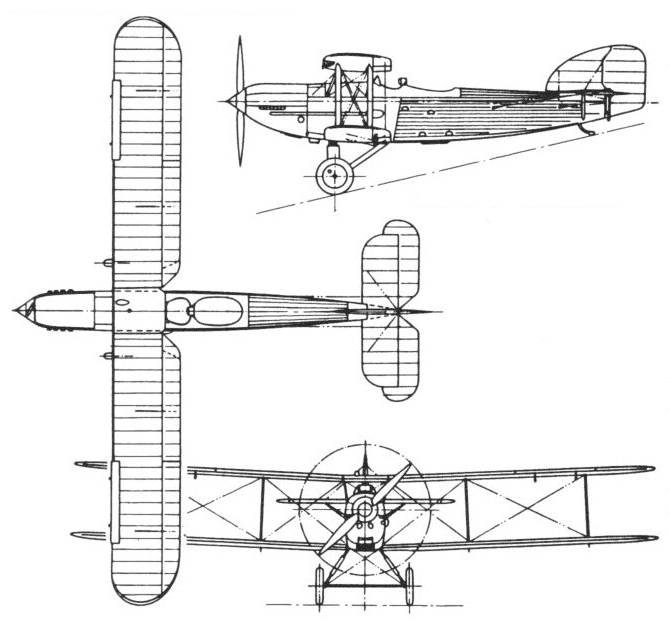
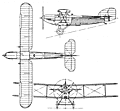 | A three-view drawing of Fairey IIIF (670 x 622) |
| David Burns, e-mail, 08.02.2017 01:31 The Royal Australian Air Force operated six Fairey IIIDs from 1921 to 1926. The most notable of the flights of the Fairey IIID was the circumnavigation of Australia in May 1924. This flight from Point Cook by WGCDR Goble and FLTLT McIntyre covered 8568 miles in 90 flying hours over an unchartered course, facing numerous difficulties. The crew were awarded the 1924 Britannia Trophy and the flight was classed by the contemporary press as 'the finest in the history of aviation'. reply | | Delfin Becerra, e-mail, 18.06.2011 01:08 Any body, please where can I find a model of this acft. I want to build one ASAP.
Thanks. reply |
| Stu Hoy, e-mail, 26.12.2009 14:15 Fairey 3Ds were used by Portugal and were to be found in service as far away as Macau. 1922 saw an enlarged version of the Fairey 3D named 'Lusitania' start the first aerial crossing of the South Atlantic by two Portuguese Admirals Gago Coutinho and Sacadura Cabral who invented the aerial sextant and wished to prove that their invention was a viable device. The Fairey 3D (No 17 Santa Cruz) that stands today in the Museu de Marinha in Lisbon is purported to be the aircraft that completed the crossing. The crossing took three aircraft, Lusitania (built to complete a 1000 mile leg of the journey) was destroyed at San Pedro Rocks whilst landing in rough seas for a refuelling stop. A Fairey 3F was shipped out to the point of Lusitania's fate and flew further down route where engine failure caused a crash destroying the aircraft and the Fairey 3D - Santa Cruz - (shipped to the next staging post) flew back to the site of the 3F crash and then continued on to Rio de Janeiro. Lusitania was 'stretched' to accommodate aditional fuel tanks in the original pilot's cockpit in the centre section and in the aircraft's floats. The Pilot was moved aft to the observers cockpit and the 'observer' was moved rear to the gunner's position. The wing span went from the standard 45ft span to 64ft span with 3 bays per wing. Fuel was pumped from the floats by wind driven impeller pumps some parts of which can be seen in the Museum along with other parts of Lusitania recovered from the crash site. The two Admirals survived both accidents and flew the entire journey. Their achievement is considered an extremely important part of Portuguse history and is widely taught in schools. The Fairey 3D Santa Cruz was refurbished in the museum in the late 90's by a team from the UK - myself included and some Portuguese enthusiasts. The then Portuguese Defence Minister officially started the overhaul when I took him up to the propellor hub and invited him to remove the retaining nut. Rolls Royce kindly overhauled the Rolls Royce Eagle engine but not to an airworthy standard as the crank case was found to be cracked. There nust have been different versions of the same Mk because the 3F used as the second aircraft had a 64ft span top wing and a 45ft span bottom wing. This was one of the most interesting jobs I have had the pleasure of being involved with. reply | | larry milberry, e-mail, 06.11.2009 18:16 Were there any foreign sales of the Fairey III? If so, to what countries? Canada received one IIIC in 1920 and one IIIF in 1929. I have heard that a Fairey III was seen on floats in western Canada (likely BC) circa 1930. It bore tail number S1858, but nationality unknown. Thanks for any light that you can shed on this query. Larry Milberry, toronto, Canada reply |
|
Do you have any comments?
|
| 
COMPANY
PROFILE
All the World's Rotorcraft
|




e
reply