|
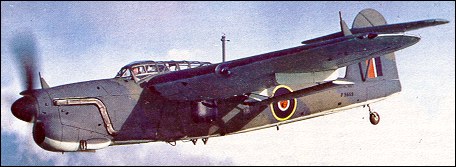
| The Barracuda was the first monoplane torpedo bomber to go into service with the FAA. The original S.24/37 was designed round the Rolls-Royce Exe 24-cylinder X-type engine. Early in the construction stage the power plant was changed to the Rolls-Royce Merlin 30, an engine with many entirely different characteristics. The delay this caused was responsible for retarding the initial production programme. The Merlin-engined prototype first flew on 7 December 1940.
The first prototype Barracuda had an unbraced tailplane in line with the top of the fuselage. During the early trials it was found that when the flaps were in the diving position the disturbed air caused serious tail flutter. To overcome this the tailplane of the second prototype was raised some 1.22m to clear the wake from the flaps and also to clear the folding wings. The first trials with the repositioned tail unit were made in July 1941 and showed that the trouble had been entirely eliminated.
The Barracuda was first used operationally in September 1941 in raids from HMS Victorious on Kirkenes in northern Norway and on Petsamo in Finland. In 1942 Barracudas took part in sweeps over French ports and in the invasion of Madagascar. The first major action in which Barracuda squadrons took part was the successful bombing attack on the German battleship Tirpitz
in Alten Fiord, north Norway on 3 April 1944. It was in action against the Japanese for the first time in an attack on enemy installations at Sabang, on the island of Sumatra on 19 April 1944.
Production of the Barracuda ended in 1946, by which time more than 2,500 had been built: as the Barracuda I with a Merlin 30 engine; Barracuda II with a 1,222kW Merlin 32 engine; Barracuda III, similar to the Mk II but with ASV 10 radar equipment in a bulge under the fuselage; and Barracuda V (first flown in June 1945) with a Rolls-Royce Griffon VII engine driving a Rotol four-bladed propeller, increased wing span, larger rudder and fin, generally strengthened structure, no rear armament but one 12.7mm forward-firing machine-gun.
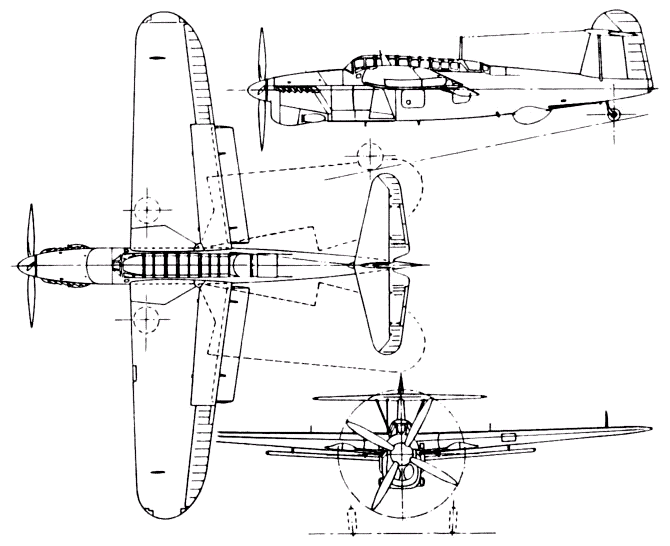
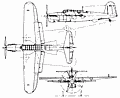 | A three-view drawing (670 x 546) |
| MODEL | Fairey "Barracuda" Mk.II |
| CREW | 3 |
| ENGINE | 1 x Rolls-Royce Merlin 32, 1223kW |
| WEIGHTS |
| Take-off weight | 6396 kg | 14101 lb |
| Empty weight | 4241 kg | 9350 lb |
| DIMENSIONS |
| Wingspan | 14.99 m | 49 ft 2 in |
| Length | 12.12 m | 40 ft 9 in |
| Height | 4.6 m | 15 ft 1 in |
| Wing area | 4.09 m2 | 44.02 sq ft |
| PERFORMANCE |
| Max. speed | 367 km/h | 228 mph |
| Cruise speed | 311 km/h | 193 mph |
| Ceiling | 5060 m | 16600 ft |
| Range | 1101 km | 684 miles |
| ARMAMENT | 2 x 7.7mm machine-guns, 1 x 735kg torpedo or 726kg of bombs |
| Bob Chambers, e-mail, 03.11.2016 16:55 The Barracuda had two large clear panels in both the wing roots. Can anyone shed any light on what they were for? Viewing panels to look out of? or to look into from the ground? reply | | Michael Ponting, e-mail, 28.05.2016 21:37 Anyone out there who remembers Maurice Coote....air gunner /wireless operator who flew in Barracudas 1944 /45 reply | | Michael Ponting, e-mail, 08.05.2016 17:18 I live next door to an ex observer /airgunner who was operational in a Barra in 1941 onwards.....I'll get some of his views...watch this space...he's 90 now reply | | Klaatu83, e-mail, 29.04.2016 04:46 "It wasn't originally designed primarily as a torpedo bomber OR a dive bomber. It's primary role was as a spotter /reconnaissance aircraft - hence the lavish views accorded to the observer. The pilot was merely the chauffeur." Actually, the Barracuda was designed to fulfill the Royal Navy's specification for a "Torpedo /Spotter /Reconnaissance" aircraft. It was the same specification that the Fairey Swordfish and Fairey Albacore had been designed to satisfy. British aircraft carriers had stowage space for a limited number of aircraft, so those aircraft had to be multi-role aircraft. For that reason, the Blackburn Skua was designed to serve both as a fighter and a dive-bomber, while the Fairey Fulmer Fleet Fighter carried a navigator in order to serve as both a fighter and a reconnaissance plane. By the same token, the Barracuda was intended to serve as a reconnaissance plane, an anti-submarine plane, a torpedo plane, a dive-bomber and as an observation plane from which to direct the gunfire of the fleet's battleships. I understand that Barracudas never actually used torpedoes in anger during WW-II, but that they carried out a great deal of dive-bombing and anti-submarine work. reply | |
| | R Bovill, e-mail, 06.03.2015 12:34 I first flew the Barracuda 2 in a non operational squadron during the war and afterwards in 815 squadron from Eglinton NI in an anti-submarine role. It was underpowered - very noticeable on take off with depth charges under each wing. However once the gear was up it climbed away quite well. I found it easy to fly and enjoyed my time in the squadron. The 'Barra' certainly was not the horror it was described as elsewhere as most who have actually flown it will testify. Those who criticise without having actually flown it should pipe down. With over 40 different marks and types of aircraft in my logbook I have flown far worse. reply |
| Marcus Mowbray, e-mail, 03.02.2015 19:30 My father enjoyed his time in a Barracuda as a trainee Observer /Navigator. He liked standing up behind the pilot when diving. The pilot was supposed to concentrate on the target, the O /N's job was to look out for on-coming enemy ammunition or planes and advise the pilot which way to turn to avoid it. Not a great plane but it did play a part. reply | | VinceReeves, 05.03.2013 21:02 The Barracuda was a pretty good aircraft, and was very effective against enemy shipping - 40,000 tonnes sunk off Norway in 1944-45.
It wasn't originally designed primarily as a torpedo bomber OR a dive bomber. It's primary role was as a spotter /reconnaissance aircraft - hence the lavish views accorded to the observer. The pilot was merely the chauffeur. reply | | ksquared, e-mail, 03.10.2012 20:07 Was the Barracuda actually designed as a torpedo bomber - or was it optimised for dive bombing? I recall comments from a test pilot of note (Winkle Brown?)indicating that it excelled as a dive bomber by virtue of speed stability in a steep dive. Did the RN abandon dive bombing after its early success with a Skua strike against the German cruiser Konigsberg? If an aircraft is used for roles it was not optimised for problems are to be expected. reply | | Kristin Ann High, e-mail, 11.09.2012 16:30 The Barracuda was a far superior Dive Bomber than any of the aircraft mentioned here in direct comparison. It was superior in every respect to the Swordfish except perhaps as a trainer. It could carry and tremendous warload at appreciable ranges and was far more rugged than the Jap aircraft cited (Jill). Improperly flying any aircraft will crash it---witness the many "far superior" Avengers in the waters of Lake Michigan or off Hawaii. The one time it flew on operations against the Jap 1st Mobile Fleet WITHOUT air superiority, the much-lauded Avenger was shot out of the sky without scoring a single torpedo hit. Of course, there were only 12 of them, flown by inexperienced crews, against experienced enemy single-engine fighters. Maximum IAS for the Mk.II /III was 235 mph, maximum continuous cruise was 193 mph, and economical cruise was 172 mph (149 knots). Capt. Brown puts the cruise at 160 knots (185 mph), considerably above that Mr. Ward flew at; Captain Brown seems also to have been able to employ the Barracuda in a Dive without finding it "positively dangerous". The Barracuda was a better warplane than the Helldiver (which was also designed to carry a torpedo), a poorer airplane than the Avenger, but certainly not the worst warplane flown by the FAA during the war. reply | | aub, e-mail, 25.10.2011 07:24 If you see the article in.the Newcatle Journal - A company in North Shieldds is renovating parts salvaged from far & wide so as the build a specimen for RNAS Yeovil reply | | deaftom, e-mail, 25.03.2011 04:02 There is an anecdote--true or not, I don't know--that during the war, an recently-arrived American pilot happened to see a Barracuda parked on the apron of the airfield. He walked up to and around it, examining it silently. Finally he said, "Well, it's very interesting, but it'll never replace the airplane!" reply | | Klaatu83, e-mail, 05.03.2011 16:11 By the time these aircraft became operational with the Royal Navy, the infinitely better Grumman Avenger had already been in combat for over a year, while Japanese Navy crews were receiving the far-superior Nakajima B6N Tenzan ("Jill"). Under the circumstances, one cannot help but feel sorry for the unfortunate FAA crews delegated to fly these slow and clumsy monsters! reply | | John Beavin, e-mail, 21.02.2011 10:30 It amazes me that 2500 of these horrible abortions were built,
where were they all used? reply | | Michael F. Shull, e-mail, 13.10.2010 22:30 I am building a model of the Barracuda prototype and need to know if the shape ( planform ) of the horizontal tail was the same on the prototypeas the raised tail used later. reply | |
| | Stephen Gash, e-mail, 14.02.2010 13:29 Fairey had designed an engine called the Monarch which was very powerful, but didn't go into production. The Rolls Royce Exe never went into production either, even though it was apprently reliable. If either of these engines had been installed in the Barracuda or the Battle, then their stories might have been more favourable. The most lamentable thing in British aviation is procurement. Those making the decisions wore blinkers. reply | | Des Fforde, e-mail, 13.10.2009 19:13 I'm just reading 'Barracuda Pilot, by Dunstan Hadley. He flew the Barracuda and speaks well of it. A lot harder to fly than a Swordfish! but rewarding. reply | | Leo Rudnicki, e-mail, 27.05.2009 22:59 During the war there was considerable secrecy regarding FAA equipment, to prevent embarassment over the total lack of effort or priority. the Barracuda's Tirpitz attack was the first reported use, one of many successful attacks on the Tirpitz. It's operational debut was delayed somewhat by 5 aircraft flipping into the ocean during practise torpedo attacks. Winkle Brown was called in, tried the procedure at altitude, recovered, and reported. This was on PRODUCTION Barracudas. Yes, the Barracuda was as good as it looked. Congrats, Mr. Ward on your survival. Apparently, the FAA Museum has wreckage of two examples. How apt! reply | | Eddy Taylor, e-mail, 27.05.2009 20:27 The Barracuda was first used operationally in September 1941 in raids from HMS Victorious on Kirkenes in northern Norway and on Petsamo in Finland.
Sorry, the raids in question above were on 30th /31st July and Albacores and Fulmars were involved reply | | andy denney, e-mail, 09.06.2008 12:31 I have an old cockpit canopy for sale.
Please contact me for further details reply | | LEONA, e-mail, 18.12.2007 03:08 THIS IS OBVIOUSLY THE PLANE EVERYONE LOVES TO HATE... reply |
|
Do you have any comments?
|
| 
COMPANY
PROFILE
All the World's Rotorcraft
|



You have served in the Royal Navy?It's really exciting!Do you have any airticle about it?Or,could you please send some photos about your logbook and your service in the military?I'm really interested in your experience.
reply