|
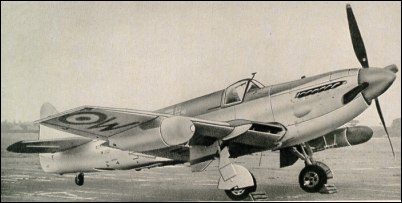
| The Firefly - which in its prototype form first flew on 22 December 1941 - was produced until the mid-1950s although most of the earlier operational versions remained in use with the Royal Navy, Royal Australian Navy and Royal Netherlands Navy. Reconditioned Firefly Is were also supplied to the air forces of Ethiopia and Siam during this period; while Firefly target tugs served in Sweden and Denmark.
The Firefly 1 was powered by a 1,483kW Rolls-Royce Griffon 2 or 12 engine driving a Rotol three-bladed propeller. The F.1 was the early two-seat day fighter and was followed by the FR.1 and 1A standard reconnaissance fighters (with search radar in a radome under the nose of the fuselage) and the NF.1 night fighter. Each was armed with two 20mm cannon in each wing. The Firefly T.1 was basically an F.1 converted for use as a deck-landing conversion and instrument-flying trainer. The raised rear cockpit was occupied by the instructor. They were usually unarmed, although a few carried two 20mm cannon.
The Firefly TT.1 was fitted for towing a glider, banner or sleeve target for ground-to-air or air-to-air firing practice. The Firefly T.2 was an armaments trainer, similar to the T.1 with two 20mm cannon and provision for carrying bombs, rockets and long-range drop tanks. The Griffon 12-powered Firefly T.3 was a version of the FR.1 intended specifically to train observers, the rear cockpit being equipped with the fullest possible range of radio and radar equipment. The Firefly FR.4 (first flown on 25 May 1945) was powered by a Griffon 74 engine driving a Rotol four-bladed propeller and had radiators moved from beneath the nose to leading-edge extensions of the centre-section. The wings were reduced in span and given square tips and the area of the tailfin was increased. Armament was the same as for the Firefly 1 but could also carry two 450kg bombs, 16 x 27kg rockets or eight heavier rockets, or long-range fuel tanks. A modified version for target-towing was the TT.4.
The similarly powered Firefly 5 was produced in three forms, as the NF, FR and AS, all similar externally to the 4. The FR.5 carried the same radar in the starboard wing nacelle as the 4 and was equipped with beam approach, IFF and communications radio. The NF.5 had the same basic radio plus a radio altimeter and other night-flying equipment. The AS.5 was an anti-submarine version and carried special submarine-detection equipment under the wings and fuselage. The Firefly AS.6 was another anti-submarine aircraft, structurally similar to the 5 but with different operational equipment and no defensive armament.
The Firefly 7 of 1953 was produced in two forms, as the AS and T, although it was used mainly as an anti-submarine training aircraft. Powered by a Griffon engine with a 'chin' radiator, the three-seat anti-submarine aircraft carried the latest detection devices and sonobuoys for tracking a target at sea. A new blister-enclosed rear cockpit accommodated two radar operators and the aircraft had elliptical wings without wing radiators and a new tail unit. The final Firefly variant was the U.8/U.9, designed as new or conversions of earlier aircraft to help with the development of guided missiles and equipped to be used as radio-controlled photographic drones.
Firefly fighters and reconnaissance fighters first went into operational service in late 1943 and were mainly used in the Pacific theatre of war against Japanese forces and targets. Successes on the Western Front included a reconnaissance over the German battleship Tirpitz which resulted in the bombing attack by Vought Corsairs and Barracudas on 3 April 1944. Post-war, Fireflies saw action in Korea, flying vast numbers of sorties from British and Australian aircraft carriers, and later in Malaya; finally going out of service in 1956. Firefly production totalled more than 1,700 aircraft of all variants.
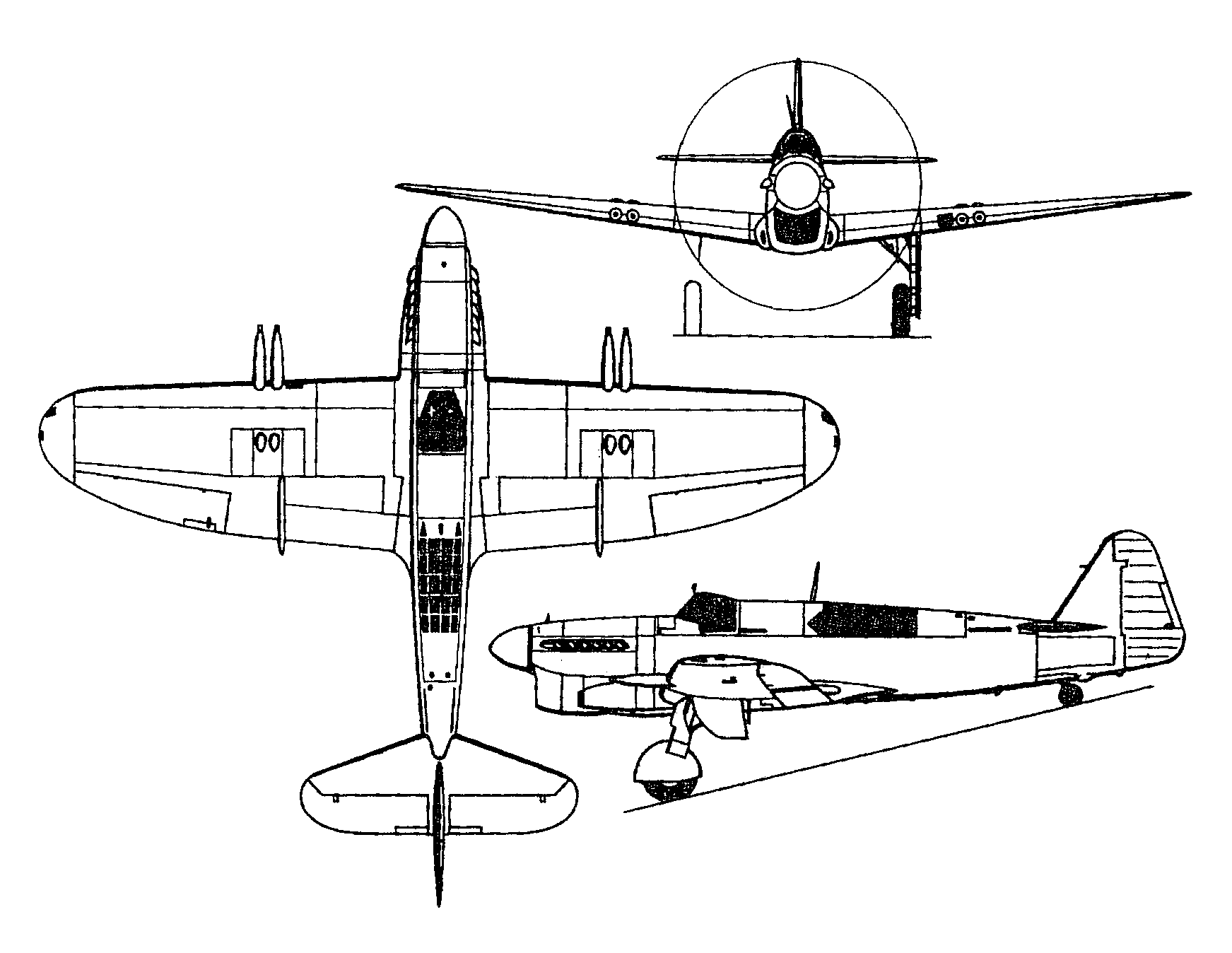
 | A three-view drawing (1743 x 1348) |
| CREW | 2 |
| ENGINE | 1 x Rolls-Royce "Griffon IIB", 1270kW |
| WEIGHTS |
| Take-off weight | 6400 kg | 14110 lb |
| Empty weight | 4420 kg | 9744 lb |
| DIMENSIONS |
| Wingspan | 13.6 m | 45 ft 7 in |
| Length | 11.5 m | 38 ft 9 in |
| Height | 4.1 m | 13 ft 5 in |
| Wing area | 30.7 m2 | 330.45 sq ft |
| PERFORMANCE |
| Max. speed | 509 km/h | 316 mph |
| Ceiling | 8530 m | 28000 ft |
| Range w/max.fuel | 1720 km | 1069 miles |
| ARMAMENT | 4 x 20mm machine-guns, 900kg of bombs |
| Klaatu83, e-mail, 30.05.2017 19:25 Although originally classed as a fighter and ostensibly a successor to the Fairey Fulmar two-seat carrier-based fighter, the Firefly was more of a multi-role aircraft than the fulmar, eventually being adapted for the roles of day-fighter, night fighter, maritime strike, reconnaissance and ASW and even an unmanned target drone. While not quite as fast as single-seat fighters of the time, the Fairefly was far more versatile. reply | | R Bovill, e-mail, 06.03.2015 13:36 I flew the Firefly Mk1 as a very junior S /Lt(A)RNVR during the war and the Mk4 and 5 afterwards whilst serving in the RCN. It was pleasant enough to fly though not outstanding. As a deck aircraft I think it's main fault was the inability of the undercarriage to take much of a side load. I well remember on the one and only time I had a deck prang, when having taken the 'cut', the port leg collapsed on hitting the deck and I ended up with the aircraft tail up and hanging by it's hook and the arrestor wire over the side in the port gun sponson. Shortly afterwards we changed to Grumman Avengers - an excellent aircraft with a typically strong Grumman landing gear which it needed especially at night when arrivals were in the nature of controlled crashes. It proved very reliable thanks to first rate squadron airframe and engine mechanics attached to each aircraft. reply | | Ian Slight, e-mail, 20.06.2014 12:23 Will always be my favourite naval aircraft, when I was with 1843 RNVR Sqn Shed a few tears when we converted to the Avenger, but that also had many endearing qualities, not least it's ability to carry a few WRENS in the hold......! reply | | Alex, e-mail, 02.11.2013 21:34 Thanks for very interesting information about this airplane reply | |
| | Paul, e-mail, 25.05.2012 11:55 I am modelling a Fairey Firefly Mk1 from Hms Triumph whilst engaged at the outbreak of the Korean War. Does anyone know if the aircraft in addition to their grey and barley colour scheme had the D-Day type black /white wing and fuselage stripes. Many Thanks reply | | B Horncastle, e-mail, 24.05.2012 03:30 Left H.M.S triumph just prior to her sailing for Korea taking the first of the british troops, was later Stationed at Naval -Air- station Anthorn, H.M.S Nuthatch, durring the mid fifties moth balling fireflys firstly inhibiting the engines, Then towing and parking them out around the airfield, Bit of a waiste of time as shortly after they all ended up at the scrap metal yard.Back to sea after that aboard the Ark Royal on her first sea trials , "Happy Times" reply | | John Cameron, e-mail, 21.12.2011 03:09 John Purvis, The only winged targets we towed were built by a company called Lines. Don't know if they are still in service. This as in the U.K. reply | | john cameron, e-mail, 12.07.2011 01:17 I give up!!!! reply | | john cameron, e-mail, 12.07.2011 01:14 please change from cameronjm=shaw.ca tks reply | | john cameron, e-mail, 02.06.2011 23:15 in 1953(give or take) I flew back seat in a Mk5 Firefly modified for target towing.Good aircraft.However, the back seat mod to allow the operator to turn the seat was diabolical. The seat back was cut down in height and the seat belt did nothing when the operator was facing backin order to operate the winch controls.We had to take three drogues which meant we took off facing the back,a drogue left and right and the third one between our legs and in the hole in the floor so we could launch it first.Full details of this operation are too long here. Suffice to say, that facing the tail on take off with a seat back below your shoulders meant nothing but grief if the plane crashed on take off. In January 1953 over Spain We had a complete engine failure due to a pump drive shear.Not good!!. Despite this event Leona I still have no bad feelings for the Firefly. reply | | John Stratford, e-mail, 22.04.2011 22:43 In the early 50's the Fireflies based at Lossiemouth,which was a RNAS base in those days,were sent to Milltown, east of Elgin, whilst the runways were being adapted for the jet age.they were early models which had their wings folded by pulling on ropes attached to the wingtips,we also had a variety of Seafires reply | | Howard Miller, e-mail, 03.02.2011 15:26 I saw the last of these fine aircraft belonging to the RAN, being scrapped at HMAS Nirimba in about 1962, some of the birds only had six hours flying time on the clock. They had been taken off HMAS Sydney along with some Sea Furies, also bound for Albert Simms, the scrap dealer. All these beautiful, as new aircraft were shredded and the remains sent to Japan. This wasteful destruction has remained a strong memory for my working life, it made me realize how foolish is the greed of the corporate world. Even as a boy of seventeen I saw how irreplaceable these beautiful birds were. reply | | LEN ALLEN, e-mail, 29.12.2009 16:31 You are talking about the aircraft I love.
I was the photographer on 827 squadron while
on H.M.S. TRIUMPH. From my collection of some
400 pictures of the carriers life I have about
30 of Firefly,s, flying and deck landing accidents.
I am looking for N /A PHOTS. Carpenter and Benson
Can supply pictures of the TRIUMPH and its aircraft.
No charge reply | | Steve, e-mail, 06.08.2009 18:47 Re. the Mk.IV's speed: Later discussions (AIR ENTHUSIAST 1972, and Eric Brown's book on WWII naval aircraft) give the lower figure, which leads me to suspect that the original was a typo. I do agree that the performance seems low for the power - two seats and all, the airplane was little bigger than a Hellcat and somewhat cleaner. I've considered the effect on performance of drop tanks, and noted that if you deleted the radar scanner fairing and the (semi?) permanent portside external fuel tank, the speed might actually match the earlier figure. Maybe that speed was recorded from a completely clean aircraft? reply | |
| | Ian, e-mail, 23.04.2009 15:51 The Firefly was om the slow side, the 316mph figure quoted for the MkI the version used in WW2 is generally quoted thus. Though later versions did have improved speed with more powerful engines, namely the MkV. The speed would always be hampered by it's size due to its 2 man crew so it could never match the speed of single seaters. Still a fantastic aircraft though that packed a fair punch for ground attack. reply | | Bob, e-mail, 29.10.2008 05:59 Leona, not sure I agree.. I have collected a fair amount of documentation on the Firefly, and the top speed of the Mk. V is noted as 386 MPH (later versions in Korea). reply | | John Purves, e-mail, 15.10.2008 14:38 Extremely interesting. As a child I remember the gliders being towe en route to war zones 9especially Arnhem0 across east Anglia. Re the towing of targets for practice, is there any information or pictures of the actual models or mock-ups used for target practice? reply | | Greg, e-mail, 17.04.2008 22:03 I am searching for photos /references for FR.1s w / 827 squadron /HMS Triumph serving during the Korean War. Canyou help? reply | | LEONA, e-mail, 18.12.2007 03:11 SLOW BUT RELIABLE. THIS IS A PLANE WORTHY OF SOMTHING MORE THEN IT WAS USED FOR. reply |
|
Do you have any comments?
|
| 
COMPANY
PROFILE
All the World's Rotorcraft
|