|
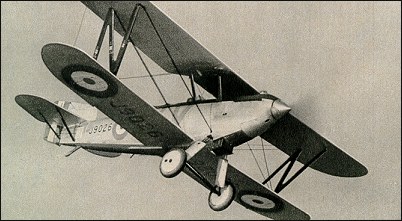
| Potentially one of the most exciting aircraft to serve with the RAF in the 1920s, the idea for this high-performance two-seat day bomber almost certainly came to C. R. Fairey (later Sir Richard) in 1923. In that year the Schneider Trophy Contest at Cowes, Isle of Wight was won by an American Curtiss CR-3 racing seaplane at a speed of 285km/h, piloted by Lieut David Rittenhouse. Close behind was a second CR-3 flown by Lieut Rutledge Irvine with a speed of 279.16km/h. The only other aircraft to complete the 344.69km course was Britain's Supermarine Sea Lion III, powered by a Napier Lion engine which was almost 19% more powerful than the Curtiss D-12 carrying the CR-3 to victory.
Richard Fairey realised that the Curtiss engine, in combination with a Curtiss-Reed propeller, was a most significant factor in this American success. The engine itself was revolutionary: the world's first wet-sleeve monobloc aero-engine; in addition it was of abnormally small frontal area, which meant that a neat streamlined fuselage could be tailored to conform. It took somebody like Fairey to appreciate how important the propeller was to the success of the enterprise. Of comparatively small diameter with forged duralumin blades of thin aerofoil section, it could be rotated at high speed - the blade tips approaching the speed of sound - without any serious loss of efficiency. So fast was the rotational speed that there was no need to interpose an energy-stealing reduction gear between engine and propeller. No reduction gear, small-diameter lightweight propeller blades and (resulting from this latter factor) a shorter landing gear, all produced weight savings that were vitally important to a high-performance aircraft.
Fairey was soon busy negotiating for the licence rights to import and/or build this power plant in Britain, and acquired in short time an engine and propeller for the development of a fast day bomber for the RAF. A prototype was built as a private venture, of single-bay biplane configuration with unequal-span staggered wings. Landing gear, tail unit and fuselage were all typical of Fairey design of that era; the fuselage, of course, was much slimmer than usual. Notable were the considerable efforts made to produce a structure as free from drag as then possible. Even the mounting for the gunner's defensive Lewis gun was of Fairey design, to eliminate the drag induced by the normal Scarff ring.
The prototype was first flown on 3 January 1925. By the time that development was finished, the company was aware that it had produced an aircraft which was aptly named Fox: well able to lead the field and even to make circles round them. Demonstrated in October of that year to Air Chief Marshal Sir Hugh Trenchard, its performance was so impressive that a complete squadron of aircraft was ordered into production. Strict budgets of that time (which became tighter as the 1930s approached) limited procurement to 28 aircraft. When issued to No 12 Squadron (in August 1926) they proved to be some 80km/h faster than the Fairey Fawns which they superseded, and were able to show an embarrassingly clean pair of heels to any contemporary fighter. At a later period some of these aircraft were re-engined with the Rolls-Royce Kestrel and redesignated Fox IAS, remaining operational until 1931.
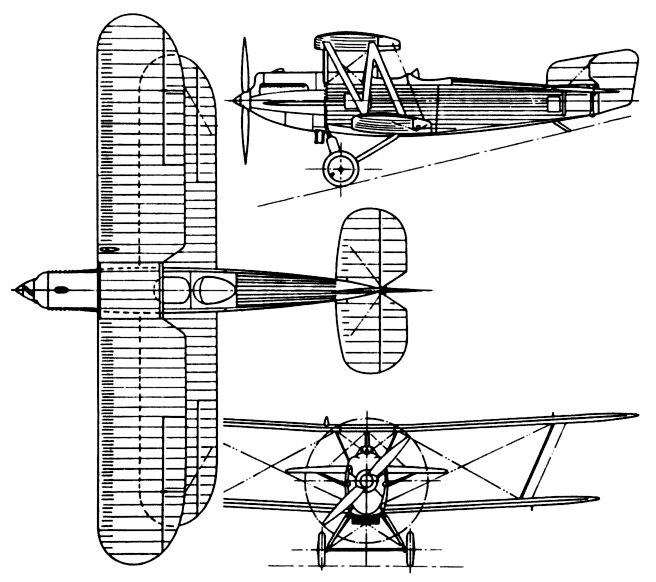
 | A three-view drawing (656 x 582) |
| CREW | 2 |
| ENGINE | 1 x Rolls-Royce "Kestrel IIS", 405kW |
| WEIGHTS |
| Take-off weight | 2140-2300 kg | 4718 - 5071 lb |
| Empty weight | 1450 kg | 3197 lb |
| DIMENSIONS |
| Wingspan | 11.6 m | 38 ft 1 in |
| Length | 9.9 m | 33 ft 6 in |
| Height | 3.3 m | 11 ft 10 in |
| Wing area | 34.0 m2 | 365.97 sq ft |
| PERFORMANCE |
| Max. speed | 304 km/h | 189 mph |
| Ceiling | 9500 m | 31150 ft |
| ARMAMENT | 3 machine-guns, 250 kg of bombs |
| Bernard Rumbold, e-mail, 20.04.2014 04:26 12 Sqn were the sole RAF squadron operating the Fox. They were based at RAF Andover. reply | | Klaatu83, e-mail, 24.09.2012 01:19 The drawing depicts the original Curiss-engined Fox, the photo is of the Kestrel-engined Fox II.
Richard Fairey believed that the airplane designers were being handicapped by the Air Ministry's unimaginative specifications. He built the Fox day bomber as a private venture to demonstrate to the bureaucrats just how good an airplane could be when it wasn't hamstrung by their outmoded specifications.
Unfortunately, the success of the Fox did not translate into sales for Fairey. In fact, when the Air Ministry eventually issued a specification for a new day bomber based upon the success of the Fox, Fairey wasn't even invited to submit a proposal! The winner was the Hawker Hart.
Since the RAF wasn't interested in the Fox, Fairey was permitted to market it for export. Later versions were sold to the Belgian Air Force, and Fairey even established a subsidiary company to built Foxes under license in Belgium. A few Foxes were used operationally against the German invasion in 1940. reply | | mark wickers, e-mail, 06.10.2011 21:20 Hi i have achassis plate for a Fairey Fox no F 955 does anyone no where i can find out about this aircraft please ? reply | | max houghton, e-mail, 05.08.2011 12:04 WFEL started life as the Fairey Aviation Company.We now manufacture tactical military bridges that are sold world wide. Our logo is taken from the squadron crest of No 12 Sqn Royal Air Force that was equipped with the Fairey Fox. I am keen to acquire a model of the Fairey Fox for display purposes at our HQ in Stockport UK.Does anyone know where i might find a model? Thanks. reply | |
| | Barry, 14.03.2011 18:46 Well Leona I'm with you, it is frustrating not having the output of the engines in the nomenclature that they were designed. Someone somewhere has gone to a lot of trouble to convert h.p. to k.w. Suffice to say that the Kestrel fitted to the Fox developed 490h.p. The original engine was the Fairey built Curtiss D12 engine known as the Fairey Felix which developed 480 h.p. Richard Fairey had gone to America and had been impressed by the Curtiss engine which allowed for very close cowling and on his return got Marcelle Lobelle and P A Ralli to design an aeroplane around the engine. The Fox as noted was so much better than anything else that the RAF had that it was ordered by Lord Trenchard immediately for service. As noted elsewhere they went to No12 Squadron who to this day commerate this aircraft on the Squadron badge symbolised by a fox's head. Fairey set up Avions Fairey in Belgium where a 170 aircraft was ordered by the Aeronautique Miltaire the last 90 were the 860 h.p. Hispano Suiza powered Fox VI, which featured a three bladed prop spatted wheels and enclosed cockpit. They fought through to 1940 and were all destroyed in the Blitzkreig. reply | | Anna Rock, e-mail, 13.06.2009 05:05 can I please use your photos on our web? reply | | Jim Brennan, e-mail, 01.01.2008 07:07 Am interested in building an r /c model of the Mk1.95" w /span. Have some 3 views but would like to get a book or mag with construction details. If you know of any, could you tell me how and where I might purchase same. Thanks. reply | | LEONA, e-mail, 18.12.2007 03:03 I LOVE THE SITE AND ALL, BUT COULD YOU TRANSLATE KILOWATTS TO HORSEPOWER? THANK YOU. reply | | pete, e-mail, 22.07.2007 13:48 Are any accurate drawings available for the Mk1 and Mk1A
hope you can help reply |
|
Do you have any comments?
|
| 
COMPANY
PROFILE
All the World's Rotorcraft
|