Of all aircraft regarded as anachronisms
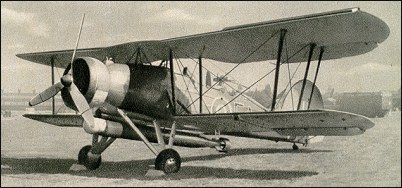
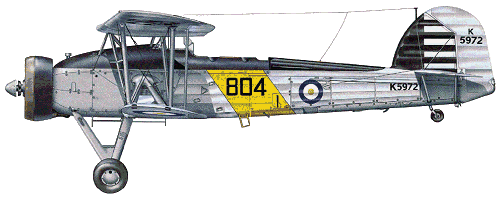
the Fairey Swordfish torpedo-bomber
must be the supreme example,
for even back in the 1930s it
appeared archaic and cumbersome.
Stemming from an earlier design
whose prototype had crashed, the first
prototype Swordfish (the TSR.II) first
flew on 17 April 1934 and the production
Swordfish Mk I was prepared to
Specification S.38/34 with slightly
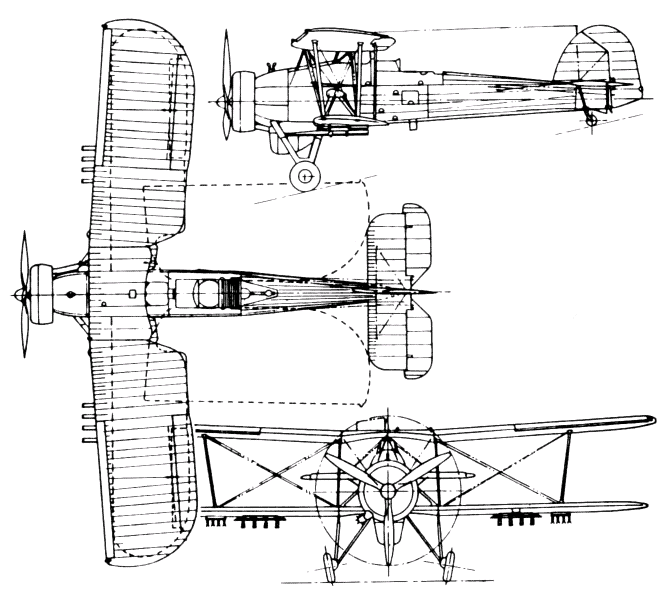
swept-back top wing; construction
was all-metal with fabric covering. By
the outbreak of war in 1939 a total of 689
aircraft had been delivered or were on order, serving with both wheel and
float landing gear aboard Royal Navy
carriers, battleships, battle-cruisers
and cruisers in the torpedo-spotter reconnaissance
role. Among the memorable
events in which the old 'Stringbag' participated was the action at Tarante
on 11 November 1940, when Swordfish
aircraft from HMS Illustrious severely
damaged three Italian battleships; the
crippling of the Bismarck in the Atlantic;
and the suicidal attack on the German
warships, Scharnhorst, Gneisenau
and Prinz Eugen during their
famous escape up the English Channel
in February 1942. Production of the
Swordfish was undertaken largely by
Blackburn, the Swordfish Mk II being
introduced with a strengthened lower
wing to allow eight rocket projectiles
to be mounted, the Swordfish Mk III
with ASV radar between the landing
legs, and the Swordfish Mk IV conversion
of the Mk II with a rudimentary
enclosed cabin. Production ended on
18 August 1944, by which time a total of
2,396 Swordfish had been completed.
Fairey Swordfish on YOUTUBE
Specification
MODEL
Swordfish Mk II
CREW
2-3
ENGINE
1 x Bristol Pegasus XXX, 559kW
WEIGHTS
Take-off weight
3406 kg
7509 lb
Empty weight
2132 kg
4700 lb
DIMENSIONS
Wingspan
13.87 m
46 ft 6 in
Length
10.87 m
36 ft 8 in
Height
3.76 m
12 ft 4 in
Wing area
56.39 m2
606.98 sq ft
PERFORMANCE
Max. speed
222 km/h
138 mph
Cruise speed
193 km/h
120 mph
Ceiling
3260 m
10700 ft
Range
1658 km
1030 miles
ARMAMENT
2 x 7.7mm machine-guns, 1 x 730kg torpedo or 680kg of bombs
At age 15 I was engaged by Fairey Aviation as an Indentured Apprentice for 6 years, while most training was within the Fairey Heaton Chapel factory where manufacture was for Firefly Mk 4 and later 7 and 8 together with Gannet sub assemblies, I eventually transferred to Fairey Flight Sheds at Ringway Airport now known as Manchester Airport during my time their an occasion occurred where I was instructed to remove the instrument cluster from the old Fairey Swordfish that had been left in a sorry state in the corner of Flight Shed 2, such a thrill to be working how ever limited on this historic aircraft, sadly later I was informed the airframe less engine had been allocated to the airport fire brigade for fire activities, presumable the aircraft was eventually destroyed?
Fairey Aviation had one at White Waltham in the 1950's. I remember it being flown at a R.Ae.S garden party there. It was taxying along with a person chasing it on a penny-farthing bicycle. One he had caught up he was hauled into the rear cockpit and the aircraft lifted off almost immediately. It then did a slow pass in front of the crowd with a pair of legs waving around upside down in the back! Is this the same aircraft that is now at Yeovilton?
The Swordfish used to fly over our house, one day they flew over when we were in the fields, I told my boys to wave, they did and the swordfish did a circuit and came back, the crew saluting! I have a photograph or two somewhere in b&w.
There are (to my knowledge) two excellent autobiographical works by former Swordfish pilots: John Kilbracken, Bring back my Stringbag, Swordship Pilot at War 1940-1945, Pen & Sword Paperback, rev. ed. London 1996 and Charles Lamb, War in a Stringbag, Cassel Military Paperbacks, London 1987.
Lamb was on board RN carrier HMS Courageous when she was torpedoed in September 1939; he flew Swordfishes in the Mediterranean.
John Godley (later Lord Kilbracken) was an Anglo-Irish nobleman, and flew Swordfishes from MAC ship HMS Nairana in North Atlantic convoys (both Canada and Murmansk).
Both authors are very informative and interesting, and entertaining.
I had the privilege of stepping into the cockpit of a Fairey Swordfish that was on display and was given a brief introduction of the aircraft by Lt.Cdr Paddy, RNAS at the recent Goodwood Revival at West Sussex, England. I first read about the Swordfish in a RN recruitment brochure I received from Whitehall, London back in 1965. As a young lad, I had wanted to join the Royal Navy but I did not have the means to travel to Great Britain then, but the dream lived on and that led me to join the RMNVR in 1984 until I retired as a Commander. Though I have been fascinated by aircrafts of the modern world, the performance, achievements and service records of this wonderful aircraft gives an everlasting impression of a great invention. It would be great to have an opportunity to fly in a Swordfish one fine day.
I had the privilege of stepping into the cockpit of a Fairey Swordfish that was on display and was given a brief introduction of the aircraft by Lt.Cdr Paddy, RNAS at the recent Goodwood Revival at West Sussex, England. I first read about the Swordfish in a RN recruitment brochure I received from Whitehall, London back in 1965. As a young lad, I had wanted to join the Royal Navy but I did not have the means to travel to Great Britain then, but the dream lived on and that led me to join the RMNVR in 1984 until I retired as a Commander. Though I have been fascinated by aircrafts of the modern world, the performance, achievements and service records of this wonderful aircraft gives an everlasting impression of a great invention. It would be great to have an opportunity to fly in a Swordfish one fine day.
If you want to see a real, live, beautifully restored Swordfish go to Vintage Wings of Canada at the Gatineau [formerly Hull] Airport. It's presently in engine o /h but should be flying again soon.
I just completed reading "At War in a Stringbag" by Commander Charles Lamb DSC DSO (1914 – 1981). His autobiographical description of WWII in the Mediterranean, Swordfish operations, and internment by the Vichy French regime is a story worthy of Patrick O'Brien's Jack Aubrey. Among other information he relates is that the swordfish's nick name "stringbag" referred to a shopping bag and described its capability to carry a wide variety of weapons including bombs, torpedoes, mines, flares and eventually radar and rockets (I had always thought that it was a description of the aircraft's construction.) The Swordfish truly deserves to be held in the same esteem as the Spitfire, Hurricane and Lancaster.
As noted above the majority of production was done by Blackburn, building 1,699 of the total production of 2,391. The Swordfish did have a remarkable career apart from the disabling of the Bismark and the destruction of the Italian Fleet at Taranto (not only 3 battleships, a cruiser, a destroyer and other warships)it's battle honours were many. For example a small group based in Malta sunk 50,000 tons of shipping every month in 1941 to 1943. Of course the Royal Navy had to find something new and whilst the imported Grumman Avenger was a notable aircraft, why oh why did they ever buy the Barracuda?
According to what I believe to be an accurate account, Admiral Richardson, commander of the U.S. Pacific Fleet in 1940, informed President Roosevelt of the danger in basing the fleet at Pearl Harbor. Up until then the fleet's home base was San Diego but Roosevelt sought to intimidate and threaten the truculent Japanese. Richardson knew what could happen and protested against the move. He foresaw the Japanese attack coming from northwest of Pearl but apparently his warnings only irritated Roosevelt who replaced him with the more tractable Admiral Kimmel. It wasn't long before Richardson's prediction was proved accurate. However, the question remains: Did Roosevelt move the fleet to Hawaii just to impress the Japanese with his sincerity or did he inwardly agree with Richardson that by doing so an attack was inevitable? An attack, he knew, that would draw us into a war that we were bound to win and which would virtually guarantee unequalled government spending, full employment,rapid growth of our then stagnant economy, an awakening of our latent industrial capacity, a merchant marine second to none, and a military and technical superiority that would raise our worldly status to the very pinnacle of world power. He must also have been considering his political chances for a third term in office, counting on the American people to re-elect a sitting president during war-time. At the time of Pearl Harbor Roosevelt was one year into his second term and the law required him to step down when the 1944 elections came around. To the patrician and confident Roosevelt, his popularity as a wartime leader would assure him of winning both the nomination and the election in November of 1944. This question is still hotly debated today. What was Roosevelt's real motive in rebasing the fleet to Hawaii? What's your guess?
The airplane that demonstrated the feasibility of Pearl Harbor to the Japanese. Unfortunately our man Roosevelt was a little slow to take note. Quite amazing how the Brits made 10 year old technology persevere. Campobello, South Carolina, USA
In 1980 a number of former Canadian Naval Airmen found a derelict swordfish in a junkyard in Southern Ontario. It was recovered to Toronto where over the next 10 yars it was restored to original condition and rolled out at on 25 July 1980 to public viewing. The Canadian government awarded wach menber of the 12 man crew the "Medalian of Excellence" in recognition of the many years of dedicated service to this project. The aircraft was stripped down during the month of August and on 9 August 1990 the String bag was airlifted to CFB Shearwater in Nova Scotia. After another 4 years of work the aircraft was declared airwothy and in early April 1994 the aircraft was successfully flown. In total the restoration crew put in approximately 28,000 manhours of labour and received a number of other awards for their outstanding effort to preserve Canadian Naval History. The venreable old Swordfish now rests at the Shearwater Aviation Museum at Dartmouth NS. Canada a tribute to the brave men who flew the "Stringbag" in every theatre of operation during WWII. Incidentally this aircraft sunk more enemy tonnage than any other aircraft and was the only aircrft to see service throughout the entire war.
ive seen this awesome plane i think it was a fantastic marine bomber espeicially when used against the Bismark in 1941 they were carried on the ww2 aircraft carrier HMS Ark Royal which is sweet thnx
Hi again,further to my comments left on discovering this site I have given the subject some more thought (40 years on)The Fairey Swordfish was 5A, The Test Pilots name was Mc something I think and the CPO (CAF A /E) was Caffrey I think.It would be lovely to hear anything about the lads, I have since read all about 5A LS326,I never knew its history!!! A second aircraft of mine, Wessex 3 XM328 1969 737 sqadron & HMS Antrim is also preserved in a museum in Somerset, type in Wessex XM328 and check out its history,you can also buy a model of it, cool! Cheers