|
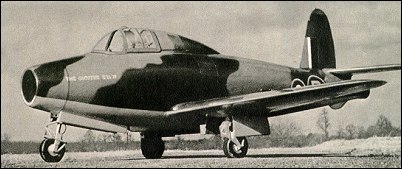
| On 12 April 1937 Frank Whittle started the world's first turbojet aircraft engine, developed from his original ideas and produced by a company known as Power Jets Ltd. In March of the following year the Air Ministry issued a contract for a single engine and subsequently awarded Gloster a contract to produce the necessary airframe and further develop the aircraft under the specification E.28/39. Although the contract was seen as representing the operational requirements of a high-altitude interceptor, this aspect was not stressed, the main concern being to give special attention to the many new features associated with the installation of the turbojet engine.
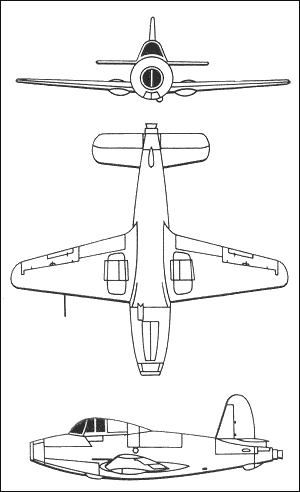
The E.29/39 was a cantilever low-wing monoplane of all-metal construction with the single engine located in the fuselage aft of the pilot's cockpit. Air that passed through the nose orifice was channelled to pass each side of the cockpit to the engine. The aircraft flew for the first time on 15 May 1941 at Cranwell, piloted by Fit Lieut P. E. G. Sayer. Subsequent development saw modifications made to the engine and airframe. The E.28/39 programme resulted in the development of the twin-engined Meteor fighter.
| CREW | 1 |
| ENGINE | 1 x Power Jets "Whittle 1", 3.8kN |
| WEIGHTS |
| Take-off weight | 2170 kg | 4784 lb |
| Empty weight | 1700 kg | 3748 lb |
| DIMENSIONS |
| Wingspan | 8.8 m | 29 ft 10 in |
| Length | 7.6 m | 25 ft 11 in |
| Height | 2.7 m | 9 ft 10 in |
| PERFORMANCE |
| Max. speed | 370 km/h | 230 mph |
| Ceiling | 10030 m | 32900 ft |
| Range w/max.fuel | 660 km | 410 miles |
| ARMAMENT | 4 x 7.62mm machine-guns |
| Richard Uppstrom, e-mail, 23.02.2017 23:37 Ref the date of first flight as 15 May 41. It may be stretching a point a bit, but it DID "fly" on the previous day. I got to know Sir Frank Whittle in the 1980s, and he told me that he had done a " high speed taxi test" on the 14th of May, and with a bit of discrete backpressure got the G-40 off the grass for a few seconds before resuming the "high speed taxi". If you were privileged to know him, this will not come as too much of a surprise. A brilliant engineer and a wonderful person. Frank--I hope I did not betray a confnence. reply | | met man, e-mail, 21.09.2011 19:01 I was a meteorological observer at RAF Edgehill in 1942 /43 and I first saw the aircraft when it was doing taxi trials. I later saw it flying when it had to make an emergency landing when being flown by F /L G Sayer the Gloster Test Pilot reply | | lucy, e-mail, 18.06.2011 11:17 A second one was built with a "whittle 2" and had a max speed of 466 mph. They were also named pioneer. reply | | deaftom, e-mail, 26.03.2011 03:27 I would love to see a modern flying reproduction of this plane, perhaps with a small Williams engine in the tail. Heck, I'd BUY one if I could get the loan. reply | |
| | d.jay, 06.03.2009 21:55 A second one was built with a "whittle 2" and had a max speed of 466 mph. They were also named pioneer. reply | | Maverick Mitchell, 05.04.2008 02:08 The G-40's Max speed was actually 340 mph reply |
|
Do you have any comments?
|
| 
COMPANY
PROFILE
All the World's Rotorcraft
|