|
| The somewhat embarrassing situation caused by the introduction into service of the Fairey Fox day bomber, made it imperative that the Air Ministry should replace the Gamecocks and Siskins equipping its fighter squadrons. It was essential that the aircraft chosen for this task should be manoeuvrable, considerably faster than anything then in service, and because increasing speeds meant that defender and attacker would be in contact for shorter periods, much heavier fire power was needed.
Such a requirement posed considerable problems to the British aircraft industry, with such companies as Armstrong Whitworth, Boulton & Paul, Bristol, Hawker and, of course, Gloster, all keen to secure what it was believed would be a worthwhile contract. Specifications F.9/26 and F.20/27 remained unfulfilled; and F.7/30 calling for a 402km/h four-gun fighter seemed initially even more unlikely to be attained. Gloster's first submission had been an improved version of the all-metal Goldfinch, and with the progression of time this design had been subjected to several permutations of airframe innovations and differing engines. When, in 1933, Gloster's SS.19B demonstrated a maximum speed of 346km/h during tests at Martlesham Heath, it was ordered into production under the name Gauntlet I.
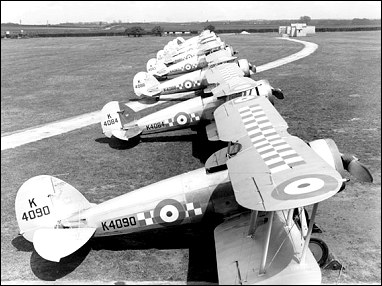
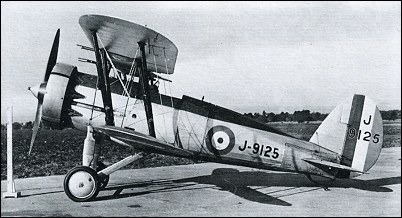
During the period 1935 to 1937 Gauntlets were the fastest fighters in RAF service, partially replaced by Gladiators and Hurricanes in 1938 and finally ousted by Spitfires in 1939. Aircraft produced from 1935, after Hawker Aircraft had taken over the Gloster company, were constructed according to Hawker production methods, bringing changes to wing spar and fuselage structure. These differing aircraft were designated Gauntlet II.
Last open-cockpit biplane in RAF service, the Gauntlet equipped 14 squadrons at its peak period of usage. It was during this same period that a very different performance was given under most secret conditions when (in November 1936) three of No 32 Squadron's Gauntlets intercepted a civil airliner under the guidance of an experimental ground-radar installation at Bawdsey Manor, Suffolk. Thus the Gauntlet has the distinction of carrying out the world's first radar-controlled interception.
| MODEL | Gauntlet Mk II |
| ENGINE | 1 x Bristol Mercury VIS2, 477kW |
| WEIGHTS |
| Take-off weight | 1801 kg | 3971 lb |
| Empty weight | 1256 kg | 2769 lb |
| DIMENSIONS |
| Wingspan | 9.99 m | 33 ft 9 in |
| Length | 8.05 m | 26 ft 5 in |
| Height | 3.12 m | 10 ft 3 in |
| Wing area | 29.26 m2 | 314.95 sq ft |
| PERFORMANCE |
| Max. speed | 370 km/h | 230 mph |
| Ceiling | 10210 m | 33500 ft |
| Range | 740 km | 460 miles |
| ARMAMENT | 2 x 7.7mm machine-guns |
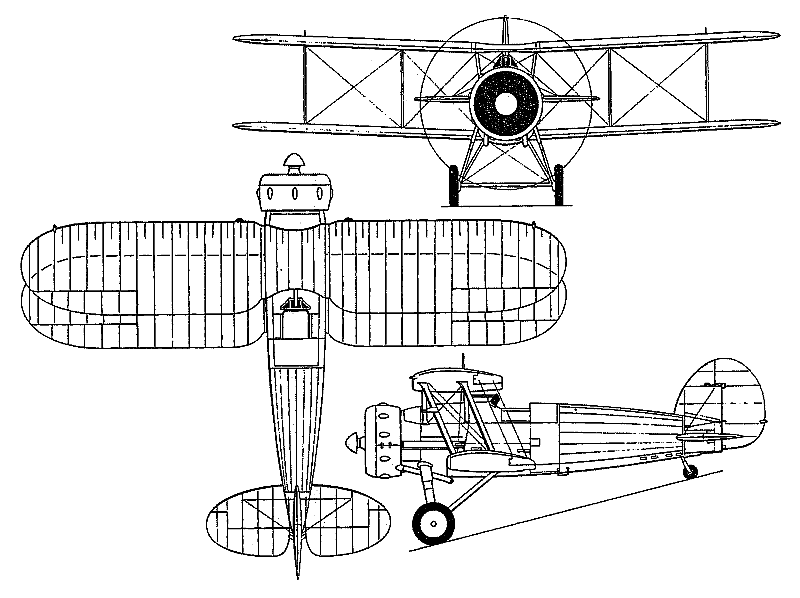
 | A three-view drawing (800 x 598) |
| Tony Newman, e-mail, 24.01.2023 20:21 I once came across the comment that because the top speed of the Gauntlet so exceeded expectation, 'special tests' were performed to determing why it was so fast. Anyone else come across this, or know the origin of the comment? reply | | Bill Pippin, e-mail, 30.10.2011 04:22 I have an APS(Aeroplane Photo Supply) photograph of this very aircraft, but the paint scheme is different and it appears the wheel pants were removed. reply | | damn, 20.06.2011 11:24 I was with 74 fighter sqdn in 1940 when they coverted to spitfire 1's from gloster gauntlets. A nice aircraft with the two guns syncronised through the prop. reply | | Arthur Westerhoff, e-mail, 26.11.2010 15:54 Comment about about being missed off the Battle of Britain pilots list.I was ground crew. reply | |
| | arthur westerhoff, e-mail, 03.12.2009 13:53 When I joined 74sqd in June1940 they wre not fully converted to Spitfire 1's and still had a few Gautlets. As the Battle of Britain got into full swing they had fully convreted. Conversion year 1940. reply | | arthur westerhoff, e-mail, 03.12.2009 13:35 I was not listed because I was ground crew working as a General Armourer.I stayed with 74sqd.until 1941 when they met their doom at R.A.F.Gravesend, after losing most of their aircraft in battle. They were later reformed. Long live the Tigers. reply | | d.jay, 31.07.2009 21:59 Lets see if you remenber signifcant dates in 70 years time, if your sill alive in 2079. reply | | Art Deco, 28.07.2009 20:08 Feb. 1939 is significantly pre-war and fairly memorable. Even the cooks knew that. It was in all the papers. reply | | d.jay, 28.07.2009 19:34 Because Mr. Westerhoff is not listed does not mean he was not with 74 sqdn, he may have been ground crew? reply | | Art Deco, 14.07.2009 05:35 The Gauntlet is credited with the destruction of a Caproni 133 in East Africa. 74 Squadron, Tiger squadron, "I fear no man", the home of "Sailor" Malan, a great pilot, teacher and man, well, they converted to Spitfire I in Feb. 1939. Every man who flew in the Battle of Britain for the RAF is listed. Missed out, Mr. Westerhoff? reply | | arthur westerhoff, e-mail, 26.03.2009 22:09 I was with 74 fighter sqdn in 1940 when they coverted to spitfire 1's from gloster gauntlets. A nice aircraft with the two guns syncronised through the prop. reply | | woody brammer, e-mail, 16.11.2008 04:14 I am building and rc model of the aeromaster kit from the '70's and was thinking about finishing it in this scheme. where can I get some color pics? thanks woody reply |
|
Do you have any comments?
|
| 
COMPANY
PROFILE
All the World's Rotorcraft
|