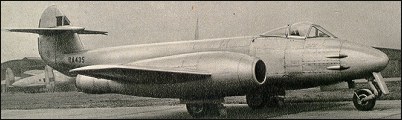
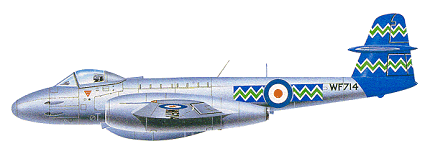
The Meteor was designed to meet Specification F.9/40, the first such British specification to be issued for a combat aircraft using turbojet engines. The eight original F.9/40 airframes were used to test several different types of British gas turbines including the Rover-built Power Jets W2B, the parent design of the Rolls-Royce Welland with which the Meteor I was fitted; the Metropolitan Vickers F.2/1, the first British axial-flow unit to fly (13 November 1943); the Halford H.1, the predecessor to the de Havilland Goblin; and the Rolls-Royce Trent, the first turboshaft engine to fly. Actually the 6530kg Halford-engined F.9/40 was the first version of the Meteor to fly (on 5 March 1943) as the W2B engines (4360kg) installed in another F.9/40 in July 1942 were not ready for flying until June 1943.
The first production version of the Meteor (the F.1) was powered by two 7400kg Rolls-Royce Welland 1 turbojet engines and had a cockpit canopy that was side-hinged. Only 20 of this first version were built, first going to No 616 Squadron, RAF and were used on operational sorties against German V-1 flying-bombs. The F.3 followed the Mk 1 into production and was the first quantity production version. The standard engines were two 8720kg Rolls-Royce Derwent Is, although the first 15 Mk 3s were fitted with Wellands. Sliding cockpit hoods were standard and provision was made for a long-range fuselage drop tank. The last 15 were fitted with the lengthened engine nacelles standardised on the Mk 4. A few were used operationally in Germany during the closing stages of World War II. The Meteor was the only Allied jet-propelled aircraft to go into operational service during this
war, but it never met a German Messerschmitt iVIe 262 in combat.
Post-war types began with the F.4, the first example flying on 12 April 1945. Power was provided by two Derwent 5 engines and the wing span was reduced to 11.33m to improve the rate of roll. Other features included long engine nacelles, pressure cabin, and fittings for bombs and rocket projectiles. An aircraft of this version set up world speed records on 7 November 1945 and 7 September 1946 of 975km/h and 991km/h respectively. The Meteor T.7 was a two-seat training version of the Mk 4, with the forward fuselage lengthened by 0.76m to accommodate tandem cockpits under a continuous canopy. No armament was carried. The first T.7 flew on 19 March 1948.
Many variants were built subsequently, including the F.8 (the major production version, first flown on 12 October 1948 and the only British jet fighter used operationally during the Korean War, flown by the RAAF), which established international point-to-point records on London-Copenhagen, Copenhagen-London and London-Copenhagen-London in 1950 and in the following year set up a new international speed record over a 1,000km closed circuit of 822.2km/h; FR.9 fighter-reconnaissance version of the Mk 8; PR. 10 unarmed version for high-altitude reconnaissance; NF.11 two-seat night fighter, the design of which was undertaken by Armstrong Whitworth and first flown in May 1950; and NF.12, 13 and 14 night fighters (night-fighter production by Armstrong Whitworth totalling 547 aircraft). British production of the Meteor totalled about 3,550 aircraft, more than 1,100 of which were F.8s. Conversions included the TT.20 high-speed target-towing Meteor and U.15, 16 and 21 radio-controlled drones developed by Flight Refuelling Ltd. Meteors were also exported in considerable numbers for service with the armed forces of Argentina, Australia, Belgium, Brazil, Denmark, Ecuador, Egypt, France, Israel, the Netherlands and Syria.
Gloster Meteor on YOUTUBE
Specification
CREW
1
ENGINE
2 x Rolls-Royce "Welland I", 7.6kN
WEIGHTS
Take-off weight
6260 kg
13801 lb
Empty weight
3690 kg
8135 lb
DIMENSIONS
Wingspan
13.1 m
43 ft 0 in
Length
12.6 m
41 ft 4 in
Height
4.0 m
13 ft 1 in
Wing area
34.7 m2
373.51 sq ft
PERFORMANCE
Max. speed
620 km/h
385 mph
Ceiling
15240 m
50000 ft
ARMAMENT
4 x 20mm cannons
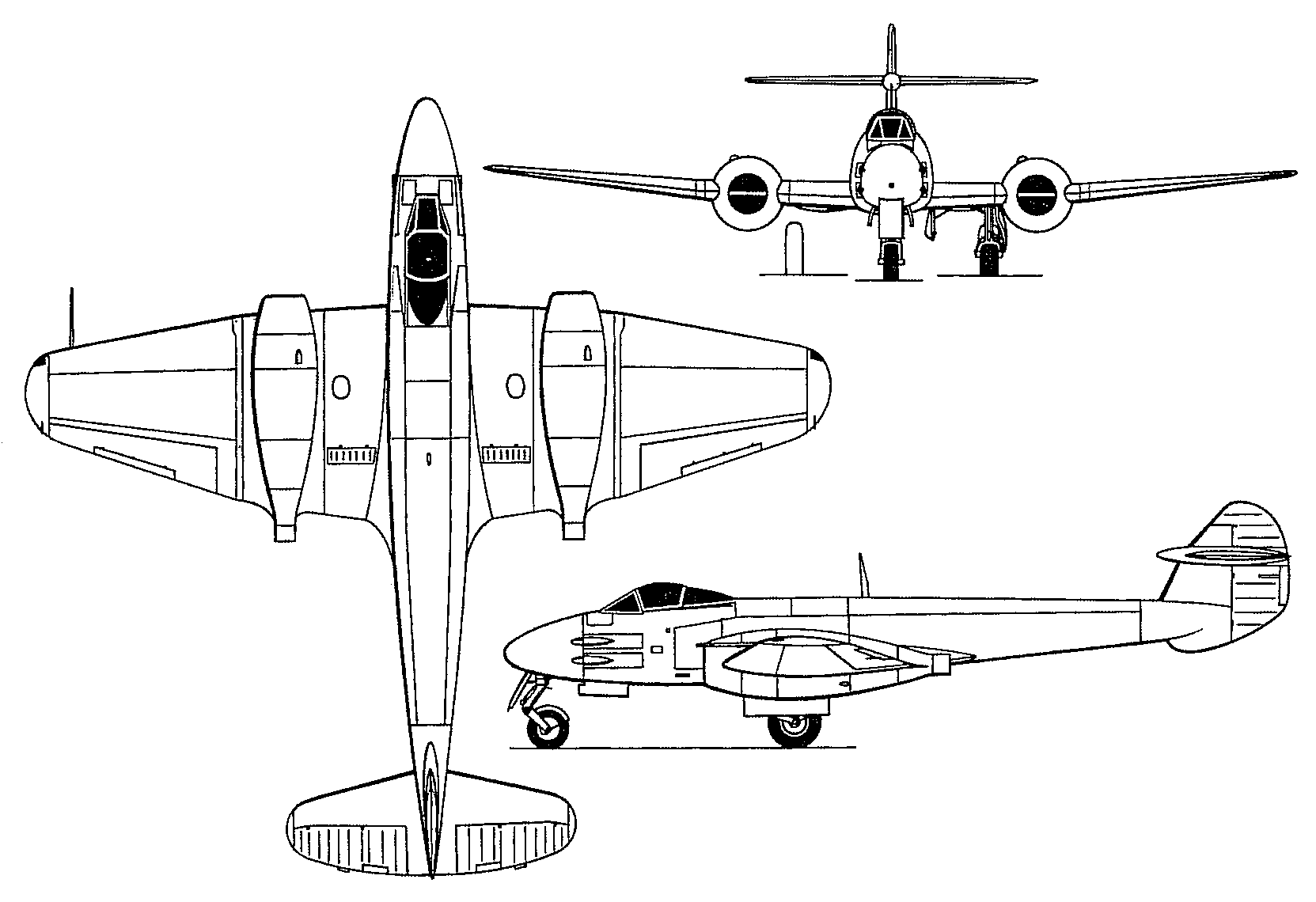
3-View
A three-view drawing (1663 x 1140)
Comments
pb smith, e-mail, 13.11.2015 06:46
In summer, 1957, during Int'l Air Cadet Exch visit to UK, received courtesy flight in Meteor T.7. No ejection seats. Engines started w / black powder charges.
I refer to the above quote by 'markski' regarding what Adolf Galland said about the Meteor. Galland did fly both types in his career and when interviewed for television in 1988 said despite some imperfections, he believed the Meteor superior to the Me262 in every way! He repeated this assertion a year later when recording his recollections of flying for a film released later by the History Channel.
Some of the last Meteors in RAF service carried on into the early 1970's at RAF Woodvale near Southport. Operated by No 5 CAACU, which stood for Civil Army Airforce Cooperation Unit. It was a hodgepodge of T7, F8 and TT20's used mainly for gunnery practice. My ATC squadron was based at Woodvale at the time so I was able to fly in the Meteor T7. No ejector seats, it was over the side, hope the tail doesn't hit you.
There were large numbers of Meteor Night Fighters in RAF service up to 1960.I flew the last Meteor NF11 to the MU at RAF Lyneham from No.5 Squadron at Laarbruch on August 16th 1960.This was the last Meteor night fighter sortie flown in the RAF (unless someone can say otherwise).
The Gloster Meteor Mark was the main equipment in RAF Fighter Command in the 195Os,when removed from service they wer modified to be used as target 'DRONES' for later equipment
Argentina purchased 100 Meteor Mk IV's in 1948. They were deployed in Tandil and Moron air bases. I'll never forget the wailng sound of its Rolls Royce Derwent or Nene turbojets, a sound I never herd on any other jet. As far as I recall the Argentine Meteors did not have eyectable seats.
THE FAMOUS GERMAN ACE ADOLF GALLAND SAID THE PERFECT COMBINATION WOULD HAVE BEEN THE ME 262 AIRFRAME & THE METEORS POWERPLANT. APPARENTLY HE HAD FLOWN THE METEOR IN ARGENTINA & HE SAID THE METEOR WAS PLEASENT TO FLY BUT HE BELIEVED THAT IF BOTH AIRCRAFT MET IN SKYS OVER EUROPE THE 262 WOULD HAVE JUST HAD THE EDGE ON THE METEOR.
The Mk 4 was well known as a brick-built s--thouse, replaced by the user friendly Mk 8. Those who flew them in the 1950s know of the "phantom dive" of the Mk 7 caused by stalling of the inner wing when flying asymetric. A number of pilots were lost. I saw a hybrid Mk 7 /8 at Farnborough in the 1990's built to counter this.