 |
Gloster Meteor (Prone Pilot)1954 |  |
| EXPERIMENTAL | Virtual Aircraft Museum / United Kingdom / Gloster |
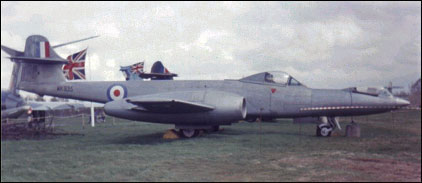 |
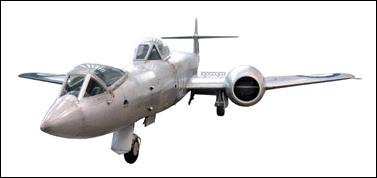
The increasing performance of combat aircraft in the postwar years saw aircrews subjected to greater and greater acceleration or g forces during manoeuvres. Reducing the distance that blood has to pump from the heart to the brain increases tolerance to g. Lying prone would theoretically give the pilot an edge in a dogfight. To test this concept for a proposed British rocket interceptor, a Meteor F.8 fighter was modified with an additional cockpit in a forward fuselage extended by 2.39m. A safety pilot remained in the notmal cockpit. Tests showed the prone pilot could indeed endure slightly more g, but suffered from vertigo, couldn't see very much - particularly behind him - and became tired quickly. After 55 hours of flight testing the idea was abandoned. FACTS AND FIGURES © In the event of an emergency on take-off or near landing, the nosegcar would have to be retracted before the prone pilot could slide backwards and open an escape hatch. © To balance the longer nose, the tail unit of a Meteor NF.12 night fighter was fitted. © The rudder was operated by moving the ankles on a foot bar, although this worked in the opposite direction to normal. The joystick was replaced by two short sticks. © The prone pilot had controls for almost everything except engine starting and the fuel system. The narrow fuselage meant a very small instrument panel.
|  COMPANY PROFILE | ||||||||||||||||||||||||||||||||||||||||

|


|