|
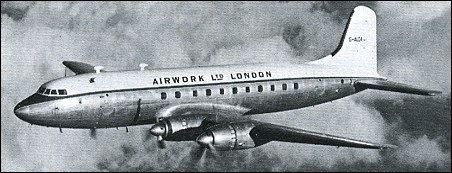
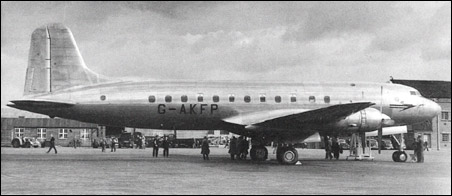
| The Hermes 4 was the first British post-war airliner built to modern standards to go into service; 25 were delivered to BOAC for use on its Commonwealth routes, services beginning in August 1950. Normal accommodation was for 40 passengers, but alternative seating arrangements provided for a maximum of 74. Originally powered by four 1,565kW Bristol Hercules 763 radial engines, all were subsequently re-engined with 1,583kW Hercules 773s and were thereafter known as Hermes 4As.
| MODEL | Hermes IV |
| ENGINE | 4 x Bristol Hercules 763, 1566kW |
| WEIGHTS |
| Take-off weight | 39000 kg | 85981 lb |
| Empty weight | 25100 kg | 55336 lb |
| DIMENSIONS |
| Wingspan | 34.44 m | 113 ft 0 in |
| Length | 29.51 m | 97 ft 10 in |
| Height | 9.14 m | 30 ft 0 in |
| Wing area | 130.80 m2 | 1407.92 sq ft |
| PERFORMANCE |
| Max. speed | 563 km/h | 350 mph |
| Cruise speed | 435 km/h | 270 mph |
| Ceiling | 7470 m | 24500 ft |
| Range | 3200 km | 1988 miles |
| Brian Emmerson, e-mail, 08.05.2026 18:38 yes i flew on a HERMES in january 1959 to SINGAPORE to join my ship H.M.S. ST.BRIDES BAY, this was a 4 day flight with only one stopover.from take off the pilot said lets have look at LONDON from the air, so we circled LONDON then the pilot said lets get going, till we came to PARIS where the pilot decided to circled PARIS before the pilot decided to start heading for SINGAPORE with 13 stops on the way, but what can i say more great flight out, then 18months out the far east causing every place we visited to make sure they remembered BRIDES BAY with a great deal of affection, from JAPAN, TO NEW ZEALAND and the MALDIVES reply | | tony Clarke, e-mail, 17.05.2022 04:59 My first flight was in an Airwork's Hermes. Flew from Aden to Khartoum, El Adem. Diverted to Luqa because of engine failure, Flew over the Empire Windrush on fire in the Med, landed at Blackbushe. Interesting first flight for a 7 year old. reply | | Mike Longhurst, e-mail, 06.05.2022 00:46 I flew to Singapore in mid 1954 and back in 1957. Out was with Skyways from Stanstead and back might have been Airwork. I had a sit in the captain's seat as we approached the first stop in Brindisi. Others out and / or back were Bagdad, Bahrain, where the heat hit us as they opened the door. Delhi overnight stop, Karachi. We were sprayed for bugs a couple of times. I loved the Hermes until I saw a BOAC Connie that we flew alongside after Bagdad for a while. I dreamed of being in that. Not only was it better looking, the BOAC passengers got favoured treatment all along the route. reply | | Gaynor Laight, e-mail, 14.09.2021 17:50 Flew to Singapore in 1958 from Blackbush. We went via Brindisi, Ankara, Baghdad, we should have gone to Basara but there was a heavy sandstorm, then on to Karachi, Calcutta and New Dehli. Not sure where but we got off the plane in India and they immediately fumigated it. We had several rough landings plus we were told the lights had to be switched off so we could take off - that might be a slight exaggeration as it was a long time ago! We did not stop after that until we arrive at Paya Lebar to be met by my father. Great experience and did not put me off flying. reply | |
| | John Henesy, e-mail, 12.02.2021 21:31 Flew from Blackbushe in March 1955 bound for Singapore. Had three attempts to take off and managed it on the third go. Got over France and had to turn back to Blackbushe due to 'technical problems'. Finally got off again and landed in Rome. From there to Nicosia in Cyprus where we were delayed for about 6 hours. Next stop Bahrain then Karachi where we stayed overnight. Then New Delhi and Calcutta, where we stayed overnight. Final stop was Bangkok before landing in Changi - about 24 hours behind schedule. Interesting experience for my first ever flight! reply | | John Walker, e-mail, 29.11.2020 00:38 I flew with my family in mid May 1956 (before the 21st) from Singapore to UK in an Airwork Hermes. The flight routed Paya Lebar-Bangkok-Calcutta-Delhi-Karachi (night stop)-Bahrain-Beirut-Brindisi (night stop)-Marseille-Blackbushe. I would love to identify the exact dates and the identity of the Hermes. The stop at Marseille was probably unusual and may help to pin point the details. reply | | Sarah Elizabeth Hymas, e-mail, 04.11.2020 13:05 Hi, I am interested in Handley Page HP.81 Hermes 4A (registration: G-ALDF) crash off Sicily on August 25th 1952. My two older sisters, then aged five and three, were aboard with my mother who was six months pregnant. Seven people lost their lives and survivors were rescued by a fishing boat from Trapani. I would love to hear from other survivors or perhaps family members of anyone involved. My email is sarahehymas@hotmail.com. Thanks. reply | | Patricia Redstone, e-mail, 03.07.2020 17:54 I noticed a message from Geoff Milner earlier in this thread regarding the incident involving G-ALDO landing at Paya Lebar 29th Oct. '57 when his mother was No.1 stewardess on the plane. Landing approx. 4pm local time in appalling weather, the plane overshot the runway into a ditch and tipped up - as Geoff Wills said earlier in this thread, great photo in the Straights Times the following day! I too was on this plane with my two children aged 2 and 3 flying out to join my husband stationed in Singapore with the RAF. We were in the rear-facing seats immediately behind the cockpit and I remember the pilot's distinguished handlebar moustache as he came through the curtain saying "Sorry about that, get out as quickly as you can!" We then made our way out the front RH door, first dropping my two small children down into the arms of Malay policemen, then I made my way down a knotted rope stepping into deep mud - the rain at the time was torrential! I've seen the photos in Straights Times but Geoff Milner mentioned he may have some additional photos and would be most interested to see them, together with the official accident report if anyone has it as I have not so far been able to find this online? Thanks in advance, Patricia reply | | Barry Redgate, e-mail, 10.05.2020 12:47 I was a technical officer in the project branch of BOAC and in April 1949 was the BOAC observer on the performance assessment carried out at Boscombe Down by order of HMG. We then took the aircraft to Castel Benito (now Tripoli) in Libya and then to Khartoum for high temperature trials. The pilot was the late Hedley Hazelden. The aircraft involved was the prototype Hermes I G-AKFP. reply | | Yvonne Hughes, e-mail, 08.05.2020 02:28 I flew back from Singapore aged 6 weeks on a Hermes born 30th September 1955, I am interested in this particular plane, my dad was in the R.A.F. at the time and said I attended the Ambassadors ball and stop in various places, he said he had a map of whete we stopped but can't find it, I would be interested to know where I went or should I say stop at along the way, would be greatful of any help with this, thank you, Yvonne Mann at the time . reply | | Yvonne Hughes, e-mail, 08.05.2020 02:28 I flew back from Singapore aged 6 weeks on a Hermes born 30th September 1955, I am interested in this particular plane, my dad was in the R.A.F. at the time and said I attended the Ambassadors ball and stop in various places, he said he had a map of whete we stopped but can't find it, I would be interested to know where I went or should I say stop at along the way, would be greatful of any help with this, thank you, Yvonne Mann at the time . reply | | Yvonne Hughes, 08.05.2020 02:28 I flew back from Singapore aged 6 weeks on a Hermes born 30th September 1955, I am interested in this particular plane, my dad was in the R.A.F. at the time and said I attended the Ambassadors ball and stop in various places, he said he had a map of whete we stopped but can't find it, I would be interested to know where I went or should I say stop at along the way, would be greatful of any help with this, thank you, Yvonne Mann at the time . reply | | Barry, e-mail, 05.01.2018 13:16 For James Talbot. James I live in a house once owned by Gerrard Fane who I think was a friend of your Dads. I have some artefacts that I am certain belong to your father that were here when we moved in. Hoping you see this! reply | | Barry, e-mail, 05.01.2018 12:57 For James Talbot. James I live in a house once owned by Gerrard Fane who I think was a friend of your Dads. I have some artefacts that I am certain belong to your father that were here when we moved in. Hoping you see this! reply | |
| | denis arthur stafford, e-mail, 01.05.2017 19:30 I flew back from Singapore in 1956, we had overnight stays at Karachi then a day delay in Calcutta due to problems then a stay in Brindisi before landing at Blackbushe.
it was a bumpy flight due to the weather conditions.It was the first time most of us had flown. reply | | Guy Ayling, e-mail, 06.01.2017 12:26 Message for James Talbot. I am Headmaster of Llandovery College where your late father was a pupil. We are constructing a timeline of eminent Old Llandoverians and I was hoping you might have a picture of him. Please contact me on warden@llandoverycollege.com
Diolch yn fawr. reply | | George adams, e-mail, 16.07.2016 06:09 G-ALDT if I remember right reply | | George adams, e-mail, 16.07.2016 05:18 September 1951
First airliner flight for me aged 11.
Off to school in England
Route Nairobi Entebbe Khartoum at night, Cairo ditto, Rome dawn, then Cool London.
What an introduction to a life in aviation!!! reply | | David N J Manning, e-mail, 07.06.2016 22:13 Correction: It was the end of 1954 . reply | | David N J Manning, e-mail, 07.06.2016 22:12 My mum , brother and I (age 6 ) flew to Dar es salaam at the end of 1956 , I remember being airsick for the entire flight , 2 days .Landed at Rome;Bengazi:Cairo;Khartoum;Entebe and Dar.Don't think we went to Nairobi.Almost put me off flying for life! But I think it must have been one of the last BOAC flights for the Hermes . I think the airoplane's name began with S . reply |
|
Do you have any comments?
|
| 
COMPANY
PROFILE
All the World's Rotorcraft
|