|
| First flown in prototype form in mid-1930, the Heyford was the last of the RAF's long-range biplane night bombers. It was powered in Mk I form by two 391.2kW Rolls-Royce Kestrel III engines and in the Mk II and Mk III by 428.5kW Kestrel VI. The Heyford was an equal-span biplane with staggered wings: the upper wing centre-section rested on top of the fuselage, while the lower was positioned well below the fuselage, connected to the under-fuselage by N-type struts. The inner interplane struts supported the engine mountings. An interesting feature of the design was that bombs of various sizes were carried inside the thickened centre-section of the lower wing, each bomb being carried in a separate cell closed by spring doors. The fixed landing gear comprised two large wheels faired into the lower wing.
A total of 124 Heyfords were built, made up of 38 Mk I and IA, 1 intermediate Mk IA/II, 16 Mk II and 71 Mk Ill - these figures being adjusted to take into account changes made from the original production orders. Heyfords served with heavy-bomber squadrons from 1933 to 1939, giving way to more modern monoplanes of World War II-type.
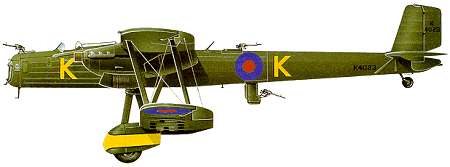
| MODEL | Heyford Mk IA |
| ENGINE | 2 x Rolls-Royce Kestrel IIIS, 429kW |
| WEIGHTS |
| Take-off weight | 7610 kg | 16777 lb |
| Empty weight | 4580 kg | 10097 lb |
| DIMENSIONS |
| Wingspan | 22.9 m | 75 ft 2 in |
| Length | 17.7 m | 58 ft 1 in |
| Height | 5.3 m | 17 ft 5 in |
| Wing area | 136.6 m2 | 1470.35 sq ft |
| PERFORMANCE |
| Max. speed | 229 km/h | 142 mph |
| Ceiling | 6400 m | 21000 ft |
| Range | 1480 km | 920 miles |
| ARMAMENT | 3 x 7.7mm machine-guns, 1580kg of bombs |
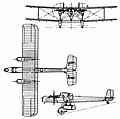 | A three-view drawing (690 x 684) |
| Fred, e-mail, 02.12.2021 11:06 Was there any difference in speed or range between the MK I and the MK III? Since the mark three had much more horsepower.
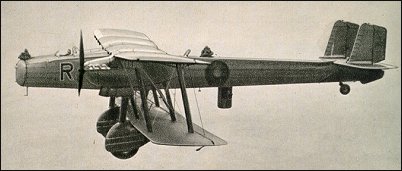
I was stationed at RAF Mildenhall (76-78) and RAF Alconbury (81-84) reply | | l chenery, e-mail, 03.05.2012 23:10 my uncle flew these from mildenhall in the thirties reply | | Barry, 21.02.2011 16:38 The aircraft in the photograph is a MkIA of 99 squadron one of eleven squadrons to be equipped with this aircraft. When first flown it was some 50% faster than existing bombers in RAF service. It was appreciated by it's crews for it's docile handling but as noted above it was gradually withdrawn from use from 1937 onwards when more modern types began to appear. reply | | Richard Beattie, e-mail, 03.07.2010 22:44 It was described as pleasant to fly - an aeroplane to go to lumch in but not to war. reply | |
| | Richard James, France, e-mail, 13.11.2009 13:11 I believe that the Heyford was the first aircraft to leave a trace on the oscilloscopes of the experimental 'RDF', Radio Direction Finding (now Radar) test equipment. Mid 1930's? reply | | Chief ROK, e-mail, 11.02.2009 07:39 One bit of trivia. The Heyford is the only aircraft named after an air base: RAF Upper Heyford, Oxon. According to the museum that is on that now closed base, it was one of the bases the Heyford called home. I served at RAF UH 1965-67 (Dispersal base; then RF-101s) and again 1984-87 (F-111Es). reply |
| WinstonBrittanica, e-mail, 26.05.2008 10:10 Thanks for featuring this fascinating aircraft - particuarly for the 3-view - after some searching, this is the only site that has one. (If you know of a "blueprint" (sort of a 3-view with cross-section shapes, designed for modelling the aircraft) I would really appreciate it.)
An integuing aircraft - one that would have been good if WWI had continued into 1919, say. Also a really integuing appearance - a giant biplane bomber. reply | | bittu saxena, e-mail, 14.05.2008 19:45 well this is an anicent plane and its a really good aircraft, with good range and good wepons which are enough good for that time war scenrio this aircraft must gave an edge to their army to enemy. reply | | john robson, e-mail, 19.01.2008 01:51 My uncle as a young officer flew in this aircraft in a training exercise on a bombing raid on london in February 1936, in atrocious weather conditions. He was killed when the plane struck Telegraph hill near Petersfield in Hampshire. reply |
| Dave Moore, e-mail, 27.08.2007 17:11 A good photo which clearly shows the ventral dustbin gun position not mentioned in the text. A defensive that later bombers gave up, except the well known American Fortress.
Great site have enjoyed looking through it reply |
|
Do you have any comments?
|
| 
COMPANY
PROFILE
All the World's Rotorcraft
|


 john robson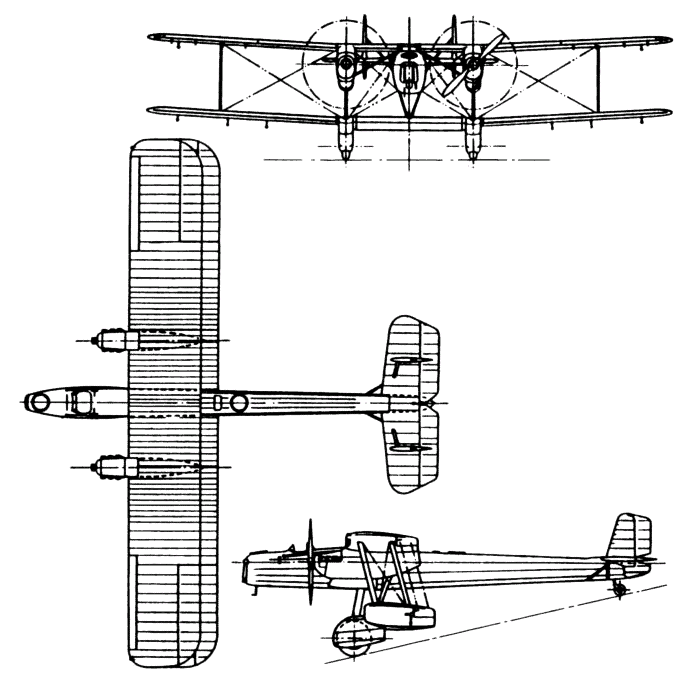


Fairey Hendon?
reply