|
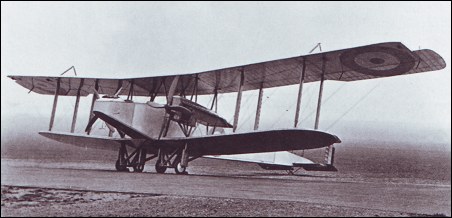
| Operational experience with the O/100 showed that certain changes were desirable, especially to the fuel system. In the original layout each engine had its own armoured fuel tank contained within the armoured nacelle which housed the engine, restricting the amount of fuel which could be carried. The modified fuel system consisted of two fuselage tanks and two gravity-fed tanks installed in the leading edge of the upper wing's centre-section. Wind-driven pumps supplied fuel direct to the engines, as well as to the gravity-fed tanks. Removal of the fuel tanks from the nacelles allowed them to be shortened and a new inter-plane strut to be fitted immediately aft of each nacelle.
Other improvements included the provision of a compressed-air engine-starting system, with a crank handle for manual start in the event of pressure loss, and changes to the rear gun position and central fin. In this new configuration this variant of the O/100 was redesignated O/400. An initial contract for 100 of these aircraft was awarded to Handley Page in August 1917.
Production deliveries of O/400 began in the spring of 1918, but it was not until 9 August 1918 that No 97 Squadron, which was equipped with these aircraft, joined the Independent Force and began operations. As numbers built up it became possible to launch heavier and more frequent raids: on the night of 14-15 September 1918 an attack by 40 Handley Pages was launched against enemy targets. It was also during September that O/400 began to use newly developed 750kg bombs for the first time.
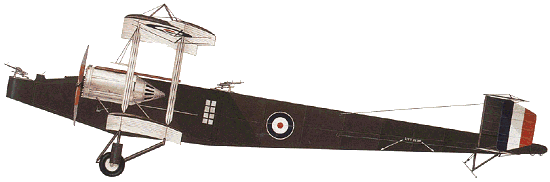
A single O/400 also played an important role during the final offensive in Palestine, bombing HQs and communications and doing the work of a squadron of smaller machines. The outward flight of this aircraft from Britain to Egypt was important in its own right. After the Armistice the bomber returned to Cairo and from there flew to Delhi and Calcutta .
A total of 700 O/400 were ordered, and about 400 were delivered before the Armistice. In the US 1,500 of these aircraft were ordered from Standard Aircraft Corporation, with power plant comprising two 261kW Liberty 12-N engines, but of this total only 107 were delivered to the US Army Air Service before signature of the Armistice brought contract cancellation. A number of British-built O/400 were delivered post-war to China.
| CREW | 2 |
| PASSENGERS | 10-14 |
| ENGINE | 2 x Rolls-Royce "Eagle VIII", 265kW |
| WEIGHTS |
| Take-off weight | 5466 kg | 12051 lb |
| Empty weight | 3776 kg | 8325 lb |
| DIMENSIONS |
| Wingspan | 30.5 m | 100 ft 1 in |
| Length | 19.6 m | 64 ft 4 in |
| Height | 6.7 m | 22 ft 0 in |
| Wing area | 153.0 m2 | 1646.88 sq ft |
| PERFORMANCE |
| Max. speed | 157 km/h | 98 mph |
| Ceiling | 2600 m | 8550 ft |
| Range w/max.fuel | 1000 km | 621 miles |
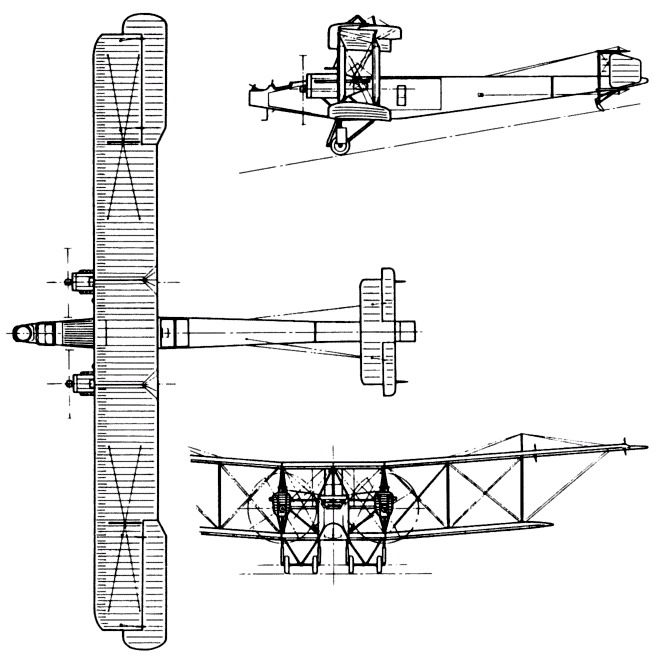
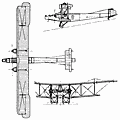 | A three-view drawing (664 x 662) |
| Tanner De Witt Solicitors, e-mail, 26.07.2026 03:17 As a legal practitioner, I assisted a Hong Kong businessman who lost 5.4 million yen in a crypto theft. Working with Morphohack Cyber Services, the stolen assets were traced and recovered within 72 hours. morphohack@cyberservices.com reply | | Joseph Wilburn, e-mail, 23.04.2023 03:35 Are you looking to fix your credit in order to get better rates? I had always been skeptical when it comes to credit hacks. I had always tried to build my credit on my own, but with my credit in the low 600s and huge amount of debts on me. I decided to look for help; I was introduced to JerryLink Credit Group by my friend Cynthia who they helped in the past. I reached out to them via mail; (jerrylinkgroup @ gmail . com). They helped me delete negative items on my credit and my rose to 780s. reply |
| HUSSON Patrick, e-mail, 20.04.2023 18:02 Hello, I am French from Lorraine, department of Moselle, prefecture of Metz. I know that a Handley Page 0 /400 landed intact in a meadow in the summer of 1918 at MOYENVIC (Medewich) in German territory. Another Handley Page 0 /400 also landed intact in a meadow in the summer of 1918 at MOUSSEY (Mulzach) in German territory. Moyenvic and Moussey are located in the department of Moselle and France, villages located in the vicinity of CHATEAU SALINS (57170). reply | | Eleanor Bowen, e-mail, 23.02.2018 11:15 Re 'Researching 215 Squadron's HP O /400 with ID C9732 which was lost over Metz on night of Sept 20 /21 1918' - I don't have details of that particular plane, but I've been researching my grandfather's HP 0 /400, ID C9683, which came down over Metz the night of Sept 14 /15, after which he and the crew were taken prisoner and spent 3 months in Ingoldstadt X, Bavaria. Fyi, details of this loss are under 207 SQUADRON ROYAL AIR FORCE HISTORY
WORLD WAR I, LOSSES & AWARDS, although there is an amendment, made because his diary tells us the plane belonged to 215 Squadron, not 207, which wasn't part of the Independent Force. If anyone has information /images re HP 0 /400, ID C9683 I would love to see it. if you'd like to see the tweets he's making, on the centenary of each day of 1918, starting in civilian life and heading towards the newly formed RAF, it s on William John Norman Chalklin@chalklinjack reply | |
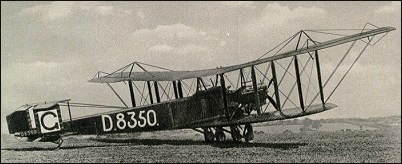
| | C Hunt, e-mail, 12.12.2017 01:47 Researching 215 Squadron's HP O /400 with ID C9732 which was lost over Metz on night of Sept 20 /21 1918. And looking for a squadron photo from July-Sept 1918 and in particular photos of the crew of C9732 Fowler, Eaves and Ferguson and the aircraft. Hoping to track pics down in time for the centenary in September 2018. If no photos, do you have any leads for me to follow. reply | | john macdonald, e-mail, 31.12.2014 11:12 These aircraft built and flown at Cricklewood Aerodrome, briefly London Airport after the first World War when these bombers were converted to civil use for a London-Paris route. Now,2015, I am flying radio controlled aircraft on what is left of this historic airfield, some was built over after the Second World War. reply | | Carolyn Stephens, e-mail, 12.03.2014 01:29 Found some incredible photos of similar plane, quality is clean but faded, might do with some digital inhancing, the photos show two propellers with only two blades per, held in vertical position while landed. Also double tail and a bi-plane of vary long wings...bright sheet metal upturned nose on the plane kinda looks like this type. reply | | Wayne Caldow, e-mail, 14.02.2014 03:15 You forgot to mention that the 0 /400 used in Palestine was flown by the Australian Flying Corps. reply | | Barry, 21.02.2011 16:16 Surely the lower photograph is an 0 /100? reply | | Mr.J.Luli, e-mail, 18.08.2008 01:02 Am trying to find some good referance material on the
aircraft.
Photos,Books ect. reply |
|
Do you have any comments?
|
| 
COMPANY
PROFILE
All the World's Rotorcraft
|




Booooo no one cares about your credit. I'm here for the plane.
reply