|
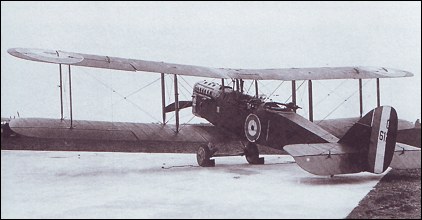
| The DH.9 entered service with No 103 Squadron RFC at Old Sarum, Wiltshire, in December 1917, and became operational with No 6 Squadron in France in the following March. Fitted originally with a Beardmore engine, the
aircraft proved to be underpowered and its performance was inferior to that of the DH.4, on which its design was based and which it was intended to replace. Engine failures were rife, and fuel consumption above 3050m was a
staggering 15 gallons per hour. Once the DH.9 was re-engined with the Packard Liberty motor, however, it became an entirely different aircraft.
RAF squadrons in France began re-arming with the new variant -
designated DH.9A - in August 1918, and the type played an important part in the Allied bombing offensive until the end of World War I. Afterwards, RAF DH.9A squadrons performed a vital policing role in the British-
controlled territories in the Middle East and India throughout the 1920s. Many DH.9s were converted for civilian air transport use.
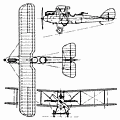 | A three-view drawing (644 x 644) |
| CREW | 2 |
| ENGINE | 1 x 420hp Packard Liberty 12 V-type engine |
| WEIGHTS |
| Take-off weight | 2107 kg | 4645 lb |
| DIMENSIONS |
| Wingspan | 14.01 m | 46 ft 12 in |
| Length | 9.22 m | 30 ft 3 in |
| Height | 3.45 m | 11 ft 4 in |
| PERFORMANCE |
| Max. speed | 198 km/h | 123 mph |
| Ceiling | 5105 m | 16750 ft |
| ARMAMENT | 2-3 x 7.62mm machine-guns, 300kg of bombs |
| Martyn Spiers, e-mail, 17.03.2017 21:00 Hi,
I'am the great nephew of Thomas Martin Phillips and was named after him. I'm planning to visit the grave of Lt TM Phillips on the anniversary of his death next year, I would love to know any information about him and the flight observer who was killed in action with him.
Regards
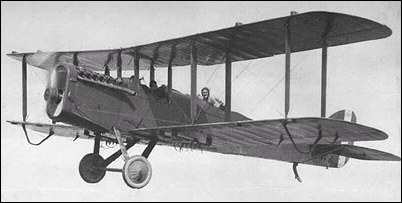
Martyn. reply | | Gary, e-mail, 17.02.2016 07:57 Just wanted to say "Thank you" for clarifying the main differences between the DeHavilland DH-4 & DH-9. Really helps. reply | | Robert Guttman, e-mail, 03.08.2010 17:26 The bottom photo is neither a DH-9 nor a DH-9A, it is actually a DH-4. The key difference is the wide space between the cockpits, with the pilot's cockpit located between the upper and lower wings.
The space between the two cockpits on the DH-4 was occupied by the main fuel tank. It's presence created two operational disadvantages. The pilot's view above and below was hampered by the wings, and communication between the two crew members was difficult.
The DH-9 was designed to alleviate those problems by exchanging the positions of the fuel tank and pilot's cockpit. That placed the pilot a little behind the wings, where he could see better. He was also in close physical proximity to the observer, so that they could cooperate more effectively. reply | | michael j williams, e-mail, 10.05.2010 20:22 hi,
i have a death plaque to a pilot who flew 31 missions during 1918 in france his name lt thomas martin phillips his flights were with aircraft number 5572, he was killed shot down by a pilot from jasta 52 sowa, his observer also died .i would love a very good picture of a dh9 and dh9a for my collection any help please.
regards mike reply | |
| | Barry, 15.09.2009 17:47 I think you are right Dan, just as the photo on the DH9A site is of a DH9 rather than a DH9A! reply | | dan, 19.12.2008 07:59 I think that the photo shows a DH-9A with US Liberty engine, rather than a DH-9 reply |
|
Do you have any comments?
|
| 
COMPANY
PROFILE
All the World's Rotorcraft
|