|
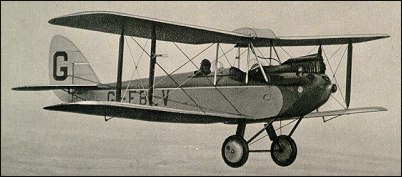
| It is not overstating the case to say that the Moth revolutionised aviation and was a direct result of the worldwide surge of enthusiasm for private flying. Although the Humming Bird offered a measure of realistic sport flying, it was too basic to meet the requirement, and yet the D.H.51 was too large. The answer was somewhere between the two and the D.H.60 appeared in 1925 as a scaled-down D.H.51 with an 89.4kW engine cut in half, reworked and completed as a 44.7kW ADC Cirrus.
First flown on 22 February 1925, the Moth exceeded expectations and a long series of tests proved that it was eminently suited for school, flying club and private use: it was selected by all the British Flying Clubs formed under the Air Ministry scheme. In addition to the home markets, many civil examples were exported and military models delivered to air forces as tandem two-seat trainers, including those of the UK, Australia, Irish Free State, Sweden, Finland, Japan and Canada.
By the close of production nearly 500 Moths had been built, excluding those licence-built in Australia, Finland and elsewhere. Other engines fitted included the 63.3kW Cirrus II, 67kW Cirrus III (as installed in the D.H.60X) and 56kW Armstrong Siddeley Genet (as the Genet Moth).
The first Moth was flown by Alan Cobham from London to Zurich and back in a single day on 29 May 1925; and in 1927 Moths accomplished the London-Cape Town return flight and won the first prize for aerobatics at the Copenhagen International aeroplane meeting. However in 1928 de Havilland produced their own engine for the Moth, the Gipsy, and so the Gipsy Moth was created.
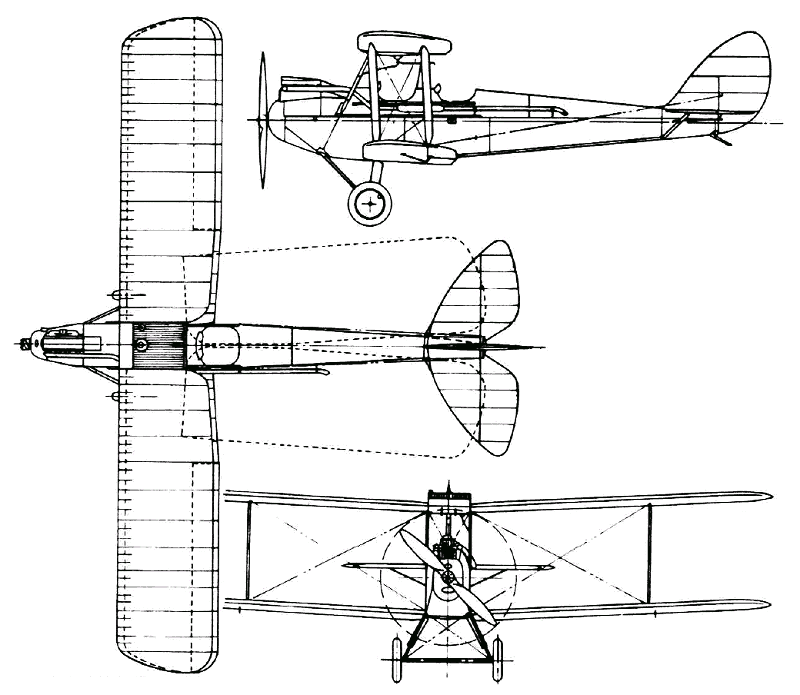
 | A three-view drawing (800 x 695) |
| MODEL | D.H.60G Gipsy Moth |
| ENGINE | 1 x de Havilland Gipsy I inline piston engine, 75kW |
| WEIGHTS |
| Take-off weight | 748 kg | 1649 lb |
| Empty weight | 417 kg | 919 lb |
| DIMENSIONS |
| Wingspan | 9.14 m | 30 ft 0 in |
| Length | 7.29 m | 24 ft 11 in |
| Height | 2.68 m | 9 ft 10 in |
| Wing area | 22.57 m2 | 242.94 sq ft |
| PERFORMANCE |
| Max. speed | 164 km/h | 102 mph |
| Cruise speed | 137 km/h | 85 mph |
| Ceiling | 4420 m | 14500 ft |
| Range | 515 km | 320 miles |
| maxmwill, e-mail, 21.07.2012 08:12 I'd like to see a three-view of the Genet Moth, as this was an interesting variant of the type. reply | | Dave Bradley, e-mail, 02.08.2011 18:01 Hello All, my Dad, Barry Bradley owned CJC in the summer of 1953 in Winnipeg, Manitoba. He towed the first glider out of Stevenson Field (Winnipeg International) with that aircraft August 3rd, 1953. Since then, with various other aircraft, Citabria, Scout, L-19 etc he has made 6242 tows and logged over 1900 hrs. reply | | G. Mac, e-mail, 20.06.2011 05:30 Thanks Andy W for getting my ancient history squared away here! I flew with my Dad and also with an uncle who was a fighter pilot in WW11 and Korea and who flew like one! I'm indeed lucky. Some memorable flights. reply | | Kenneth Ball, e-mail, 18.02.2011 03:37 This is a great web site. As an apprentice at De Havilland 1949-54 I helped overhaul GELBV a DH60 moth at the London Aeroplane Club at Panshanger near Hatfield. At that time it was the oldest flying aircraft on the UK civil register. We also overhauled a Huck starter used in WW1 and now in the Shuttleworth collection. reply | |
| | Andy W, e-mail, 20.11.2010 19:56 G Mac they are differebt aircraft the Tiger Moth you flew in is the DH 82 with a later fuselage and altered wings from the DH 60 amongst other things but developed from the Moth. The DH 71 Tiger was a monoplane a light racer built in small numbers the name being applied later to the much modified aircraft you flew in ----- I envy you your flight reply | | G. Mac, e-mail, 08.10.2010 06:57 in the 1940's - 1950's as a kid I flew in one of these as a passenger - up front. We called this aircraft Tiger Moth not simply Moth. I see a monoplane here as a Tiger Moth. I'm old and easily confused! Anybody know what gives namewise? reply | | tommy, e-mail, 06.10.2010 05:30 hey ned, just to set it strait it was definatly a tiger moth,cf-cjc dh82c ser 5171 three guys out drinkin and flying in the dark,one in the back and two in the front.they got cold and yes cjc was lost, i saw what was believed to be the prop years later that a local diver had recovered from the harbour,reverse pitch gypsy major's went opposite direction from other engines, dad got a week suspension fer impaired flying ...imagine that. reply | | Ned Gulbran, e-mail, 16.09.2010 07:39 Sorry, I misspoke in my comment below. It was a Gypsy Moth. reply | | Ned Gulbran, e-mail, 16.09.2010 07:34 I saw a Tiger Moth on floats at Prince Rupert, B.C. in June of 1958. We heard later that the young man who flew it crashed in the harbour. He survived, but the plane sank.
I remember that the airspeed indicator was a pivoting paddle with a spring on it mounted on the struts. reply | | Ad, e-mail, 02.12.2009 18:03 Hello Martin,
Do you know where the G-AAMY is based at the moment?
Regards
Ad reply | | vermeulen martin, e-mail, 15.10.2009 21:53 Dear Paul,
The Gipsy Moth in the movie is the G-AAMY.
According to the flight log it's a D.H.60GM.
At this moment the engine gets 4 new cylinderheads
yours sincerely reply | | Kenneth Paul, e-mail, 27.08.2009 19:03 I'm looking for info about the Moth shown flying in the 1985 movie, "Out of Africa." It shows Registration marks G-AAMT, and British CAA records indicate this reg was issued Sep 16, 1930, and "lapsed" (destroyed?) in Nov, 1930. I have no doubt that the movie producers may have selected a lapsed registration mark so the actual aircraft shown would not be traceable, but all I'm looking for is the TYPE of the actual aircraft: is it in fact a DH 60X, as G-AAMT originally was? I want to build an exact replica model in 1 /16 scale. reply | | Matthew Good, e-mail, 12.11.2007 01:50 In reply to the message above, I would be very interested to know what it was that he flew in the RIAF. reply | | Aladdin, e-mail, 07.11.2007 15:38 Hi . a very interesting website and a useful A /C museum . As an old pilot of the late Royal Iraqi Air Force . when I look at the pictures of the Gipsy moth , I remember at once the cration of the RIAF . It's 5 pilots flew a formation of puss moth and gipsy mothes to Iraq , arriving to Baghdad after 15 days trip from London on the 22 April 1931 , thus making that day the birthday of the 1st modern Arab air force . Alas this Air force was destroyed totally and disbanded after the 2003 war against Iraq , which toppled Saddam's regime . A new air force is created now , which retains its birthday as 22nd of April 1931 . let us hope it will be worthy of carrying on the old IAF traditions and history reply |
|
Do you have any comments?
|
| 
COMPANY
PROFILE
All the World's Rotorcraft
|