|
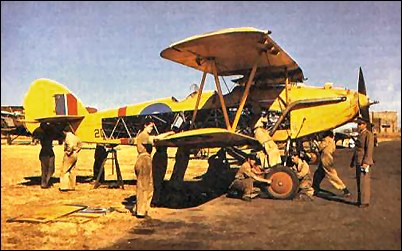
| The outstanding performance of the Fairey Fox day bomber, undoubtedly came as something of a shock both to Fairey's competitors and the Air Ministry. As a result the Air Ministry Specification 12/26 for a new light bomber required an improvement upon the performance of the Fox.
Hawker's submission for this requirement, which eventually became known as the Hart, was evolved in conjunction with Rolls-Royce, and when submitted in late 1926 proved sufficiently attractive for construction of a prototype to be authorised. Sidney Camm's design utilised what became known in later years as 'Hawker's patent metal construction system', a lightweight and robust structure with fabric covering. From Rolls-Royce came a new engine - known then as the F.XI, a development of the Falcon engine -which had weight-saving six-cylinder monoblocs instead of individual cylinders.
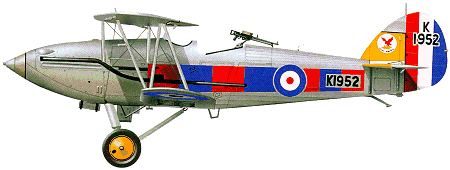
The airframe design was that of an uncluttered single-bay biplane, the fuselage nicely streamlined, very much a conventional Hawker tail unit, and robust fixed landing gear with tailskid. The biplane wings were of unequal span, the lower wing of constant chord and with a straight leading edge. The upper wing, however, was slightly swept back - a useful recognition feature - and incorporated the ailerons and Handley Page leading-edge slots.
The prototype was flown for the first time in late June 1928 in the hands of Flt Lt Bulman and was subsequently flown in competitive evaluation against the Avro Antelope and Fairey Fox II. With superior performance of the Hart confirmed, 15 pre-production aircraft were ordered initially for development and familiarisation, and the first 12 of these entered service with the RAF's No 33 (Bomber) Squadron in late 1929 or January 1930 and one was sent for trials in India. Once again, as with the Fairey Fox which was introduced into service in 1926, a new day bomber was to cause acute embarrassment to the fighter squadrons.
In RAF service the Hart was to prove itself one of the most adaptable aircraft of its era, resulting in a number of variants. These included the Hart Trainer (483 built, not including conversions of other models); Hart C communications aircraft; and tropicalised versions known as the Hart India and Hart Special. A version was built for the Royal Navy, serving both with wheeled and float landing gear, and this was designated Hawker Osprey. In addition Harts were built for overseas customers which included Estonia, Sweden (also licence-built 42 Pegasus-engined Harts) and Yugoslavia, while ex-RAF aircraft eventually went to South Africa, Egypt and Southern Rhodesia.
Harts remained in service with the RAF on the North-West Frontier in India until displaced by Bristol Blenheims in 1939. Some Royal Navy Ospreys were used for target towing and training until 1940, but so far as is known the last in operational service was a Hart used by the South African Air Force well into World War II. Most extensively built between-wars British military aircraft, a total of 952 had been constructed when production ended in 1937, with Armstrong Whitworth, Gloster and Vickers acting as sub-contractors.
Hawker records also refer to a civil-registered Hart, first flown on 15 September 1932 and known as the Hart II. This was powered in succession by a Kestrel IIS, Kestrel VI and Kestrel XVI, with the latter having an all-up weight of 2,109kg. It was used for demonstrations at air displays and for taking air-to-air photographs of Hawker aircraft, accumulating 627 flying hours in these roles from August 1933.
| CREW | 2 |
| ENGINE | 1 x Rolls-Royce Kestrel XDR, 380kW |
| WEIGHTS |
| Take-off weight | 2066 kg | 4555 lb |
| Empty weight | 1148 kg | 2531 lb |
| DIMENSIONS |
| Wingspan | 11.35 m | 37 ft 3 in |
| Length | 8.94 m | 29 ft 4 in |
| Height | 3.17 m | 10 ft 5 in |
| Wing area | 32.33 m2 | 348.00 sq ft |
| PERFORMANCE |
| Max. speed | 296 km/h | 184 mph |
| Ceiling | 6510 m | 21350 ft |
| Range | 756 km | 470 miles |
| ARMAMENT | 2 x 7.7mm machine-guns, 230kg of bombs |
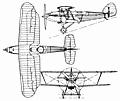 | A three-view drawing (688 x 578) |
| Tony Moor, e-mail, 21.09.2012 19:12 The aircraft at Ticehurst was a Hawker Hind of 21 Squadron
based at Lympne serial No.K5388. I am writing a book on Lympne
if anyone can add to information please contact mr=e.
I am also looking for a photo taken of this crash. reply | | J>Russell, e-mail, 09.05.2012 16:02 Our museum has a photo (WW 2) of a hawker biplane serial No.W 3053- last figure unclear. Can anyone give info.on this aircraft. The serial seems unusual. reply | | Evan, e-mail, 01.04.2011 09:32 My dad was in the SAAf and flew in Hawker Hartebeests during WW2 as a radio operator / tail gunner. They were actively used during the East Africa campaign as far north as Abysinnia. He raved about their versatility and how robust they were. Very reliable and much loved by the aircrew. reply | | allan Perera-Liyanage, e-mail, 08.12.2010 11:15 Is it possible to get some information about the Hawker Hart that was named 'City of Edinburgh'?. Most appreciated if the registration numbers and any other markings are also included. Thanks reply | |
| | J.Willis, e-mail, 23.11.2010 01:02 I have a black and white photograph of my brother sitting in an aircraft which I believe to be a Hart India. This taken on the Northwest Frontier, late 1942 /early1943. Anyone aware of the likelyhood of this please contact me. reply | | MARCELO PRICOLI, e-mail, 22.06.2010 13:22 amazing information here!! iam starting build my model of hawker hart se it at hippocketaeronautics(point)com
thanks all for the information!
marcelo pricoli reply | | M Oswin, e-mail, 08.07.2010 16:48 For interest I have a photo taken circa 1939 /40 of my father and another serviceman in front of a Hart number K2641. regretfully most of the plane is covered by its tarpaulin.m I have been unable to confirm where the plane and my fathers squadron were stationed at the time reply | | marcelo pricoli, e-mail, 18.05.2010 02:24 hi all, iam building now a ff scale hawker Hart.
please need pictures of the interiors, instrument panel , gun machine allocation, etc.
if anybody have a decent pictures please send me !!!!!!!
where i can see color squemes for my hart???
thanks all reply | | Geoffrey White, e-mail, 16.04.2010 19:28 Does anyone have information regarding a Hawker Hart shot down by an enemy aircraft in July, 1940, after taking off from Old Sarum RAF Aerodrome in Wiltshire ? Two man crew, rear cockpit armed with single machine gun, may have been in use as communications aircraft or trainer. reply | | Luis M. Moreno del Rivero, e-mail, 11.12.2009 18:23 Magnifico aparato. Me habria gustado pilotar uno- reply | | Les Palmer, e-mail, 14.04.2009 21:56 The South African Air Force Hawker Harts were called Hawker Hartebeests. My dad flew them as a student pilot just prior to the Second World War in the South Africa. I have some old 'photo's of a squadron of them in SA. If I remember correctly, they flew from Dunottar or Palmietfontein? reply | | Les Mills, e-mail, 03.02.2009 19:28 Does anyone know how I can track the number K 5388. Supposedly a Hawker aircaft, which flew from Lympne and crashed on Ticehurst, Kent before WW2.
Grateful for any info,
Regards
Les reply | | Ray Leach, e-mail, 30.06.2008 13:37 In July 1930 a Hart was sent to No 16 Squadron, which was attached to the School of Army C0-0peration at Old Sarum. The stated purpose was 'for tests and trials'. As the squadron eventually was re-equipped with the Audax, I assume that they found the Hart unsuitable - or do you know better ? reply | | John Talbot, e-mail, 19.01.2008 14:50 The South African Air Force Harts were called Hawker Hartebeests, according to accounts that I have read. reply | |
| | Roy Tassell, e-mail, 31.08.2007 20:26 At least 2 Rolls Royce engined Harts which were float equiped were supplied to Sweden (i have photos of both). If there were any more float versions i would like to know. Cheers Roy. reply | | norman atkinson, e-mail, 15.08.2007 11:17 I have been trying to get a photograph which appeared long before the last war. It was- I believe- called the Bombing of Port Hendon( Yes) with Hart or variants attacking what appeared to be the Grahame White Co Hangar.
OK, it was a staged attack with oily smoke etc.
I know that Heyfords did a similar thing much earlier.
It is creepy, but I have a record of a crash situation which occurred on the 21st April 1949. You see, I was there!Almost identical.
Bonkers? Not a bit of it- the plaque to the actual crash is in the Peel Room over the road in 'Met'. reply |
|
Do you have any comments?
|
| 
COMPANY
PROFILE
All the World's Rotorcraft
|