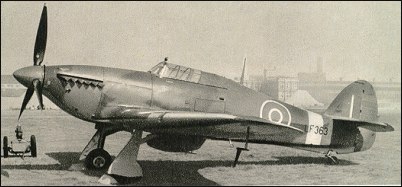
Few British aircraft have attained the special niche in the history of the RAF which is accorded to the Hawker Hurricane, sharing with the Supermarine Spitfire the brunt of air defence during the Battle of Britain in August-September 1940. One of the significant statistics of the Hurricane's contribution to this hard-fought battle was the fact that these aircraft destroyed more enemy aircraft than the combined total of all other defence systems, air or ground. Even that factor must be equated with the information that at the beginning of the battle (on 8 August 1940) approximately 65% more Hurricanes than Spitfires (2,309 to 1,400) had been delivered to the RAF's Fighter Command. Perhaps, in the final analysis, such figures can be regarded as more controversial than revealing. The fact remains that this combination of machines and courageous pilots was enough to deny the Luftwaffe access to the daylight skies over Britain without unacceptable loss.
The family tree of the Hurricane can be traced back to a 'Fury monoplane' proposal of 1933, then to be powered by the Rolls-Royce Goshawk evaporative-cooled power plant. Instead it was decided in early 1934 to adapt this design to incorporate the new PV.12 engine which Rolls-Royce had developed - and which was the direct forbear of the famous Merlin. From that time the airframe/engine combination bore so little relation to the Fury that it then became identified as the 'Interceptor Monoplane'.
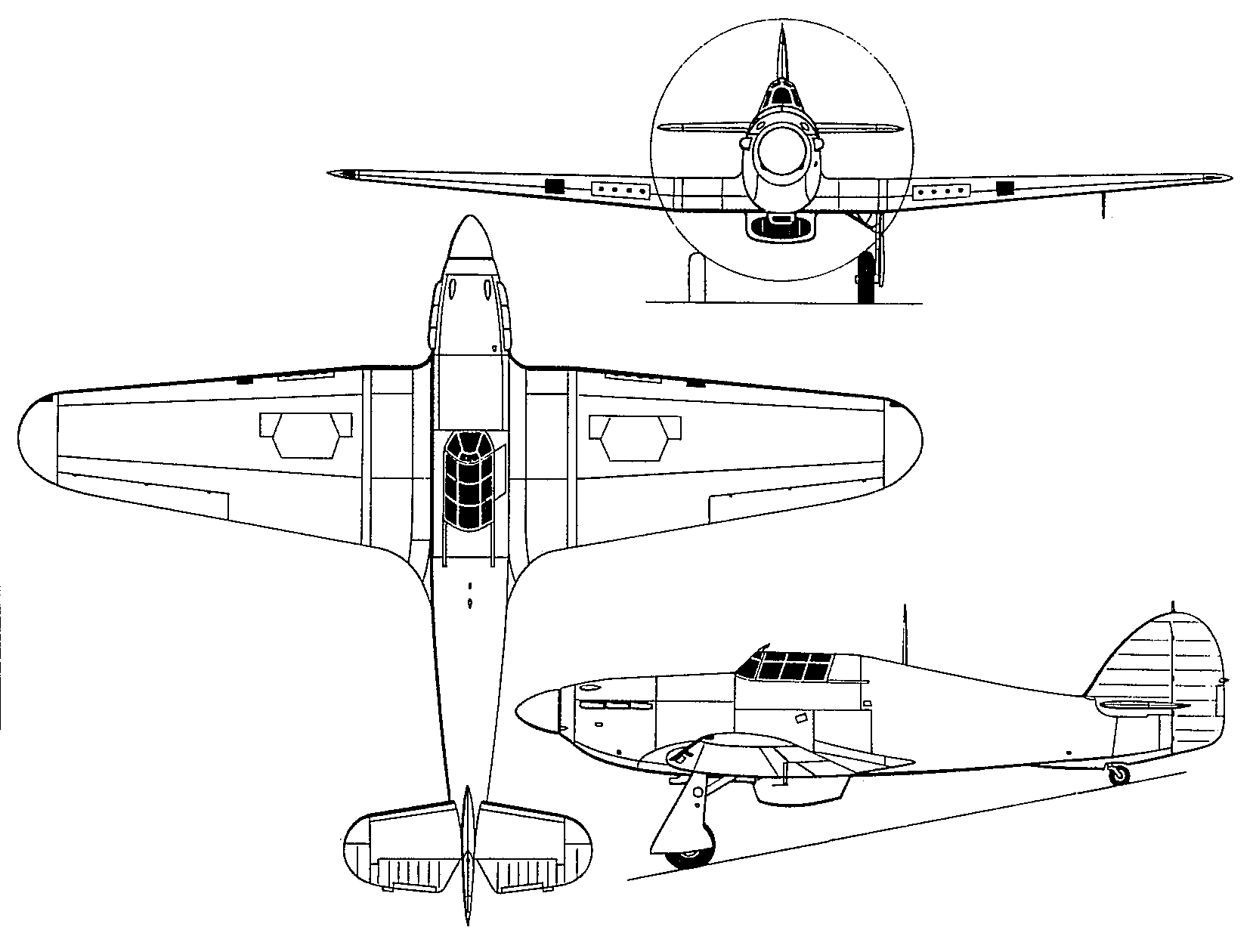
This finalised design was submitted to the Air Ministry in 1934, and in the following year a prototype was ordered to Specification F.36/34. On 6 November 1935, powered by a 767kW Merlin 'C' engine, the Hurricane took to the air for the first time. Although of cantilever monoplane configuration, its construction was typical of the Fury from which it stemmed, and even its wings were fabric-covered in early Mk Is, with a metal leading edge and trailing-edge flaps. The tailwheel-type landing gear had hydraulically retractable main units of wide track. Armament of production Mk Is comprised four 7.7mm Browning machine-guns in each wing, making this the RAF's first eight-gun fighter.
Early tests of the prototype confirmed the predicted performance, and an initial order for 600 placed in June 1936 was followed by one for 1,000 additional aircraft in November 1938. The first production aircraft flew in October 1937 and Hurricane I began to enter service in December 1937, first with No 111 Squadron. In early February 1938 Britain's breakfast-time newspaper readers almost choked on their toast when headlines assured them that, during the night, No 111 Squadron's commanding officer (Sqdn Ldr J. GilIan) had flown his Hurricane from Edinburgh to Northolt at an average speed of 657km/h, assisted by a tail wind!
Subsequent Hurricane versions included the Mk IIA with Merlin XX and eight guns; Mk IIB with 12 guns; and Mk IIC with four 20mm cannon. Mk IID with two 40mm Vickers 'S' guns and two 7.7mm guns (plus additional armour for low attack) were used extensively in the Western Desert. The final production version was the Mk IV with a wing able to accept armament comprising two Browning machine-guns plus two 40mm guns, or eight rocket projectiles, or two 110kg or 225kg bombs, or long-range fuel tanks. The Hurricane V (only two built) was powered by a Merlin 27 or 32 engine, while Hurricane X, XII and XIIA were produced in Canada by the Canadian Car and Foundry Company with Packard 28 or 29 engines. A total of 12,780 Hurricanes were built in Britain, plus 1,451 in Canada.
Sea Hurricanes joined the Royal Navy in January 1941 and became the first carrier-based British single-seat monoplane fighter when taken to sea by HMS Furious in July 1941. Under the 'Catfighter' scheme, Sea Hurricane IA were equipped for catapult launch from the decks of CAM merchant ships (catapult-equipped merchantmen) to counter the threat posed by Germany's Focke-Wulf Fw 200 Condors, introduced in the spring in 1941. Only the Mk IA was specially built. The approximate figure of 800 Sea Hurricanes which entered service included 50 Mk IA and about 750 conversions of Mk II and Canadian-built aircraft.
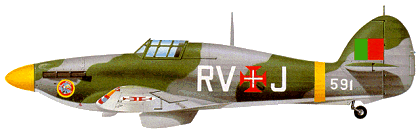
In addition to the Hurricanes already mentioned, more than 4,000 were supplied to other air forces, including Belgium, Canada, Egypt, Eire, Finland, India, Persia (now Iran), Poland, Portugal, Romania, South Africa, the Soviet Union, Turkey, and Yugoslavia.
Hi i'm modelling 1 sqn hurricane mk11c nightfighters based at Redhill including JX-B BE581, any idea where I can obtain a list of other serials /codes of hurricanes that were there? Cheers Ian
I have read all this and I still don't have actual data to form a true opinion. I just know I have always admired that fighter plane and believed it had a greater capability than it was generally given.
Can anyone tell me why very few Canadian produced Hawker Hurricanes that stayed in Canada did not have spinners. One of the few that does is Ser. # 872-46002 being restored @ Vintage Wings of Canada. I am working on the project and we would like to know.
The Hurricane out killed the Spitfire in the Battle of Britain. And while slower in level flight, and not able to match the 109 in climb or dive, the Hurricane could out turn it. In the hands of a competent pilot, still a match for the 109.
***
The front line logistics were that the 109 gruppe handed off to their leader who engaged opposition squadrons from behind. RAF tactic thus allowd their least experienced pilots to die quietly.
But there was a logarithmic limit to this MO as the lead pilot had to be in position to make the kills. OTOH a few German pilots became legendary aces doing so.
With hindsight it is easy to forget that there was nothing accurate in any RAF text book about air warfare since 1918.
The prototype Hurricane achieved 400 mph when it was first flown the wings were substituted for the Hawker Hector dive bomber wings which lost the hurricane about 20 mph.
Also there was a squadren leader pilot who came back from france with his hurricane and substituted a later mark of merlin engine into his plane and found it outperformed spitfires ,,, messerschmidts et al at high altitude Typically when the men from the ministry found out they took the later model merlin engine from the hurricane and that was that?
when Aussie was forming squadrons in north Africa they took over some aircraft from the RAF,well used Hurricanes and other hawker makes. The order was in for US p40s,the p40s replaced the mixed bag of aircraft that the Aussies started out with,likely a way to get set up with the limited resources, i think the Aussie figured p40 parts would be more reliable to get from the USA then to hope for parts from England for Hurricanes,[regarding the Pacific theater also]so in that regard the p40 did replace some Hurricanes but mostly American mustangs replaced the p40s and spitfires replaced the Hurricanes,End result was more and more sqns to out gun the German aircraft. All interesting stuff
Much has been made about which was the best the fastest which could climb faster or turn tighter than other machines over the years. The hurricane was a mid 1930's era design and by 1940 it was becoming outclassed by other aircraft however and it is a big however; this aircraft shot down many more German aircraftduring the batlle of britain than its newer faster etc colleague the spitfire. It could therefore be said to have influenced the outcome of the war as if Britain had lost this battle and been forced to withdraw from the war Germany would have been free to fight on one front (eastern)America would not have become involved in the european war and the world we now live in would be very different. Also once relegated from 1st line fighter status the Hurricane was armed with cannon and became a very successful anti-tank weapon in the North African desert making a massive contribution to Montgomery's victory in 1943. A very significant, effective and successful aircraft by anyones standards.
Have hunted high & low as to when and which version had the so called oil deflector plate fitted to the front of the engine cowling immediately behind the propeller. Can someone advise. Thanks
Often i read that p40 replaced the hurricanes in North Africa ,more so new sqn were equipped with the p40 while the spitfire replaced the hurricane at the old squdrons , maybe this was because of the similar equipment ,parts, training, ect. i think i read the cock pits of the spitfire and hurricane are also similar. I checked out a long list of aircraft used by the African sqns and i don,t think i recall one that switched over from hurricanes to P40, The Australians only used P40 I wonder what happened to the remaining Hurricanes, sent to Yugoslavia or Greece??I will check it out
often climb rate for the hurricane mentions the mk11c. I read that this aircraft was 1800 lbs heaver then the mk1. some mk1 had only two speed wood propellor, newer mk11 had the constant speed prop and the extra 400 horse power. lots of armor and four big cannon, so climb was usually around 2700 fpm, mk 1 or two with the constsnt speed prop,, find it interesting p40 had the great high speed roll rate,could be trouble for the me109, as this was often there way out,Interesting
Hi all: It`s performance complimented, and sometimes surpassed ,the "Spittee" however, at 84 yrs old I know that to see a spitfire on the ground ,or overhead,in film or doco, that I have just seen the most beautiful aircraft ever ,or likely . Even the start-up cough of the "Merlin is enough. Cheers. Ron H
Stan, while the Hurricane flew in Nov 1935, the P-36 flew in May, 1935. The re-engined P-40, with P-36 airframe flew in 1938. That makes it a '30s airplane too. A bit older, even.
The more you read about historic aircraft like the Hurricane the more confused you become. Critics cite poor climb, compare it to P36, P40, Wildcat and even the mighty Corsair, the Hrri is not that bad. Dive? the prototype was clocked at 560 mph with fabric wings and a fixed pitch prop, metal wings added 80 mph to dive speed, do the sums. This stacks up with experiences of pilots in Burma who could dive away from zero's and Oscar, the latter more than once shedding wings trying to follow the Hurri. One pilot of a Hurri was disappointed following a long dive which over-revved the engine and locked the controls solid to find that on recovery using the tail trim he was still only doing 320 mph and speed falling, until he watched the asi unwind a complete revolution and the Hurri return to more or less controlled flight. The mechanics worked this out to over 600 mph, but we'll never know. I did read that the Hurri has the record for the most axis aircraft shot down, more than the Spit or Mustang. It certainly fought for longer periods in any theatre than the others but can anyone confirm?
never really hear about how the p40 really would stack up against the hurricane, in africa when they changed over to p40 ,some pilots probebly tried it out in mock dog fights, i assume p40 could dive away maybe p40 could out manuver the hurricane at higher speed .?
Often there are overstated, almost false statements about . say p40 or hurricane and others example Hurricane poor climb, well compared to a me109 yes , but it was respectable compared to other aircraft, though the climb angle was steep and speed was low, and p40 ,cant turn, sure not like a zero. but almost nothing could roll like a p40 at high speed and, this was the one of the most important advantages in new era dogfights. something the fw190 could use to evade the spitfire. and really its only advantage over the mk 9 spitfire, speed over mk 5 also