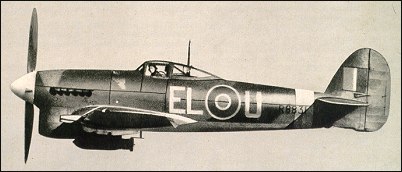
Air Ministry Specification F.18/37 was concerned with the design and development of two advanced interceptor fighters: one with a Rolls-Royce Vulture engine was identified initially as the R (Rolls-Royce) type fighter; the second, with a Napier Sabre engine, was known as the N (Napier) type. Prototypes of both were built, the first designated as the Hawker Tornado, but development problems with the Vulture caused this programme to be abandoned.
The Sabre-engined N-type fighter prototype flew for the first time on 24 February 1940, but after the collapse of France in June was stopped to enable Hawker to devote its maximum effort to the production of the Hurricane. This caused considerable delay in the introduction of the
Typhoon, work on which was not resumed until later in 1940. The first production Typhoon flew on 26 May 1941. This was, in profile, a very Hurricane-looking low-wing monoplane, with retractable tailwheel-type landing gear. Construction combined what had become traditional Hawker with stressed-skin techniques. The one very un-Hurricane-like feature was the chin-fairing for the ventral radiator.
Typhoon IA production aircraft began to enter RAF service in September 1941, and went into action in the summer of 1942. Initial usage proved a great disappointment, with unsatisfactory high-altitude performance, inferior rate of climb
and frequent engine breakdowns. When structural failure of the tail unit caused a number of fatal accidents it was suggested that the Typhoon should be withdrawn from service. Fortunately its superb low-level performance ensured that fast action was taken to overcome the shortcomings, and introduction of the Sabre II engine brought improved reliability.
Typhoon I A were armed with 12 x 7.7mm Browning machine-guns, but the bomb-dropping, cannon-firing or rocket-firing Typhoon IB became 'train-busters' and, with the invasion of Europe, proved to be a valuable component of the 2nd Tactical Air Force. Utilised on a 'cab-rank' system, under which Typhoons on standing patrol could be called in from the ground for tactical close support of army formations, they decimated the enemy's Panzer divisions. Indeed, the Typhoon's fire-power was sometimes compared with that of a broadside from a cruiser, and was sufficient to penetrate the most heavily armoured tanks.
A total of 3,330 Typhoons were produced for the RAF, but by the end of 1945 none remained in front-line service.
Hawker Typhoon on YOUTUBE
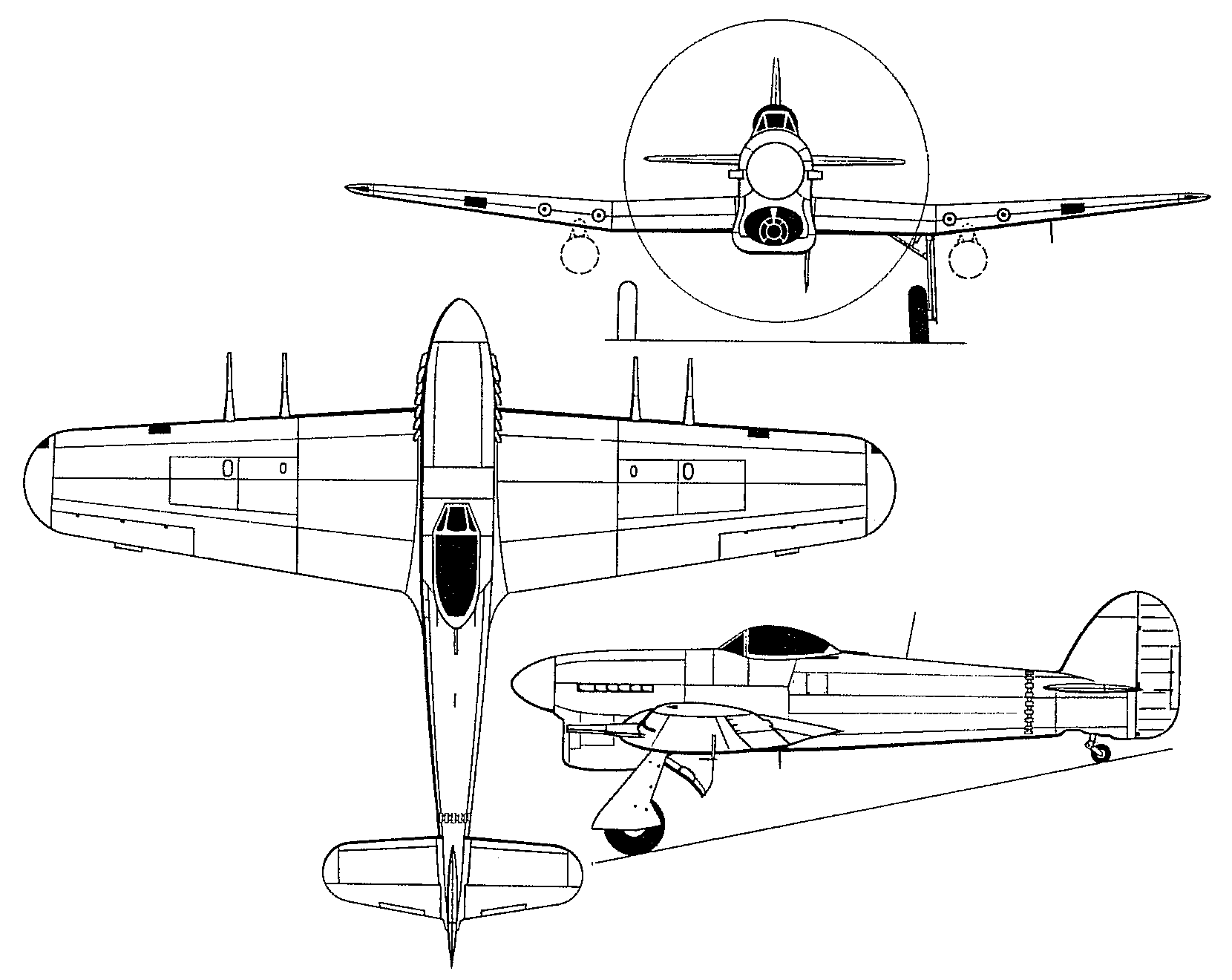
3-View
A three-view drawing (1660 x 1320)
Specification
CREW
1
ENGINE
1 x Napier "Sabre IIA", 1605kW
WEIGHTS
Take-off weight
5170 kg
11398 lb
Empty weight
3992 kg
8801 lb
DIMENSIONS
Wingspan
12.7 m
42 ft 8 in
Length
9.7 m
32 ft 10 in
Height
4.7 m
15 ft 5 in
Wing area
25.9 m2
278.79 sq ft
PERFORMANCE
Max. speed
673 km/h
418 mph
Cruise speed
530 km/h
329 mph
Ceiling
10360 m
34000 ft
Range w/max.fuel
1530 km
951 miles
Range w/max payload
980 km
609 miles
ARMAMENT
4 x 20mm cannon, 900kg of weapons
Comments
Amanda, 11.09.2012 03:00
My grandfather often talked about two crazy Typhoon pilots in his Green Section: Lily and Zee. Lily never flew in formation, and Zee always stuck on him no matter how low they went. Lily caught something near Abbeville, flak probably, and was burning when he dropped 1,000 pounders on the targeted rail station. Apparently he made another pass and drew off the ground fire while grandpa and his wingman made their pass. Zee was with him the entire time. Lily crashed just a mile off Dover. Was posthumously awarded a D.S.C. Zee, ever faithful, circled the crash until a fishing boat arrived at the scene. My grandfather still cries whenever he tells us about those guys. RAF pilots everywhere, you are all my heroes.
Hi- This webpage completely neglects the tragic participation of the Typhoon squadrons in "Operation Big Shipping Strike." The rocket, bombing and strafing attacks of 3 May 1945 killed over 7,000 concentration camp prisoners on board the "Cap Arcona", "Thielbek" and "SS Deutschland" anchored in Neustadt Bay. Don't those victims at least rate one sentence?
On a Victory in Europe Tour, celebrating the 50th anniversary of the Allied Forces victory over the Axis powers, I met Glyn Sago, and his lovely wife, Peg. They were from Victoria, Australia, and Glyn flew Typhoons for the RAF in 1944-'45.
We were about 40 on the tour. Many were WWII vets with battle experience in the ETO. The tour took us to many well known sites, including RAF and USAAF bases in England, embarkation ports for the Normandy invasion, the 5 invasion beaches, Market Garden, Battle of the Bulge sites, the bridge at Remagen, and the memorials and war museums in England, France, Belgium, Luxemburg, Holland, and Germany.
In a WWII museums in Normandy, Glyn was just ahead of me as we entered. Hanging from the ceiling of the main display was a fully restored Typhoon, reportedly the only one in existence.
Glyn saw the Typhoon and almost fainted. He fell back into my arms. He had no idea he'd ever see the plane he flew 150 missions in during the battle for Normandy. That's right, 150 missions in 10 weeks. Five sorties a day from his base in England, weather permitting.
That evening in Caen, local officials held a ceremony in Glyn's honor. He received medals and commendations. I have photos of the event, of Glyn paying his respects to fallen Typhoon pilots at a memorial in their honor in Normandy and of the Typhoon.
God bless you, Glyn Sago. Typhoon pilot, 150 missions in Normandy, 1944.
Jack I feel you may be wrong about two Typhoons flying from HMS Eagle to the USS Essex. There is no record of Typhoons ever attemting carrier landings yet alone take offs. I think there the aeroplanes you saw were more likely to have been were Sea Furies. Richard both Typhoons and Hurricanes operated in Italy at the end of the war.
during the Korean War two typhoons from HMS Eagle landed on USS Essex for a sit-down conference with admiral and staff. The pilots got our of their planes wearing their dress blues...odd flight gear for that time and place.
I have read two sources that state that Typhoons operated in Italy from the early-winter of 1944 /5 until the end of the war. Do you know if this is true or if the writers misidentified Hurricanes firing RPs as Typhoons? The Official History states that RP-armed Hurricanes joined the Desert Air Force at this time.