|
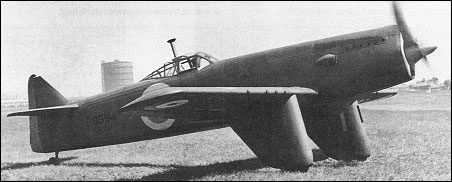
| Designed by James Martin with the collaboration of
Capt Valentine H Baker, the M.B.2 was built to conform
to the requirements of Specification F.5/34, but funded
as a private venture. Conceived for manufacture in
large numbers by semi-skilled workers at low cost, the
M.B.2 employed a steel-tube structure with fabric skinning,
was powered by a Napier Dagger III 24-cylinder
H-type engine with a rated output of 798hp at 1675m, and carried an armament of eight 7.7mm Browning guns in the wings. The depth of the
fuselage was virtually constant from nose to tail and
vertical tail surfaces were eliminated, the rudder being
hinged to the sternpost behind the elevators. First
flown on 3 August 1938, the M.B.2 demonstrated
serious directional instability and a rudimentary fixed
tailfin was immediately introduced. A level speed of
515km/h was recorded with full armament,
but official reports of trials at Martlesham Heath, while
enthusiastic concerning its engineering design, pronounced
the M.B.2 unstable about all axes and
generally unpleasant to fly. More orthodox vertical tail
surfaces were fitted early in 1939, these markedly improving
handling, but the RAF evinced no interest in
the fighter, development being discontinued.
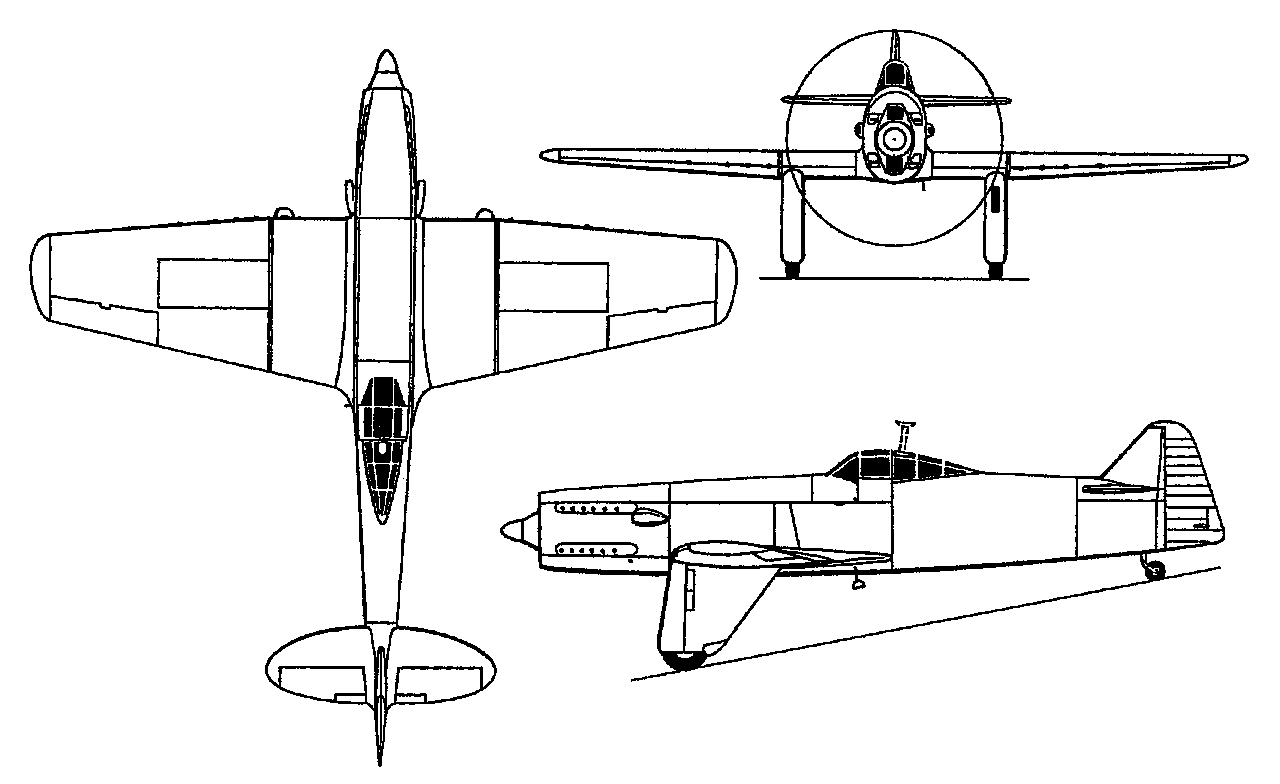
 | A three-view drawing (1280 x 784) |
| WEIGHTS |
| Take-off weight | 2512 kg | 5538 lb |
| DIMENSIONS |
| Wingspan | 10.36 m | 34 ft 0 in |
| Length | 10.51 m | 35 ft 6 in |
| Height | 2.97 m | 10 ft 9 in |
| Wing area | 19.79 m2 | 213.02 sq ft |
| PERFORMANCE |
| Max. speed | 515 km/h | 320 mph |
| Trevor Webb, e-mail, 29.01.2021 05:25 Following my comments of more than six years ago, thought of a peculiar point. The MB-2 was photographed often marked "MB1". This clashes with their touring aircraft the MB-1. reply | | Barry Flewitt, e-mail, 21.04.2015 00:25 I believe that this aeroplane would not take up a natural banking attitude in the turn.I suspect the trousered U /C contributed to this. reply | | Trevor Webb, e-mail, 23.10.2014 15:11 Noting the critical comments on the Dagger engine that although it gave troubles in its installation in the HP Hereford, it did serve out much of World War II in the Hawker Hector, much of that service in the Middle East, without overheating problems.
It is a pity that this site does not include mention of Martin's two earlier aircraft. The Martin Baker MB-1 was a very conventional two seater touring aircraft with side by side seating. The Martin M-1 was designed and built before Martin teamed up with Baker. The M-1 was almost identical to the MB-1 except that the enngine was behind the two seats as in the P-39. Both were one-offs. reply | | James W., e-mail, 01.11.2013 22:43 'Unpleasant', 'noisy', 'complex', 'maintenance headache'?
Sounds like an F 1 car..
Sure you are not extrapolating the service use the high strung Dagger was condemned to.. powering a bomb truck?
[The Handley-Page Hereford]
Fighter pilots, like F 1 pilots want a hi-po, responsive mill, & the MB 2 failed for technical, developmental & political reasons, not because of the Napier engine.. reply | |
| | Stephen Round, e-mail, 17.10.2013 03:50 Martin Baker designed some superb aircraft and this one did have some potential they were the new kids on the block and on the outside looking in.
They never did get any orders from the Air Ministry and companies like Napier and Fairy were in the doghouse with the Air Ministry because Rolls Royce and Bristol were sacrosanct perhaps the well known nefarious activities of present day BAE were policy from way back and the Air Ministry was bought and sold??????????
I would say that 320 mph with a fixed undercarriage and armed with its full armament was some super achievement and look at the excellent view from the cockpit the concept was fundamentally OK. The MB1 needed more inspiration and a hydraulic retractable undercarriage , someone could have made this a more than viable front line fighter it could have been a spitfire replacement.
As for the much maligned Napier Dagger engine the rear cylinders overheated too easily while the front cylinders were overcooled as it was it needed careful warming up.
Ideally the Napier Dagger should have had either active oil cooling spraying the underside of the pistons along with a separate oil cooler or a simple method of water cooling. Whoever designed the ridiculously restrictive cooling arrangement for this air cooled engine did Napier or Martin Baker no favours whatever - who was he working for?
I wonder how could someone arrange the cooling of this engine as though it were an afterthought???????????. reply | | Peter Holland, e-mail, 14.02.2013 21:26 This design (and two others) were intended for service in tropical areas, such as the Egypt and Malaya. In the event, a capable and reliable fighter was needed but not available. reply | | steve, e-mail, 22.07.2011 00:39 The Dagger was an attempt to combine the low frontal area of an inline with the advantages of air cooling. The problems were in the execution. First, the engine was simply too small for the power - twice the size (~2000+ cubic inches) would have made more sense.
Second, Napier neglected the control of the flow of cooling air. The P&W R-4360 had the same length of "cylinder blocks", but the skewed rows and careful baffling ensured adequate cooling. (The misapplication of the Ranger V-770 to the slow Curtiss SO3C was a similar problem)
Third, the Dagger's manufacturing problems were a clear omen of the more serious troubles with the more important Sabre.
There was nothing inherently wrong with the idea of a high-power air-cooled inline - the surprising success of the orphaned Rolls-Royce Exe demonstrates that. I find myself repeately getting wistful about possible air-cooled X-16's in the ~2500 cubic inch range. reply | | bombardier, e-mail, 24.05.2011 11:24 The ugliest British aircraft ever built reply | | Klaatu, e-mail, 25.04.2011 00:26 A simple, inexpensive fighter - powered by one of the most complex and unpleasant engines available. The Dagger engine was extremely noisy and, with it's 24 cylinders, a maintenance headache. Who thought that this would be a good idea? reply |
|
Do you have any comments?
|
| 
COMPANY
PROFILE
All the World's Rotorcraft
|