|
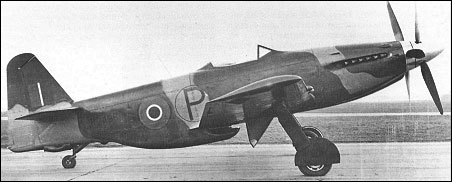
| Retaining the wings, undercarriage and fuselage
primary structure of the M.B.3, the M.B.5, first flown on
23 May 1944, was considered by many to represent the
peak of single-seat piston-engined fighter development. Powered by a Rolls-Royce Griffon 83 affording
1,900hp for take-off and driving a six-bladed counterrotating
propeller, the M.B.5 carried an armament of
four 20mm Hispano cannon. Lack of directional
stability resulted in the introduction of taller vertical
tail surfaces at an early flight development stage, but
despite superlative qualities subsequently demonstrated,
the M.B.5 proved of no more than academic interest
to the RAF in view of the availability of jet
fighters. Flight testing continued into 1947, the sole
prototype being scrapped thereafter.
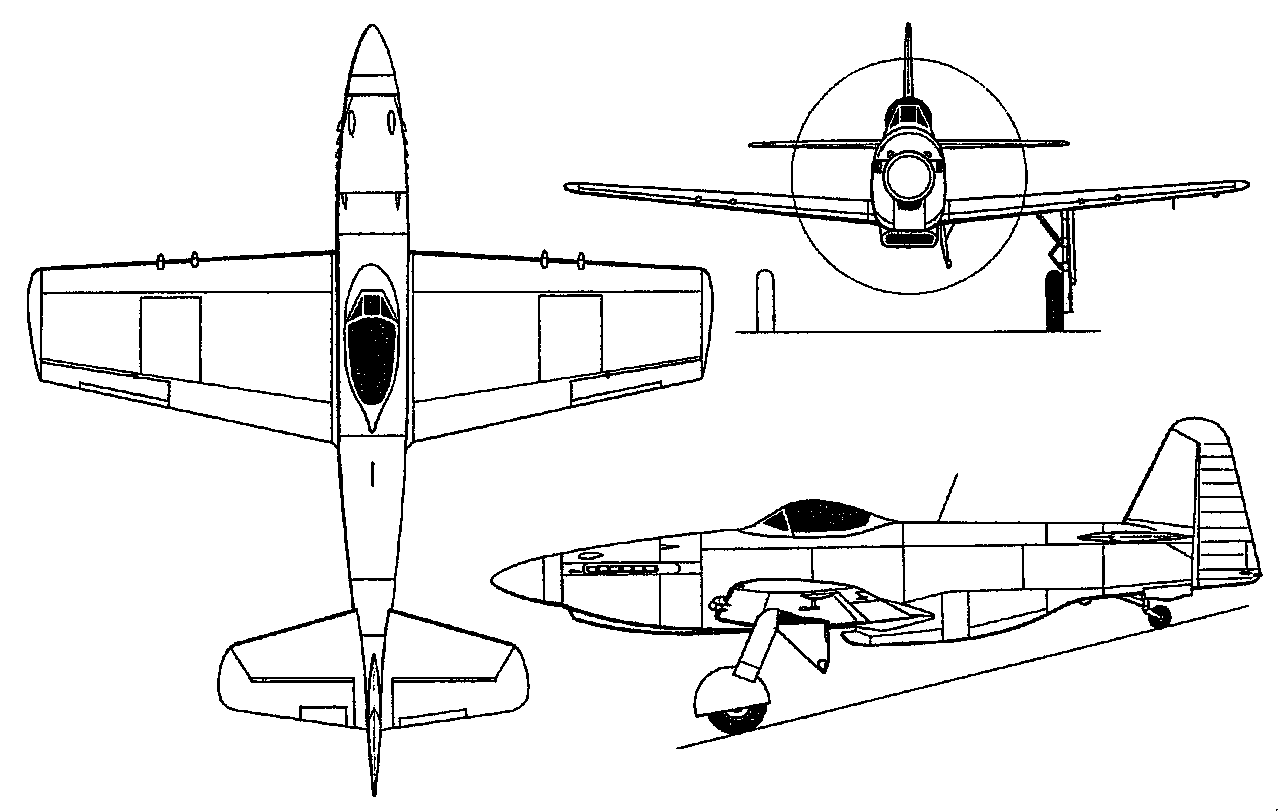
 | A three-view drawing (1280 x 812) |
| WEIGHTS |
| Take-off weight | 4994 kg | 11010 lb |
| Empty weight | 4192 kg | 9242 lb |
| DIMENSIONS |
| Wingspan | 10.67 m | 35 ft 0 in |
| Length | 11.30 m | 37 ft 1 in |
| Height | 4.37 m | 14 ft 4 in |
| Wing area | 24.40 m2 | 262.64 sq ft |
| PERFORMANCE |
| Max. speed | 740 km/h | 460 mph |
| Range | 1770 km | 1100 miles |
| Jason Whisttle, e-mail, 04.01.2017 17:19 The Australians did not copy the MB-5, they produced the CAC CA-15 all on their own. There are doubts about the voracity of the Reno copy as it is poorly finished and inaccurate in any case. Cut down P-51 wings do NOT an MB-5 make. reply | | Stephen Round, e-mail, 17.10.2013 03:57 Didn't the Aussies copy this aircraft just after the war it looks just like they did there must still have been a demand for a fast piston engine fighter at least up to 1955... reply | | Klaatu83, e-mail, 04.01.2013 22:57 The MB-5 was the ultimate development of the earlier MB-3. described as looking like a cross between a P-51 Mustang and a V-2 rocket, it may well have been the best piston-engine fighter ever built. Unfortunately, it appeared too late. reply | | Clive, e-mail, 07.01.2012 06:51 My father was a toolmaker at MB during WW2. I remeber him saying that the test pilot who flew the MB 3 was really impressed on his first flight. I have no idea if it was the same person who crashed. He also said that the air ministry wanted production immediately and they were unable to do that so it never saw the light of day as a production aircraft. reply | |
| | a.machiaverna, e-mail, 26.09.2011 07:12 Martin Baker went on to perfect the ejection seat. reply | | tony smith, e-mail, 07.07.2011 15:05 the mb5 possesed such a clean airframe, combined with the 2300 hp griffon,sbf(sheer brute force), the combination enabling the fighter to reach app.460 mph-all without a laminar flow wing!a wing of similar specification to the mustang p51 f model was planned to be fitted if approval was given by the ministry for production,but,the rest is history.combined with,say,a 3000hp turbo-prop and the l.f.wing,air tunnel tests pointed to app 530 m.p.h!the mustang airframe was resricted to .76 mach.(505 m.p.h.)so the mb5 must have had a very strong airframe...ahh,what might have been. reply | | John Klein, e-mail, 09.10.2009 02:54 i saw a nearly completed copy of the mb 5 at reno last two weeks ago. two gentlemen in their seventies have been working for ten years on the project. its in a private tee hanger near the where the pit area was race week. reply | | john Bucko, e-mail, 08.04.2008 20:05 MB5 Seems to have a lot of P51 H attributes... radiator scoop, laminar flow wing with square tips Edwards AFB has a P51H converted to turboprop with counter rotating props. It sits in a compound with lots of other cool stuff. It looks real similar to the MB5 with out the radiator scoop. Probably similar problems to early Douglas Turbo-prop fight /bomber (skyshark?) that had problems with contraprops on early turboshafts. Similarity with Grumman Bearcat is unmistakable too. Same tail and wings? That companies didn't save their prototypes for museums is sad!! reply |
|
Do you have any comments?
|
| 
COMPANY
PROFILE
All the World's Rotorcraft
|