|
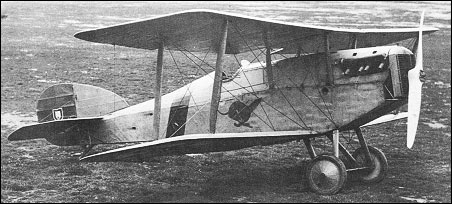
| Widely considered to have been one of the best single-seat
fighters to emerge during World War I, the Buzzard
began life as a private venture design by G H Handasyde
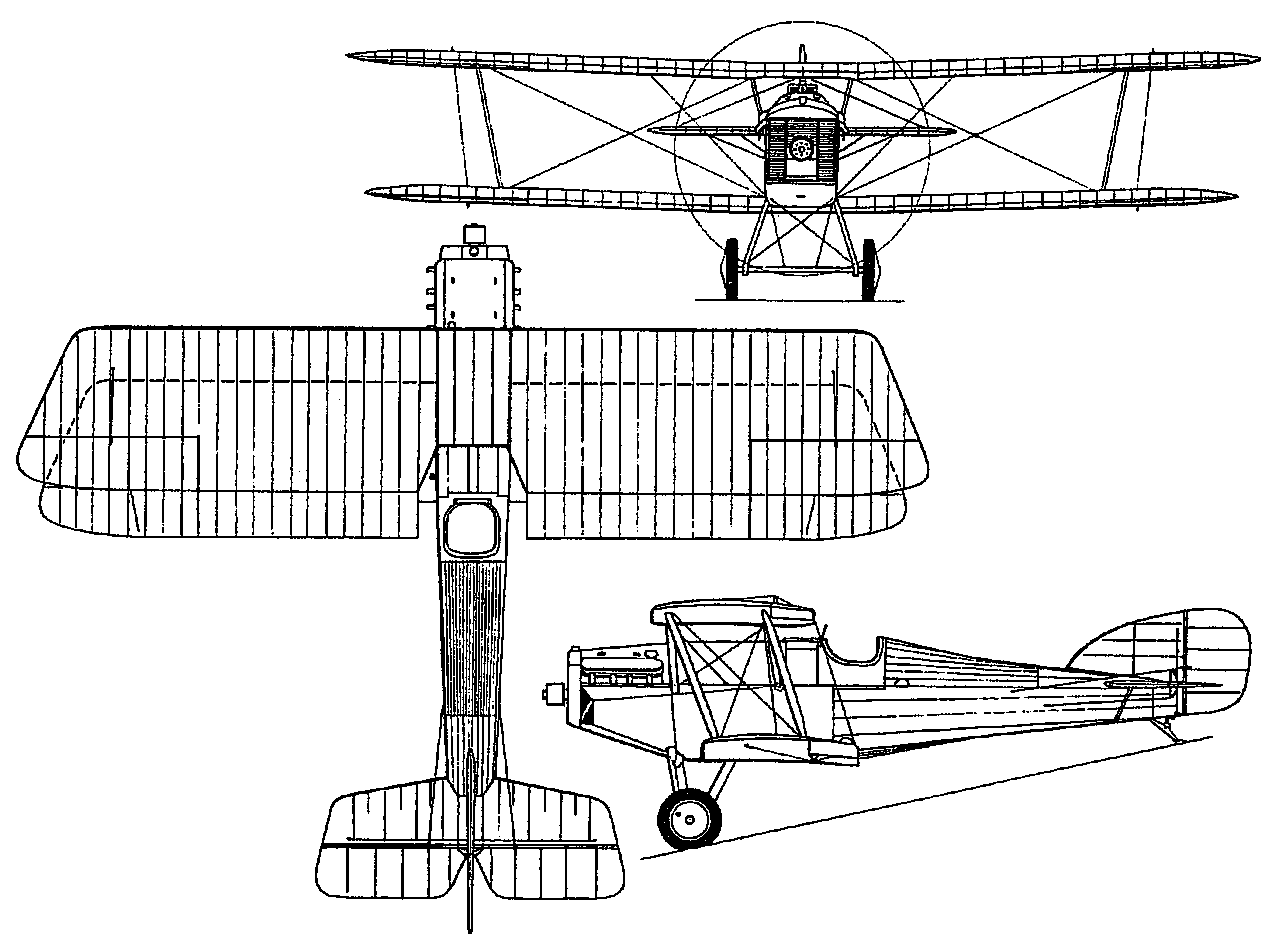
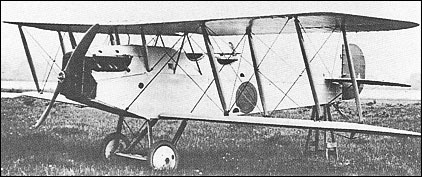
designated F.3. A single-bay staggered biplane of
conventional wooden construction with fabric skinning and powered by a Rolls-Royce Falcon engine of 285hp,
the F.3 appeared in the autumn of 1917. It underwent its
first official trials on 3 October, six further prototypes
being ordered and a decision to manufacture the F.3 in
quantity being taken before the end of 1917. The, F.3
was powered by the 275hp Falcon III engine, but priorities
in Falcon engine supplies enjoyed by the Bristol
Fighter led to the reworking of the F.3 for the 300hp
Hispano-Suiza 8Fb. With this it was redesignated F.4
and (from September 1918) officially named Buzzard. It
is uncertain just how many of the original batch of 150
aircraft were completed as Falcon-engined F.3s, but most were certainly finished as HS 8Fb-engined F.4s,
the first of the latter being tested at Martlesham Heath
in June 1918. Additional contracts for the F.4 were
placed with the parent company (300), Boulton & Paul
(500), Hooper (200) and Standard Motor (300). Armed
with two synchronised 7.7mm Vickers guns,
the F.4 differed from the F.3, apart from power plant, in
having revised fuselage decking contours and more extensive
plywood skinning. Belated engine deliveries and other factors delayed production, only seven
having been handed over by November 1918, and, in
the event, no RAF squadron was to be equipped with
the type. Production of the F.4 by the parent company
continued for a time after the Armistice (no other contractor
apparently producing any complete Buzzards)
and more than 370 airframes were built, some being fitted
with Falcon engines. A number of F.4 Buzzards was
sold abroad by the Aircraft Disposal Company, the principal
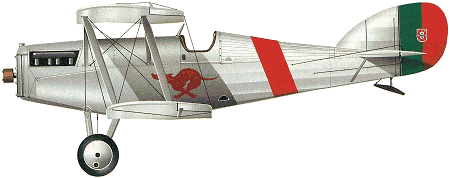
recipients being Finland (15), Portugal (4), Spain
(20) and the USSR, the last-mentioned procuring 100
aircraft of this type. A two-seat variant, the F.4A, was
produced in 1920, a much-modified derivative with
two-bay wings of increased span appearing in the following
year. This had a Lewis gun in the rear cockpit
and several were supplied to Spain in June 1921, both
single- and two-seat Buzzards being referred to as
F.4As in Spanish service.
 | A three-view drawing (1280 x 948) |
| MODEL | F.4 Buzzard |
| WEIGHTS |
| Take-off weight | 1088 kg | 2399 lb |
| Empty weight | 821 kg | 1810 lb |
| DIMENSIONS |
| Wingspan | 9.99 m | 33 ft 9 in |
| Length | 7.76 m | 25 ft 6 in |
| Height | 2.69 m | 9 ft 10 in |
| Wing area | 29.73 m2 | 320.01 sq ft |
| PERFORMANCE |
| Max. speed | 212 km/h | 132 mph |
| vance gilbert, e-mail, 05.02.2017 22:38 Has anyone ever seen an F.4 on skis sans military markings? reply | | Arthur Moreton, e-mail, 16.11.2016 16:07 Bruce Murdin - re Buzzard Propeller.
As historian for North Weald Airfield, which this year commemorated its centenary and had a Buzzard flying from there in 1918'. I would love to provide a home for it at North Weald. reply | | Bruce Murdin, e-mail, 09.03.2016 15:08 I have an original propeller from an F4 Buzzard which my father had owned for over 50 years. If anyone is interested in it, please email me as it is too large for our house. reply | | Kyle Bogosian, 13.08.2011 23:35 Pete, the Sopwith Snipe and Royal Aircraft Factory SE 5 would have been considered rivals in the RAF. The Snipe had worse performance but was selected to be the standard RAF fighter post-war because it was cheaper; the older SE 5, meanwhile, had a lot going for it and was certainly a match for the Buzzard. reply | |
| | pete mitchell, e-mail, 04.01.2011 03:40 very interesting what other aircraft would be considered close competition? reply | | Patrick Fleming, e-mail, 23.05.2009 02:20 The Irish Air Corps operated four F4's in the early 1920's reply | | Gerald Sankey, e-mail, 09.04.2008 15:08 I seen much higher top speeds given for the Buzzard also it was chosen as the day escort fighter for Handley Page bombers as part of the independent air force had the war go on to 1919 that variant would have been the Mustang of it day. reply |
|
Do you have any comments?
|
| 
COMPANY
PROFILE
All the World's Rotorcraft
|