|
| The B.E.
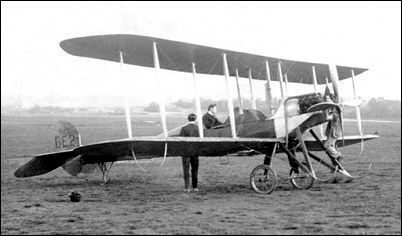
designation at first indicated 'Bleriot Experimental', Louis Bleriot being credited with having originated the tractor-engined aeroplane. With the appearance of aircraft from the Royal Aircraft Establishment it was taken to mean 'British Experimental'.
The original B.E. was designed by and built under the supervision of Geoffrey de Havilland, later Capt de Havilland of the RFC and chief designer for the Air raft Manufacturing Company. A later type of the same general design was the B.E.2, a tandem two-seat biplane with incredibly stable flying characteristics which, in several versions, was employed throughout World War I as a reconnaissance aircraft.
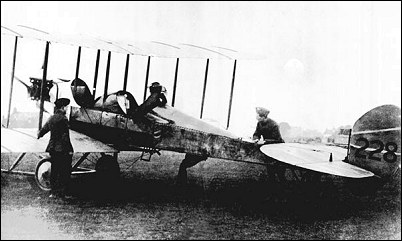
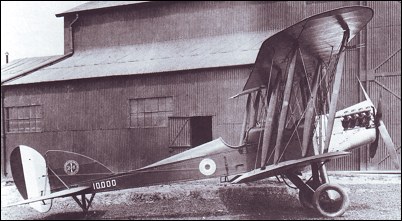
The first version to enter service with the RFC was the B.E.2a, built in very small numbers and the first aircraft to reach France at the outbreak of World War I. Flying alongside a Bleriot monoplane, a B.E.2a made the first RFC reconnaissance over German lines on 19 August 1914. The first version built in reasonable numbers was the B.E.2b (which introduced ailerons) followed by the mass-produced B.E.2c which superseded earlier versions from April 1915. Power was provided by a 67kW RAF 1a engine and wing dihedral was introduced. It was also the first armed version, carrying a machine-gun in the forward cockpit. This gun arrangement greatly restricted the observer's field of fire, which was reversed on the B.E.2d but reintroduced on the final and most numerous version, the B.E.2e.
With the B.E.2d/e in service, the B.E.2c (and earlier versions) was flown as a training aircraft, and a number were employed successfully at home in attacking airships and used on other fronts. Throughout its career the B.E.2 performed very useful work but was over-stable and slow. With the deployment of fighter aircraft, it proved a sitting duck and was the main victim during the so-called 'Fokker Scourge' which lasted the winter of 1915-16 and again during 'Bloody April' in 1917. In total more than 3,200 B.E.2s were built. FACTS AND FIGURES © The pilot's cockpit had no blind-flying
instruments, so entering a
cloud was often a fatal mistake.
Many B.Es went into spins from
which they could not recover. © Over 3200 B.E.2s were built by over
20 contractors in a variety of models
with few visible differences. The last
model was about 5km/h
faster than the first. © Lateral control was effected
by warping the wings, which
was fine for sedate turns but
not for evading enemy
fighters or anti-aircraft fire
| MODEL | B.E.2e |
| ENGINE | 1 x RAF 1a, 67kW |
| WEIGHTS |
| Take-off weight | 953 kg | 2101 lb |
| Empty weight | 649 kg | 1431 lb |
| DIMENSIONS |
| Wingspan | 12.42 m | 41 ft 9 in |
| Length | 8.31 m | 27 ft 3 in |
| Height | 3.66 m | 12 ft 0 in |
| Wing area | 33.44 m2 | 359.94 sq ft |
| PERFORMANCE |
| Max. speed | 145 km/h | 90 mph |
| Ceiling | 2745 m | 9000 ft |
| ARMAMENT | 1 x 7.7mm machine-gun |
| lorrdplanece, 02.07.2025 05:21 i rlly like planes reply | | gatelord6 7, 02.07.2025 05:20 i rlly like planes reply | | CluckPro48, 02.07.2025 05:17 i rlly like planes reply | | CluckPro48, 02.07.2025 05:16 i rlly like planes reply | |
| | Anonymous, 03.12.2021 17:04 The reason why the B.E.2 was designed with the observer seated in front of the pilot was so that the observer would be located at the aircraft's center of gravity That way the aircraft could be flown solo, without the observer on board, without altering the aircraft's center of gravity. It should be stressed that stability was the principal criterion around which the B.E.2 was designed, not the ability to defend against enemy aircraft, which was not even a factor at all at the time when the aircraft was designed. reply | | Anonymous, 03.12.2021 16:56 The B.E.2 has frequently been criticized for its' lack of maneuverability, rendering it vulnerable to attack by enemy aircraft. However, the B.E.2 was designed well before WW-I began, at a time when the concept of combat between aircraft did not even exist as a factor. In fact, the principal factor that the R.A.F. considered when developing its' aircraft at that time was positive stability. The B.E.2c was specifically designed to be stable in the air, and it met that criterion extremely well. in other words, it did exactly what it was designed to do, and did it very well. reply | | Anonymous, e-mail, 21.11.2021 23:13 Just some additional information and a question. Based on the below photograph, the B.E.2c had a tachometer and a compass. Does anyone know what the third instrument might be?
static2.bigstockphoto.com /7 /6 /7 /large1500 /76723037.jpg reply |
| Billy R Leon, e-mail, 31.08.2021 20:03 I think one of the things that struck me about this aircraft was its crew configuration and defensive armament. It was unarmed in the a and b models. But still observation must have been much better in the rear cockpit. But not in this case. The pilot sat in the rear. Now the c model was armed, but the gunner still in the front seat, fired over the pilots head. How disconcerting that had to be. Starting with the d model some machines had the crew reversed. Somewhat better, but still with the aircraft so underpowered so that it could not run and barely fight in skies contested by Albatros and Fokker aircraft. Not an enviable position to be in for sure. But in my eyes, just to go up in one of these aircraft qualifies one as a hero. reply | | Graham Clayton, e-mail, 13.02.2021 08:06 The B.E.2 inspired the first generation of fighters by displaying all of the qualities that no one wanted in a fighter aircraft, including poor visibility, poor reliability, difficulty of control, slow speed, and weak armament. reply | | Greg Spence, e-mail, 18.08.2014 18:55 My family has in it's possession a piece of canvas type material about 5 x 3 inches painted a red colour on one side and a hand written inscription on the reverse which reads " A piece of the Union Jack which was on the ill fated British aeroplane brought down by our troops in mistake for a German at Gheluveldt on Oct 26th 1914 " This artefact was found in my Grandfather's possessions about 25 years ago. My Grandfather was a soldier in the Great War. Supposedly this aircraft is the first historical Ground to Air Friendly Fire incident ever recorded. I am looking to return it home after 100 years. Any suggestions? I have the names of the crew of this aircraft - LT C G Hosking and Capt T Crean and think it best be given to their direct families.
Regards Greg reply | | deneckere, e-mail, 17.08.2009 21:33 Hello,
Can you sent me a scan of the BE2 nr 228.
Thanks.
Bernard reply |
|
Do you have any comments?
|
| 
COMPANY
PROFILE
All the World's Rotorcraft
|




The link is actually
static2.bigstockphoto.com / 7 / 6 / 7 / large1500 / 76723037.jpg
with the spaces removed.
reply