 |
Royal Aircraft Factory F.E.31913 |  |
| FIGHTER | Virtual Aircraft Museum / United Kingdom / Royal Aircraft Factory |
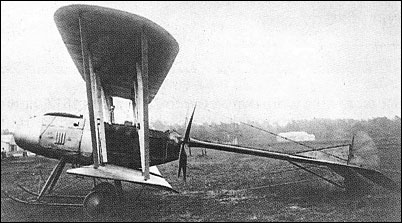 |
Located at Farnborough and engaged primarily in aeronautical research, the Royal Aircraft Factory (so named in April 1912) was responsible for the design and development of a number of warplanes during World War I. In accordance with the factory's purpose they received designations combining a prefix letter (at first indicating the general configuration, but later the role) with E for experimental (although several, such as the B.E.2, F.E.2, R.E.8 and S.E.5, were to be built in large numbers). Built in 1913, the F.E.3 was thus the third design in the "Farman Experimental" series of pusher biplanes, and was designed to carry a COW one-pounder quick-firing gun. Alternatively known as the A.E.1 ("Armoured Experimental"), the two-seat F.E.3 was a two-bay biplane with overhanging upper wing, and a four-bladed pusher propeller driven by a shaft and chain from the 100hp Chenu eight-cylinder watercooled inline engine mounted in the front of the fuselage. The large cruciform tail unit was carried on a single central boom secured through the hollow propeller shaft and braced by wires to the upper wing and the undercarriage. Flight tests showed that the tail attachment was not sufficiently rigid and the gun, fitted in front of the fuselage, was fired only in static tests at Farnborough after flight testing was abandoned. The F.E.3 used fabric-covered wooden construction for the wings and tail unit, but the fuselage nacelle was of steel tube construction with aluminium and plywood skinning. A large central orifice in the nose took in air for the engine radiators, which were inside the nacelle.
|  COMPANY PROFILE | ||||||||||||||||||||||||||||||||||||||
|


|