|
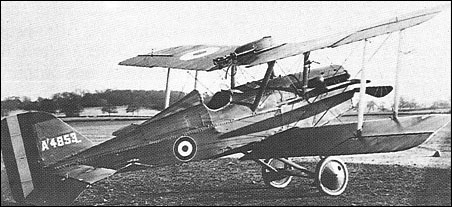
| Second only to the Sopwith Camel in reputation as the
RFC's outstanding fighter of World War I, the S.E.5 was
designed under the direction of H.P. Folland. Of classic
tractor biplane configuration, the S.E.5 was initiated to
take advantage of the new Hispano-Suiza engine that
began test-running in Spain in February 1915 and was
in production in France a few weeks later. Two versions
of the engine became available during 1916, the
basic direct-drive 150hp unit and a geared version producing
200hp. Examples of both were included in the
British orders placed in France and, subsequently, with
Wolseley for licence-built examples (as the 150hp
Python and 200hp Adder respectively). The S.E.5 was
intended, from the outset, to be powered by the 200hp
geared engine and to be armed with a 7.7mm Lewis machine gun firing through a hollow propeller
shaft, but, in the event, early aircraft had to use
the 150hp Hispano 8Aa, and had an armament of one
Vickers gun in the front fuselage, offset to port, with
interrupter gear, and a Lewis on a Foster mount above
the centre section. Unarmed, the first of three prototypes
of the S.E.5 flew on 22 November 1916. It was a
compact single-bay biplane with equi-span wings featuring
raked tips, a similarly-raked tailplane, triangular
fin and almost rectangular rudder, with a small ventral
fin and a V-strut undercarriage. A large windscreen
was provided over the front of the cockpit. All major
components were of conventional wood construction,
with fabric covering. Of two further prototypes, one
was similarly powered and first flew on 4 December
1916, whereas the other introduced the 200hp engine
and became, effectively, the prototype for the S.E.5a. Production of the S.E.5 was ordered "off
the drawing board" with a first batch of 24 built by the
RAF at Farnborough, where the first was completed in
March 1917. A second batch of 50 followed on, but at
least 15 of these were to emerge as S.E.5a's, and some
S.E.5s in service were also modified to have 200hp
engines. In service with the RFC in France by early
1917, production S.E.5s were modified in various ways,
particularly by removal of the windscreen. Other
changes tried out on S.E.5s to improve the lateral control
were consolidated in the S.E.5a.
| ENGINE | 1 x Hispano Suiza, 149kW |
| WEIGHTS |
| Take-off weight | 878 kg | 1936 lb |
| Empty weight | 635 kg | 1400 lb |
| DIMENSIONS |
| Wingspan | 8.51 m | 28 ft 11 in |
| Length | 6.38 m | 21 ft 11 in |
| Height | 2.87 m | 9 ft 5 in |
| Wing area | 23.20 m2 | 249.72 sq ft |
| PERFORMANCE |
| Max. speed | 196 km/h | 122 mph |
| Ceiling | 5790 m | 19000 ft |
| muhammad amjad mahmood, e-mail, 16.07.2015 12:24 i have worked on different aircraft in Pakistan Air Force,had 18 years experience reply | | David B Nelson, e-mail, 05.06.2012 22:22 my dad flew an SE 5 aircraft in the 1st world war and was stationed in Bagdad, the only information I have is my dads discharge papers in 1917, his name was Samuel Banks Nelson. he joined the british air force before it was renamed the Royal Airforce, I would like to know more about my dads career in the service if anyone has any information about him. thank you for your information (my age now is 82 yrs old)
David Banks Nelson
1275 Elgin St apt 804
postal code L7S1E2
Burlington Ontario Canada reply | | DICK GREENWOOD, e-mail, 17.01.2010 18:58 DO YOU MEAN BY 1917 THE PARACHUTE WASN'T DEVELOPED; EVEN FOR TEST FLIGHT ACTIVITIES ? WHAT A LOSS. OR WAS IT A PARACHUTE FAILURE ? reply | | DICK GREENWOOD, e-mail, 17.01.2010 18:49 Was he thee 'f.o.' Brown ? reply | |
| | d.jay, 11.07.2009 00:22 The photo is of a S.E.5.A not a S.E.5 it did not have a faired pilots head rest. reply | | SYD BROWN, e-mail, 24.04.2008 21:34 My dad flew this for the RCAF in WW1. reply | | robert , frank, widenham ,lye, e-mail, 08.03.2008 14:00 Major f, w, goodden was chief test pilot and also had a lot of input in the se5 project,he was killed when the wings folded at 12,000ft he was the youngest major in the R F C He was also my great uncle.He was killed on Jan 26 1917 and buried in aldershot millitary cemetery along side a friend of his who was killed a few days before, and still bore a wreth saying in loving memory frank goodden.I was given his christian names, frank widenham.I hope this will be of interest. reply |
|
Do you have any comments?
|
| 
COMPANY
PROFILE
All the World's Rotorcraft
|