|
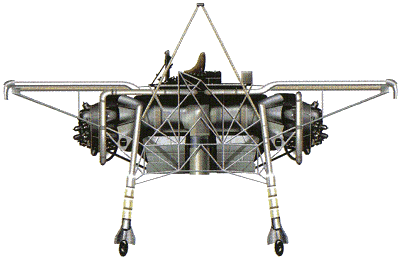
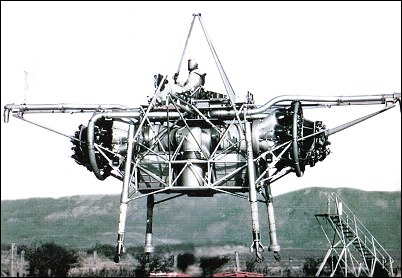
| The very basic Thrust Measuring Rig or 'Flying Bedstead' was the first
British VTOL aircraft and gathered useful data for the P.1127 (Harrier)
project. The Bedstead's loaded weight was only about 272kg less than
the combined thrust of the two engines, and some of that thrust was ducted
away for the control ducts. Each control movement reduced the lifting
thrust, requiring a bit more throttle and meaning that it could not be
controlled at maximum thrust without a height loss. There was little margin
for error - and none at all if one engine faltered. The only plus side was that
the engine nozzles were arranged to give thrust (lift) on the centreline so that
at least it would plunge vertically rather than flip over. Both Bedsteads did
crash, one fatally, and the Harrier adopted a quite different lift system. FACTS AND FIGURES © The pilot's control stick
opened and closed valves that
directed compressed air to
the nozzles mounted at front
and rear and on the sides. © Like all early jet engines, the Nene
took a while to spool up to a new
power setting, meaning adjustment:
had to be made before they were
needed. © The pilot was totally exposed
in his seat above the rig. Only
after the initial test programme
was over was a rudimentary
rollover cage added to offer
some crash protection.
| ENGINE | 2 x 1840kg Rolls-Royce Nene turbojets |
| WEIGHTS |
| Take-off weight | 3400 kg | 7496 lb |
| Robajobgob, e-mail, 25.07.2024 02:45 Where did the bombs fit? reply | | Gary Beaven, e-mail, 05.10.2022 21:39 Hi there I am after some information, my mum grace Beaven worked at rolls Royce back in the 1940 /1950s I was wondering if any worked with her I believe she was in the filling department and involved with the plans of the fly bedstead. Thank you reply | | Tom Davey, e-mail, 05.07.2022 21:24 I was Junior Technician TH Davey stationed at RAF Hucknall in August 1954. I witnessed one of the first flights of the “Flying Bedstead” that month. My time at Hucknall was from late 1953 ending November 1954.
I was the Station Armourer at RAF Hucknall and had first hand viewing and knowledge of the development and the progress of the testing at Rolls Royce.
Anyone remember me ?
T H Davey. reply |
| Gena Froggatt, e-mail, 15.03.2016 14:12 You are certainly correct Sheila, it was tested at Hucknall, I always believed more of it's past was at Rolls Royce Hucknall due to the Flying Bedstead public house.
I believe one flew over the Alma hill area of Kimberley from the lawn mills in the mid-late 70's. I never saw it but it was the talk of gilt hill school the next day as it was almost dusk, the street lights may have been on as I was in. Everyone was asking each other if they'd seen the UFO and my parents said they'd heard something but I don't know what years Ron haslam bought his farm at smalley as he used the grass by the hoggs head for his microlight. It was unidentified reply | |
| | gordon, e-mail, 29.01.2016 21:18 has anybody got drawings of the flying bedstead as i am trying to build a model of it thanks reply | | Robin Gordon, e-mail, 26.05.2014 16:14 My wife and I were talking about our teen lives when the subject of the Rolls-Royce Flying Bedstead was brought up. In 1953 I was working with Louis Newmark Ltd in Purley Way Croydon as a wireman in their Aviation Department. The Company was involved in aircraft autostabiliation work and was tasked with producing 2 sets of autostabiliser equipment for the " flying bedsteads", one set of which I actually wired the boxes. As a reward for my efforts and interest in the aircraft I was shown around XA314, sat at the controls and shown where the equipment I had wired was located. A truly memorable day. reply | | TONY BROWN, e-mail, 16.01.2014 05:08 I remember this bedstead flying at the RAE Thurleigh.Beds uk.c1967. Pilots nickname Balls of Fire, I was an apprentice there.1965 to 1969. reply |
| ray james, e-mail, 01.01.2014 01:14 I have a photo of the bedstead taken at Farnborough I was told. An anorak question, does anybody know who supplied or made the tubing used in the crafts construction? Accles & Pollock of Oldbury were mentioned, and it could indeed be them but no one has confirmed it, any help much appreciated. reply | | Kit Spackman, e-mail, 29.11.2013 20:13 While the Bedstead's lifting system didn't carry over to the P.1127 /Harrier programme, its reaction control system certainly did. Even the F-35 uses a similar system in engine-borne flight to this day. reply | | Michael Wontner-Riches, e-mail, 11.07.2013 19:45 Re: The Flying Bedstead. No I do not have any photo or record of that day. All I have are the pictures in my head of that day. I travelled with my Mother and friend from Victoria to Gatwick and crossed the iron footbridge straight down on to what was then a grass covered airport. I remember clearly seeing this strange object hovering a few feet off the ground. There were only a few hundred people at that air display and it is so frustrating that I can find no one to confirm what I saw at that show that day. reply | | I. M. A. Kite., 06.02.2012 17:51 Michael, I think your friend is right. The bedestead was purely a research venture. All of the works would have been at the Beford site.Are you getting mixed up with Farnborough? It may have displayed there.The displays at Gatwick were tiny. They would not have carted a high profile machine like the bedstead to such a small event. Do you have any records of your visit (i.e. picture or similar). Try the Gatwick aviation society they may be able to help. reply | | ELVER JOHN, e-mail, 15.07.2010 03:10 THANKS FOR GIVING CREDIT TO BRISTOL
THINK IT WAS BEFORE SIDDLEY CAME ON THE SCENE reply | | Sheila McCoy, e-mail, 31.08.2010 23:30 A test model of this machine flew out of Hucknall, Notts. (I think). As kids we could wave to the guy(s) on board - it flew around the Erewash Valley (Langley Mill) - and was certainly more than just a few feet off the ground. reply | | Michael Wontner-Riches, e-mail, 21.10.2009 19:09 Not really a comment, but a friend doubts that I ever saw the Flying Bedstead at an Air Display at Gatwick Airfield in probably 1954. Where can I search to prove that I saw it hover a few feet off the ground all those years ago. reply | |
| | Barry, 22.06.2009 15:56 Stictly speaking the research on the "bedstead" was used in aircraft like the Short SC1. The Harriers engine, the Pegasus, used totally different research which was developed by the original designers Bristol Siddley. reply |
|
Do you have any comments?
|
| 
All the World's Rotorcraft |


 TONY BROWN

20
reply