|
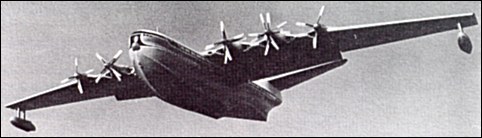
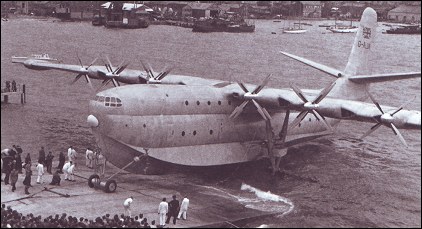
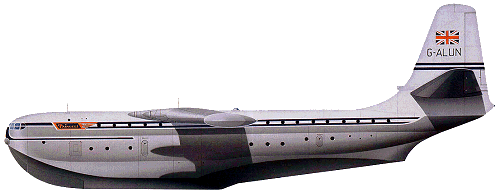
| The three prototypes of the giant Saro SR.45 Princess flying-boat, ordered in May 1946, were intended for non-stop transatlantic service by BOAC, but early post-war appreciation that landplanes could operate on this route just as safely and more economically killed all interest. Instead, the boats were to be completed as long-range military transports for the RAF, but the lack of a suitable powerplant brought even these optimistic hopes to an end. Larger than the Martin Mars and heavier than the Bristol Brabazon I, the Princess prototype was flown for the first time on 22 August 1952 and spanned 66.90m with its wingtip floats retracted, weighed 156,492kg on take-off, and could attain a maximum speed of 579km/h on the power of its 10 2386kW Bristol Proteus 600 turboprop engines. These were mounted in the wings as two single outboard engines and four inboard paired engines, but development problems with the gearboxes of the inboard engines contributed to the decision to end development. The second and third Princesses did not fly and were cocooned.
FACTS AND FIGURES © The four inboard nacelle units
were coupled engines driving
contra-rotating propellers.
The outboards were single
engines and propellers. © Despite the obvious
obsolescence of the flying
boar, Saro wanted to build
even bigger jet versions with
up to 1000 passengers. © The flight deck crew consisted of
two pilots, two flight engineers, a
radio operator and a navigator.
Two decks carried 105 passengers
in first and tourist class.
| MODEL | SR.45 "Princess" |
| CREW | 6 |
| PASSENGERS | 200 |
| ENGINE | 10 x 3780hp Bristol Proteus 2 turboprops |
| WEIGHTS |
| Take-off weight | 156500 kg | 345025 lb |
| DIMENSIONS |
| Wingspan | 66.90 m | 220 ft 6 in |
| Length | 45.11 m | 148 ft 0 in |
| Height | 17.37 m | 57 ft 0 in |
| PERFORMANCE |
| Max. speed | 612 km/h | 380 mph |
| Cruise speed | 579 km/h | 360 mph |
| Range | 8484 km | 5272 miles |
| grahamclayton, e-mail, 07.05.2023 08:33 What a leviathan! reply | | James Harwood, e-mail, 27.04.2023 20:10 In 1948 I was as an 11 year old attending an Air League of the British Empire camp at the Hamble flying school when a trip was arranged to visit Saunders Roe at Cowes where the Princess flying boats were being built. I have photos of the occasion and also also of a prototype SRA /1 jet seaplane which took off whilst we were there and crashed into the sea when landing.A memorable day. reply | | Ellen Bunton, e-mail, 07.10.2022 04:54 Dear Webmaster, I present to your attention adultpbn.site - this exchange for the automatic sale /purchase of adult links!
When you buy links on the site adultpbn.site - your site will get a sharp increase in search engines and accordingly you will get quality traffic - and that's money!
When you sell links from their sites - you'll get a passive income!
Register on the site adultpbn.site - and start earning!
Sincerely, adultpbn.site team reply | | Miles Watson, e-mail, 16.02.2020 23:44 Amazing Plane. Such a Beauty! reply | |
| | Howard, e-mail, 14.06.2017 03:12 I left England in Mar 1952 and sailed out from Southampton as a small boy. Sorry I missed this last British Flying Boat, but have been associated with a group that held a 60 yr. first flight anniversary at the East Cowes former Saunders Roe hanger..a great time, and a long trip over from the U.S. meeting some really wonderful former Saunders Roe employees. reply | | David Irvine, e-mail, 27.12.2016 01:49 As a boy I lived near Bordon in Hampshire and used to listen to Raymond Baxter's radio commentaries about the Farnborough airshow and in 1953 heard him say the Princess flying boat would be coming in from Cowes. As I continued to listen I suddenly heard an aircraft approaching and rushed out to see it fly overhead.
I continued to listen to Raymond and he covered the Princess's display and then said it was returning back to it's base. After a short while I heard it again and went out again to see it fly over.
I feel that as a result of that incident (and personal visits to the show in subsequent years), I was convinced to get involved in aviation and thus 6 years later I commenced my apprenticeship at de Havilland, where I ultimately worked on the Comet airliner, etc. reply | | Barbara Chapman, e-mail, 12.11.2016 18:49 My Father, grandfather, Uncle and cousin all worked for Saunders Roe. At the age of 4 I can remember standing on the slipway at West Cowes, with my hands on the fencing, watching the flying boat being cacooned. This was one of my last memories whilt we still ived at East Cowes, as Dad had been head hunted and we moved to Surrey as he went to work for Vicars at Weybridge later working on Concorde. reply | | EricDyer, e-mail, 15.05.2016 17:28 I remember seeing the princess and the brabason side by side flying over freshwater after being at the farnbough air show in 1953the brabason flew with the princess and flew over cowes for the worker to see then the princess flew with the brabason To Fulton so that the Bristol worker could see them both then retuned too cowes reply | | peter matthews, e-mail, 18.06.2015 16:47 In the late 1944 s I was a deck hand on paddle steamer lord Elgin run by the isle of white Co .we had the job of transporting parts and materials for the princesses .the thing I remember was the size of the propellers in their crates .I well remember them at calshot we once tied up at their pier. reply | | Axel., e-mail, 13.05.2015 01:08 Hi folks.
I seem to be younger than most here so my only eye-contact with one of these came at the very end of their life and early in mine. I read the last went for scrapping in 1967. I saw one awaiting the axe I presume on Calshot spit from a Thorensen ferry going down the Solent en-route to Le Havre. So I guess that must have been my first trip on that route, in 1968, when I was not yet 8 myself.
Well I have always assumed thats what it was. Perhaps someone in the know can enlighten me. Its been pointed out here that they were cocooned in black rubber but as I remember this the aircraft I saw was grey. Had the covering been removed for inspection during the putative overseas sales bid? I cant think of any other aircraft with that appearance and size. As I remember it, a forlorn whale aground, parked haphazardly and incongruously on the bleak slipway.
This is one of those cherished glimpses of things that connect me back to a time before I was born in a way nothing in a museum ever can. reply | | Tim Neville, e-mail, 04.01.2015 00:30 I was a 10-year old boy on holiday on the IoW and on a round-the-island trip on a paddle steamer when, as we were passing Cowes, it was announced that the Princess was taxiing out. Most of the passengers rushed to the appropriate side of the deck and we had a good view of her taking off on her maiden flight. I wonder how many there are today who actually saw that take-off. I saw her several more times during that holiday, escorted by a DH Vampire, I think it was. reply | | Peter Page, e-mail, 26.07.2014 08:29 Memories! I now live in Australia and worked on the Princess at Saro but left in 1950 so did not see it fly (shame)but remember being a 'dolly boy' rivetting the hull and still have my hearing!!! reply | | Simon Chaddock, e-mail, 14.06.2013 01:52 There is a You Tube video of the Farnborough fly past.
Search "Saro Princess flyby"
Apparently all those on the Saunders Roe stand had their fingers crossed that all ten engines would keep going as many of her 100 flights ended with an engine failure! reply | | Leonard Brett, e-mail, 10.01.2013 10:43 It was nice to see Eric Jollife's comments on the radio station I had equiped, the wire recorder was by Armour of America and was one of only two in this country on loan from America the other one was at Farnborough, and I had to go to the Air Ministry in London to get this one which was on short term loan for me to record the pilot during the test flight.So I can say that we had the first speech recorder on the Island. reply | |
| | ERIC G. JOLLIFFE, e-mail, 08.01.2013 22:42 With ref. to comments by Leonard Brett, he refers to the ground radio station ( Guildar Control) for the SRA /1 and Princess -I was his apprentice at the time 1947. My first radio station using vhf tranceivers TR 1143 and a wire recorder. reply | | Anthony, e-mail, 28.11.2012 23:58 When an engineering student at Hamble many years ago, I took my 6ft. span flyingboat with a trainee pilot fiend in a small boat for it's maiden flight. We went down the Hamble river and well out into the Solent, started then stopped the tiny Elfin engine to make adjustments, when we happened to look towards Cowes. There must have been a north wind that day, for coming towards us at full song was the Princess for it's maiden flight, it passed low over our heads. What a sight, never to be forgotten. I wander to this day if we were observed by anyone on board, and what inspection of the takeoff run is carried out on such an occassion. reply | | John Collier, e-mail, 25.08.2012 00:25 I went on the same trip as Jack Mercer as I was at the same school, Little Appley at Ryde. reply | | Brian Paddock, e-mail, 16.08.2012 12:04 I went to York st. in Cowes school at the time the princess was built and often watched her take off and land.The first memory of hearing the roar of her engines was when we were out in the playground and on hearing the roar of her engines a lot of kids threw themselves to the ground,perhaps memories of the war. she was a beautiful sight and was a shame the program was scrapped reply | | Paul Wyatt, e-mail, 22.07.2012 09:33 My father worked at the RAE at this time and told me that the operational model that flew experienced severe engine problems with salt water getting into the engines during take off and landing. I saw the flight over Farnborough and thought it the most beautiful airplane ever at that time. reply | | Jack Mercer, e-mail, 06.03.2012 23:22 I was at Little Appley School near Ryde and we were taken to The SR factory to see the flying boat being produced. To a small boy it was an incredible size. Wec were told by the headmaster, Mr. Mitcheson, not to take any "bits" away with us. Apart fom being away from school it was a wonderful day to see this magneficent plane being made. reply |
|
Do you have any comments?
|
| 
COMPANY
PROFILE
All the World's Rotorcraft
|