 |
Short S.23 Empire1936 |  |
| PASSENGER FLYING BOAT | Virtual Aircraft Museum / United Kingdom / Short |
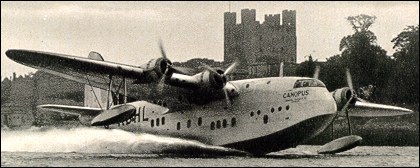 |
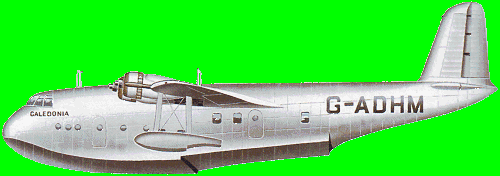
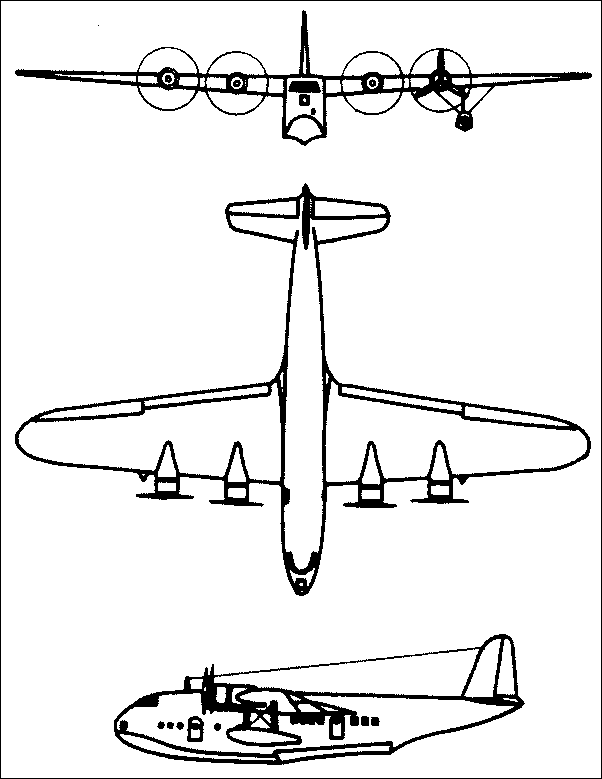
In 1935 the British government took the bold decision to carry all mail within the Empire at the ordinary surface rate (in Britain then equal to 0.625 p). Combined with.increasing passenger traffic, this called for a sudden expansion of Imperial Airways and the equally bold decision was taken to buy 28 of a totally new flying-boat 'off the drawing board' from Short Brothers. Flying-boats were then favoured because they could be more heavily loaded than landplanes, the latter being constricted by the small and rough fields available. The prototype S.23 made its very successful maiden flight on 4 July 1936. It was named Canopus and all sister-ships had names beginning with C, the boats also being known as the C class. Features included light-alloy stressed-skin construction; a cantilever high wing with electric Gouge flaps; four 685êW Bristol Pegasus Xc radial engines driving DH Hamilton two-position propellers; and a streamlined nose incorporating an enclosed flight deck for captain, first officer, navigator and flight clerk. A steward's pantry was amidships and in the normal configuration seats were arranged in front and rear cabins for 24 passengers. On long hauls sleeping accommodation was provided for 16, with a promenade lounge. On some routes experience showed that the mail capacity had to be raised from 1.5 to 2 tonnes, reducing the passenger seats to 17. All 28 were delivered, plus three for Qantas (Australia). Two were long-range boats with increased weight and transatlantic range. Eleven S.30s (eight for Imperial and three for Tasman Empire Airways) had 663kW Perseus XIIc sleeve-valve engines and greater range - the first four also being equipped for flight refuelling to greater weight. The final two boats were S.33s with increased weight and Pegasus engines. During World War II most of these great aircraft served on long routes all over the world. Four were impressed for RAF use with radar (two being destroyed in Norway in May 1940) and most were re-engined with the same 752kW Pegasus 22 engines as the Sunderlands (the derived military version). Their achievements were amazing: one made 442 crossings of the Tasman Sea, two evacuated 469 troops from Crete and one was flown out of a small river in the Belgian Congo in 1940. Others maintained schedules on the North Atlantic, between Britain and Africa, the dangerous Mediterranean route from Gibraltar to Malta and Cairo, and the Horseshoe route between Australia, India and South Africa. Most were retired in 1947
Rachel Sweasey, e-mail, 15.06.2023  Leslie dawson Leslie dawsonHi Leslie, leslie dawson, 27.09.2023 Rachel SweaseyHi Rachel Leslie Dawson, e-mail, 26.04.2022 David GurneyHallo David, Barry Slatter, e-mail, 14.10.2021 David GurneyHello David, Anonymous, 28.11.2020 Yoel SherMy father flew home from his army service in Kenya at the end of the war in a C-Class, he flew the same route as you did from Kisumu to Khartoum and thence to Cairo. Lyle Beavers, e-mail, 23.06.2020 Yoel SherI have two certificates of contemporary travel from the Canopus dated 14 /1 /1939. The commander George C. Bults. Would be happy to send you a picture if you are still around and interested. Leslie dawson, e-mail, 15.07.2021 Geoff GurrHi Geoff Paul Sheehan, e-mail, 29.10.2020 Geoff GurrHi there Geoff. If you can give me the dates of your travel, I can give you all the details. Please feel free to email me. Yoel Sher, e-mail, 13.12.2020 Paul SheehanHi, I flew 80 years ago (10-15.1.1941) from Lourenço-Marques to Tiberias on Canopus and Cleopatra, but cannot remember which was first and which second. and if we changed planes in Khartoum or Cairo. Leslie dawson, e-mail, 15.07.2021 sandra.waltersHallo Sandra
|  COMPANY PROFILE | |||||||||||||||||||||||||||||||||||||||||||||||||||||||||||||||

|


|
Hallo Beverley
Canopus was the flagship for the famous empire or C-class flyingboats operated from Southampton (Imperial Airways) and then Poole Harbour (BOAC) during the war.
My Wings Over Dorset- and more recently Fabulous Flying Boats (Pen and Sword) details their history and what they were like to pilot and to be flown by as a passenger.
The Solent Sky museum in Southampton is crammed full of historic aircraft and features- and was built for- the flyingboat operated by Charles Blair as Southern Cross. The Aussies subsequently requested it was exhibited as Beachcomber, its former name, before bought by Charles Blair, whose wife was the lovely Maureen O'Hara.
You might also be interested in my latest book - 20th Century Passenger Flying Boats- a pictorial follow up to Fabulous Flying Boats with over 100 large photographs of their history.
Regards
Leslie Dawson
Bournemouth, Dorset
reply