|
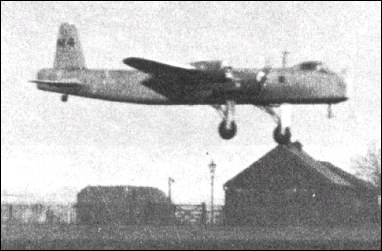
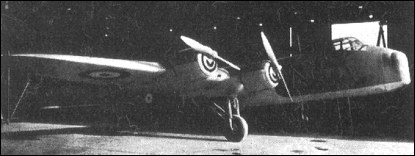
| After receiving orders for two prototypes and 100 production aircraft to the S.29 design which became the Short Stirling, Shorts built in 1938 a 1/2-scale prototype at its own expense. Powered by four 90hp Pobjoy Niagara III engines, this Short S.31 was mostly of wooden construction apart from a semi-monocoque fuselage, and seated two in tandem. In overall silver finish and marked M4, the Short S.31 flew on September 19, 1938, at Rochester. It later acquired a lengthened u/c (as adopted meanwhile on the Short S.29 to give greater effective wing incidence during take-off and landing); then in January 1939 it was fitted with 115hp Niagara IVs and in March with a larger tailplane. In 1940, now in green/brown camouflage with yellow undersides, the Short S.31 was fitted with Va-scale mock-ups of the Boulton Paul Type O ventral and Type H dorsal twin-cannon turrets proposed for a version of the Stirling II, and was tested in the RAE 7.3m wind tunnel. Further flights were made from March 13, 1942, onwards (with a shortened u/c), and the Short S.31 was scrapped after a takeoff accident at Stradishall in February 1944.
| WEIGHTS |
| Take-off weight | 2586 kg | 5701 lb |
| DIMENSIONS |
| Wingspan | 15.09 m | 50 ft 6 in |
| Length | 13.31 m | 44 ft 8 in |
| PERFORMANCE |
| Max. speed | 290 km/h | 180 mph |
| Alec Travers, e-mail, 21.10.2025 21:00 A pity there don't appear to have been any photos taken of the S.31 in the company of an S.29 Stirling - it would have made for an amusing comparison! reply | | Mike Dunne, e-mail, 24.07.2015 11:00 Heard an interesting story about Captain Eric Brown looping the S-31 in front of some truly amazed fighter pilots who obviously thought, at a distance, that they thought it was a full size Stirling!! Anyone out there verify this amusing yarn? reply | | Matt Bearman, e-mail, 10.10.2014 07:49 The 'Hangar Doors' story is an oft-repeated myth. No RAF hangar doors were 100ft. reply | | Wrong Shorts, Ben!, e-mail, 04.06.2014 15:13 Ben, you'd be better off leaving your comment on the page for the Shorts S.29 Stirling because that is the aircraft which you are describing. This page is about the Shorts S.31 experimental test bed which, neither being a bomber nor having to traverse the Alps, was not overly hampered by it's relatively short wing. reply | |
| | Ben Beekman, e-mail, 07.02.2011 22:43 We can't possibly let this page go by without bringing to light the reason for this promising design's miserable performance. According to Wm. Green's book "Famous Bombers of the Second World War", Volume 2, (Hanover House,1960)the government's design specification required that the wingspan be less than the 100-foot wide door opening of standard R.A.F. hangers. The resulting low-aspect ratio wing of 99-ft 1 inch span with its high induced drag had the expected adverse effect on performance. The maximum loaded service ceiling was thus only 16,500 ft, forcing pilots who were attacking targets in Italy to fly through the Alps rather than over them! Not only that, but the size of the fuselage cross-section was dictated by the size of standard packing cases! The design of its bomb bay, divided into three longitudinal cells by two strengthening girders, prevented the carrying of the really large "blockbuster" size weapons which came into use later in the war. Another drawback was the mid-mounted wing. Though offering certain advantages in flight, the mid-wing location required an exceptionally tall undercarriage that resulted in a tendency of the loaded aircraft to swing dangerously on takeoff, especially on muddy grass fields. Only 2,375 Stirlings were ever built owing to the impossibility of modifying the design to meet the later wartime requirements.
The figures given above are for the half-scale flyable model built to perform certain aerodynamic tests and are, naturally, scaled down. The actual dimensions of the Stirling were:
Span: 99 ft. 1 inch
Length: 87 ft. 3 inches
Height: 22 ft. 9 inches
Wing area: 1,460 sq. ft.
Engines: Four Bristol Hercules XI 14-cylinder sleeve- valve, double-row, radial air-cooled engines rated at 1,590 hp for takeoff.
Weight: 59,400 lb. normal loaded; 70,000 lb. max. permissable.
Max. speed: 245 mph at sea level; 260 mph at 10,500 ft; Economical cruising speed: 200 mph at 15,000 ft
Range: 1,930 miles with 5,000 lb bombload; 740 miles with 14,000 lb bombload. reply |
|
Do you have any comments?
|
| 
COMPANY
PROFILE
All the World's Rotorcraft
|