|
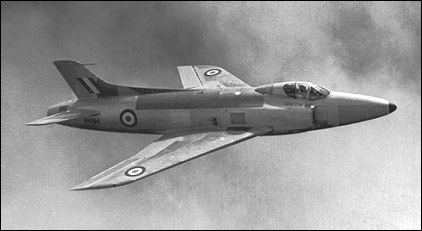
| The Swift was a single-seat swept-wing fighter powered by a Rolls-Royce Avon axial-flow turbojet engine. On 10 July 1952 the prototype established an international point-to-point record between London and Brussels, covering 320km in 18 minutes 3.3 seconds, representing a speed of 1,071.7km/h. On 25 September 1953 a Swift F.4 raised the world speed record to 1,184km/h over a 3 km course.
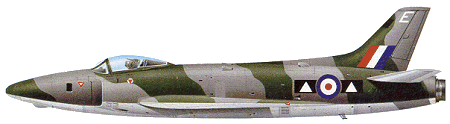
The RAF received a total of about 60 Swift F.1s, F.2s and F.3s, with an Avon RA.7 turbojet engine and two 30mm Aden cannon; four Aden cannon and a new wing planform with compound leading-edge taper; and with an Avon RA.7R engine with afterburner and changes to the rear fuselage respectively. These versions were not used operationally. The Swift F.4 had an all-moving tail of increased area. Only the FR.5 was used for any length of time and was a fighter-reconnaissance aircraft with a longer nose to accommodate a camera. Deliveries began in 1956. Sixty were flown by the RAF; one further aircraft ordered crashed on delivery and several others were not completed.
FACTS AND FIGURES © The F.4 and later models had
a variable-incidence tailplane
which finally cured the
Swift's pitch-up problems. © During development the engine was
changed from the Rolls-Royce Nene to the
slimmer Avon. It was too late to change the
fuselage, which was fatter than necessary. © Armament of the Swift F.1 and FR.5
was two 30mm cannon.
Most other models had four 30mm cannon, and eight
unguided rockets.
| MODEL | Swift FR. Mk 5 |
| CREW | 1 |
| ENGINE | 1 x Rolls-Royce Avon 114 turbojet, 42.04kN |
| WEIGHTS |
| Take-off weight | 9707 kg | 21400 lb |
| Empty weight | 6094 kg | 13435 lb |
| DIMENSIONS |
| Wingspan | 9.86 m | 32 ft 4 in |
| Length | 12.88 m | 42 ft 3 in |
| Height | 4.11 m | 14 ft 6 in |
| PERFORMANCE |
| Max. speed | 1102 km/h | 685 mph |
| Ceiling | 13960 m | 45800 ft |
| Range | 1014 km | 630 miles |
| ARMAMENT | 2 x 30mm cannon |
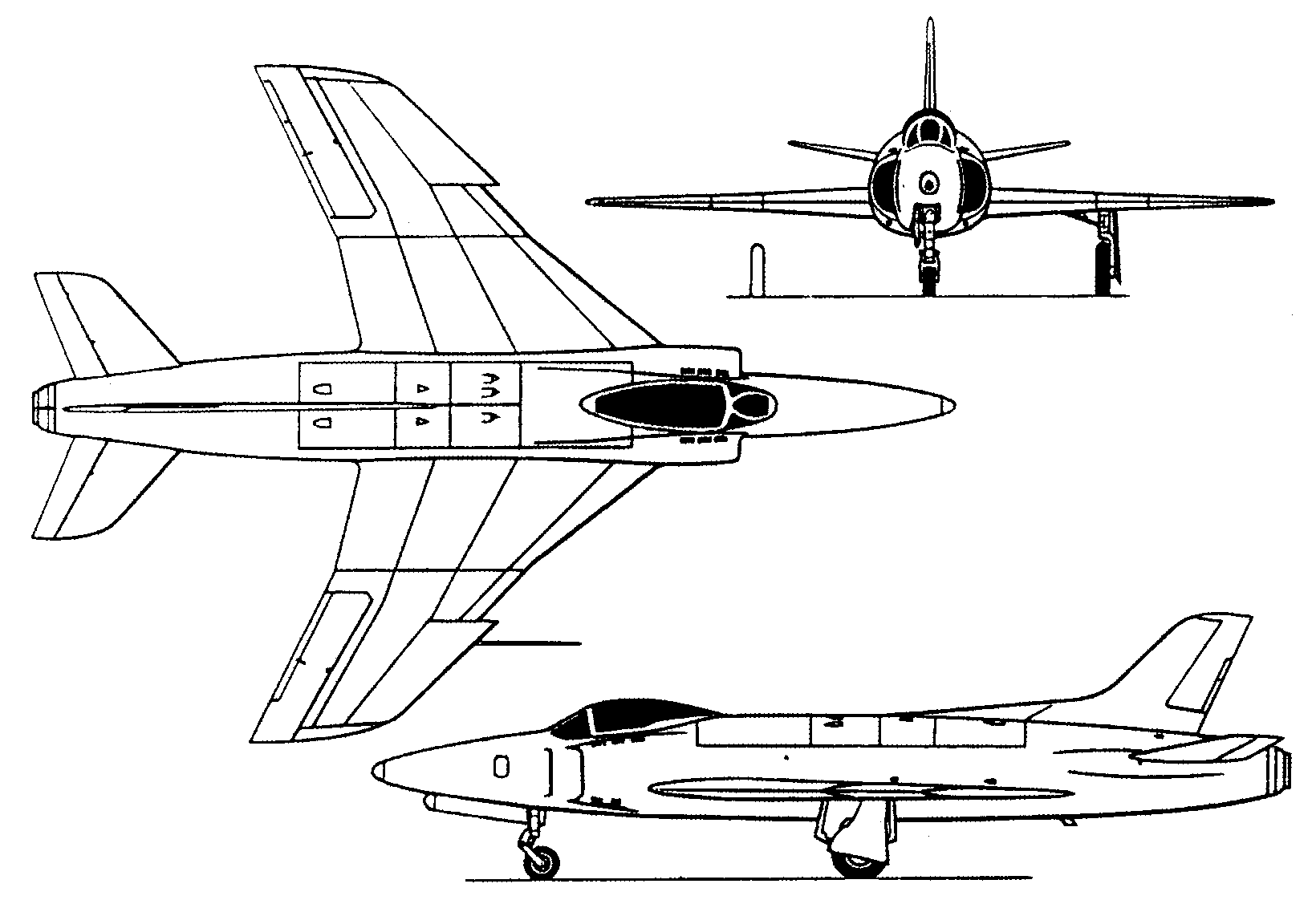
 | A three-view drawing (1640 x 1127) |
| Newton Revell, e-mail, 21.09.2016 23:37 I just finished two Swift models, the early model by Hawk (primitive by today's standards), and Airfix's new FR5. A good opportunity to learn about this early and largely forgotten aircraft. The early development from Seafang, to the Attacker, then the various Mks of Swift is fascinating.
I am an ex-USAF avionics tech on 1970's interceptors, so this research broadens my knowledge on jet interceptors. Great info, guys! reply | | Frederick Bower, e-mail, 06.10.2015 14:28 Bower First a Question is the Fr4 flying as of 2014 or if not is it on track to fly?. I served on 2 Sqd RAF Jever 1959 to March 1961 as a S,A,C, First line Electrician. reply | | Mike Thorne, e-mail, 15.04.2014 17:03 A Mk 4 Swift was discovered in Hereford and bought by Tim Wood and this is being renovated and on course to fly Summer 2014. It is the only one left in the world, my late father Peter Thorne flew it in 1955 when lead test pilot A Squadron Boscombe Down, and though he liked the later versions, he was one of the people whose observations from flying the Swift lead to its not becoming the RAFs mainstream fighter, despite considerable corporate military and political pressure for it to be so. I really look forward to hearing about this renovation (the engine is in really good condition and the cockpit was sealed apparently so it is vgc despite being outdoors for years!) We heard about this a fortnight ago in a message for ymy Dad, who had died only days before 9(with a picture of the Swift in his nursing home room: RIP) reply | | Ken Foster, e-mail, 24.06.2012 22:44 In the spring of 54 it was announced that – in recognition that the Leuchars Wing was the "Point of the Air Defence Spear" - it was to be the first to be equipped with the new swept wing fighters. No 43 Squadron were to be equipped with the short range Hunter F1s and No 222 Squadron to have the longer range Swift F1s by the Summer. After receiving poor reports on the performance of the Swift F1 from Central Fighter Establishment, the 222 Squadron Commander, his Flight Commanders and PAI flew their Meteor F8s to CFE, West Wraynham for simulated air combat flights against Swifts flown by CFE's 'Aces'. At altitude, the Swifts were completely outmanoeuvred by the Meteors and so without hesitation the CO declared he would not accept the Swift for 222! There was a hurried change of plans and 222 were then allocated Hunter Mk 2s to arrive in November, 54. reply | |
| | S Beveridge, e-mail, 01.05.2012 13:19 There was a story circa 1960 going around that the Swift was prone to catching fire. In this case a person went up as a passenger for a trip. The pilot told him the bail-out procedure in the event of a fire. The passenger asked how much time he had in this event. The pilot said that if he called eject and the passenger said 'What?' he would be talking to himself.
It may be just a story of course but where there was smoke...! reply | | John, e-mail, 29.11.2011 13:54 I was a boy in 1954. While doing a paper round I saw a model of the Swift in a window of the house I was delivering to. I knocked and asked the man if I could have a look at the model. He willingly obliged and asked would I like it? I kept that model for years. It was a solid model and beautifully finished. At that time in 1954 I was enthralled with its strong, good looks especially the wings. Recently I bought a model of the Swift although it could never replace the one I had when I was a boy. reply | | colin cunliffe, e-mail, 19.08.2011 14:00 In 1959-61 I was Sergeant i /c Grd Equipment at RAF JEVER in Germany. We had Swifts with 2 Sqd. Flt,Lt Roy Rimington had a flame out and on ejection his harness came undone, caught on his boot buckle, and he landed head first in a river!. See story on superb website 'raf jever'. Also Pete Adair, in a Swift, engaged the Crash Barrier at approx 150 knts a record at the time. The Barriers were my responsibility so my team helped to get him out and repair the Barrier, in 6 inches of snow and freezing. reply | | paul scott, e-mail, 01.07.2011 22:53 Yes the later versions, Crawshaw, didn't have the same probs above 25,000 feet, though as another says, the serious problems with reheat not igniting at high level so led to it not ever achieving pure interceptor status. It performed better at low level. Also later versions, encompassing four cannons meant that the wing root was extended and affected performance considerably. So much so, that ballast was added in the nose, for stability and then affecting aerodynamic ability. A nice looking aircraft, but sadly, probably best like the WW2 Typhoon, better at ground attack /low level. reply | | bombardier, e-mail, 22.05.2011 19:27 The Swift had many problems especially on it's early versions,it was dangerously unstable and it's afterburner couldn't be lit at high attitude.Despite it's problems it had a lot of distinctions as well,it was the first swept wing jet to serve the RAF,it was the last production aircraft to hold the world speed record,the F7 variant was the first British fighter with guided air-to-air missiles. reply | | Barry, 10.03.2011 16:35 Although the F1 and F2 equipped 56 Squadron from February 1954 to May 1955, this plane was never a great success in service even though the FR5 did serve with some distinction with Nos 2 and 79 Squadrons in RAF Germany. Eventually twelve examples of the F7 were produced with a radar nose, slab tail, afterburning and armed with Fireflash missiles giving this fighter the performnce and capabilities that it deserved. Unfortunately they were never to enter service and so another "what if". reply | | Gordon Lukert, e-mail, 18.01.2011 04:21 Sept 1952 until Dec. 1955 I worked for Vickers-Supermarine at Hursley, Hants, as a layout draughtsman. I remember laying out the type 541, 544, 545 & 546. It was a great day when the 541 took the speed record in Tunisia. reply | | John, e-mail, 05.01.2010 14:22 The Swift FR5 had 3 F95 cameras in the nose - 1 facing forward & 2 facing sideways. Also a G45 gun camera
It served with 79 squadron in Gutersloh, Germany in the late 1950s reply | | Crawshaw, e-mail, 19.10.2009 18:18 The Swift Mk 5 had no problems above 25000ft. It was wonderfully stable at high speed /low level making it a superb photographic platform. Only problem range at low level without slipper tank reply | | paul scott, e-mail, 14.08.2009 00:21 A fine looking aircraft, shame that it had problems /dangerous flying conditions above 25,000 feet - ironic that the excellent Spitfire had never been bettered by the company and just faded into oblivion. reply |
|
Do you have any comments?
|
| 
COMPANY
PROFILE
All the World's Rotorcraft
|