|
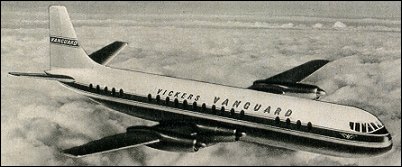
| The very considerable success of the Vickers Viscount in airline service was due to the smoothness, economy and reliability of its turbine engines. In one enormous leap it had raised cruising speed almost 100% by comparison with the piston-engined Vickers Viking; it carried two or three times as many passengers (according to type) and offered increased range. In early 1953, not long after the Viscount entered service with British European Airways (BEA), discussions began to initiate the design of a successor. Both BEA and Trans-Canada Airlines were interested in a generally similar aircraft; compromise in design to satisfy the views of these two operators resulted in the low-wing configuration and 'double-bubble' fuselage to provide a large underfloor cargo hold beneath the main cabin.
The power plant considered originally for inclusion in the design was the Rolls-Royce Dart. But Rolls-Royce intimated that development of a new engine, the RB.109, was then well under way and it (later known as the Tyne) was chosen to power this new transport. Construction was entirely conventional except for the wing, which introduced integrally machined skins of light alloy to provide spanwise stiffening at low cost, and three shear webs instead of the single spar in the Viscount wing. When tied together by closely spaced ribs it produced a rigid box structure and outboard of the centre-section it was sealed to form integral fuel tanks.
First flight of the prototype Vanguard, as the new aircraft had been named, was made on 20 January 1959. But because of the normal development programme of a new civil airliner - coupled with delays caused by problems with the new power plant - it was not until 1 February 1961 and 1 March 1961 that these aircraft began regular service with Trans-Canada Airlines and BEA respectively. By then this and other second-generation turboprop-powered airliners had been deposed by the development and introduction into service of economical turbojet-powered airliners such as the Boeing Model 707. Consequently production ended after the original orders had been completed: 20 for BEA and 23 for Trans-Canada Airlines.
On 10 October 1969 the first of nine freighter conversions of the Vanguard, called Merchantman, was flown for BEA.
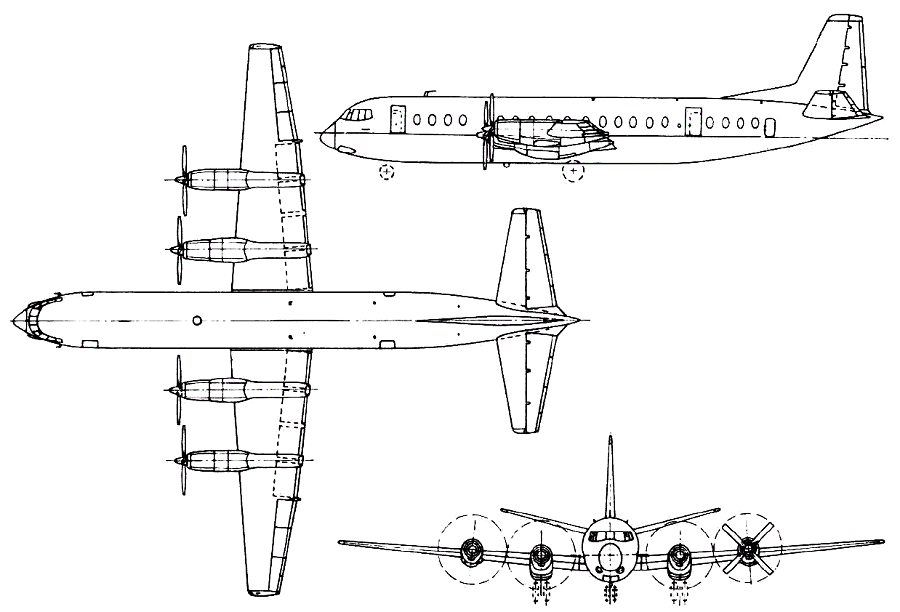
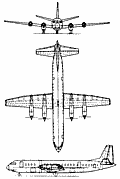 | A three-view drawing (900 x 612) |
| MODEL | Type 952 "Vanguard" |
| CREW | 2-3 |
| PASSENGERS | 97-139 |
| ENGINE | 4 x Rolls-Royce Tyne RTy.11 Mk 512 turbo-prop, 4135kW |
| WEIGHTS |
| Take-off weight | 63977 kg | 141046 lb |
| Empty weight | 37421 kg | 82500 lb |
| DIMENSIONS |
| Wingspan | 36.14 m | 119 ft 7 in |
| Length | 37.45 m | 123 ft 10 in |
| Height | 10.64 m | 35 ft 11 in |
| Wing area | 141.86 m2 | 1526.97 sq ft |
| PERFORMANCE |
| Cruise speed | 684 km/h | 425 mph |
| Ceiling | 9145 m | 30000 ft |
| Range w/max payload | 2945 km | 1830 miles |
| Michael Davis, e-mail, 04.05.2020 15:56 Like Martin Lovegrove, I too was a co-pilot on Vanguards in the late '60s before escaping at last onto a jet, the Comet 4B. My memories of that era were too many early mornings to Glasgow, Edinburgh and Belfast, and the weirdness of the RR Tyne engine which had to have its HP shaft splines, "excercised" at the top of climb and then again an hour later in the cruise. Apparently the splines stretched under power - hardly imaginable in this day and age. Verdun's last email overlooked the ADLS system which seems as complex as Rolls could devise - Auto Drag Limiting System - which was triggered in the event of an engine failure - Again, only God now understands it, I never did! reply | | andrew Salmon, e-mail, 01.03.2020 19:20 The First Plane I Flew on was a Air Canada Vanguard from
Toronto to Canadas Capitol Ottawa, Canada and back in 1966.
I went with my School Classmates and our Teacher. It was a
thrill of a lifetime for me and I still have the Boarding
pass. I was 11 years old and had a Grand time! Andrew reply | | Tim, e-mail, 22.12.2016 00:42 Fifty years ago I experienced my first ever flight on a commercial airliner - a Vickers Vanguard from Heathrow to
Gibraltar, on December 23, 1966. I was not quite 7 years old, traveling with my Mum and Dad and 1 year old brother.
I got to see the cockpit during that 40 hr and 40min flight, I asked the pilot if he had an ejector seat! Nice food and plenty of attention from the cabin crew. Half a century and a couple of hundred flights later I have to agree that airline service is not quite what it used to be - or perhaps no flight since has ever quite lived up to what is among the best of my childhood memories. I think Brookfields Museum is a very fitting place for the Vanguard to spend her retirement. reply | | Martin Lovegrove, e-mail, 25.02.2016 23:52 Brilliant aircraft. I was a co-pilot on them with BEA from 1969 to 1974, both passenger and freight. A real aircraft that relied on pilots rather than computers. While at school, I went on the wooden mock-ups of both the Vanguard and VC10, little realising that I would be flying one of them later. reply | |
| | allan carson, e-mail, 21.07.2015 19:28 This was the very first aircraft I flew on in July 1967 from Glasgow to Heathrow. As a 9 year old child I was escorted on to the plane before the other passengers. My parents had told me we would be going on a Trident, but despite initial disappointment I thought the Vanguard was large and luxurious and I'm very glad I got this one and only chance to fly on one. reply | | Michael, 02.04.2015 01:58 Like John Buscombe I flew from London to Malta to see my grandparents on BEA Vickers Vanguards. I remmber the 4 seats round a table which was like being on an old train. reply | | J.L.Jones, e-mail, 17.01.2015 18:06 I worked on the Vanguard right through the build during my apprenticeship and after .My claim to fame I wired up all four engine electric connectors to engine bulkheads on all but one Vanguard and this was because I was on Holiday. Fantastic aircraft. reply | | Mark57, e-mail, 25.11.2014 05:57 I have just seen the video of the 1996 return to Brooklands. I can't believe that I missed it. I have lived in Weybridge since 1959 reply | | Mark57, e-mail, 25.11.2014 05:54 First plane that I ever flew on October 1964. BEA Heathrow to Gibraltar. We sat face to face over a table. I remember the air pockets and dropping like a stone. Travel time was about 4 hours but great fun (aged 7) reply | | John Buscombe, e-mail, 06.08.2014 22:55 As a child of 8 flew to Malta on a BEA vanguard. Great plane. My memory (which may be wrong) is of 4 seats round a table at the back 2 rearward facing, small table 2 forward facing.
May back was a Comet 4B with much less room.
Also as a child waiting for my Grandparents at Luqa I noted most of the times the BEA Vanguard came in with an engine out reply |
| Jerry Senfluk, e-mail, 11.07.2014 21:35 P.S.: Sorry, spotted the mistake too late. Of course, in the middle of the paragraph before last, it should have been "their hands" instead of "there hands". reply | | Jerry Senfluk, e-mail, 11.07.2014 21:15 As a student in the '60, I used to spend half of my Summer holidays at the old Prague Airport. It was built at about the same time as the Croydon Airport; the terminal looked quite similar, too (some years ago, it has been rebuilt in the usual atrocious "modern" way but that's another story). In those days, BEA used to serve the London-Prague link with Viscounts. I didn't work in anything really exciting, just filling cargo holds with luggage and, occasionally, cargo of all sorts. Exciting enough for me, though, since I came into direct contact with all the aeroplanes I could only admire from a bit of a distance previously.
Although I am, to this day, a staunch fan of the piston-engined machines (Dakotas, Connies, Seven Seas & the rest, for there's nothing like the wonderful sound of their radials and the smell of burnt avgas), I did like the Viscounts with their original appearance and distinct whistling sound.
One day, BEA came in with a Vanguard, having to carry significantly larger amount of passengers. Hordes of football fans or something, gods know.
What an impressive sight!
During the start up of her Tynes prior to her return to London, I stood right underneath the tip of her port side wing. By Jove, they were the loudest engines I've ever heard. Well, with the exception of Tu-114's Kuznietsovs but I only ever saw this one circling around the airport, never having landed and taken off.
Everyone around me covered their ears with there hands. Not me, in my youthful stupidity. I just had to show what a hero I am. Paid a price for this, though: for the following 3 or 4 years, my ears were overproducing wax, getting clogged up frequently. Often so badly that I had to seek services of members of the medical profession.
Grand aeroplane, nevertheless. Alas, never had the opportunity to travel on her reply | | Bernie Proctor, e-mail, 10.05.2012 11:30 I spet the latter half of my apprenticeship on the Vanguard. I remember the the tests being made following the Lockheed Electra fatigue problems. I understood vibration on take off was due to the prop tips exceeding the speed of sound sometimes causing some inner panels to come adrift being 'velcroed' on reply | | danny, e-mail, 27.09.2011 16:35 the first time i ever flew. was on a chartered flght to Lourdes (school holiday) and it was in a vickers vanguard. i absoutley loved it.i have flown many times since, but nothing beats that first experience. i would love to fly in it again. reply | |
| | Alan Saunders, e-mail, 26.07.2011 22:12 I remember at the end of my apprenticeship being involved with the MNA aircraft coming back for their majors. Also seeing the last either being disposed off to Air Bridge or being reduced to spares. The MNA returnees always brought back it's own zoo, which gave options for large homemade spiders being dangled over unsuspecting tradesmen.
Brooklands Museum at Weybridge run (or at least last year 2010) run theirs as often as they can. search youtube for videos of its arrival (by air) and subsequent engine runs and open aircraft displays.
I never got to fly or be onboard for runs but the Vanguards did their engine runs next to the runway canteen, during those runs it was hard to find something that didn't rattle or vibrate off the tables! On those days lunch was always short.
1971 apprentice intake
BAED West Base 761A gang. last of the Vanguards and Trident Mods /Rib 5 repair 1975-1980.
ALS reply | | Roger Carvell, e-mail, 27.06.2011 17:21 I can remember the early BEA Vanguards, particularly on a Sunday. Why Sunday?. That was the day one would arrive over a sleepy RAF Manston in Kent, where I lived at the time in 1961. Each Sunday a BEA Vanguard (or a Comet 4B or Argosy) would perform countless circuits and bumps while undergoing crew-training. The aircraft came from Heathrow or Stansted (BEA's Vanguard training base). My father was a warrant officer in the RAF and he worked in the control tower at Manston. One Sunday he took me and my younger brother out onto the airfield to watch a Vanguard standing on the runway while the trainee crew went about their check lists. It WAS impressive, the big 'red square' BEA logos I recall well, and the din of the four Rolls-Royce Tynes was memorable and very exciting.
Another very good British airliner, often derided at the time as being too late for the airline market, but nevertheless an airliner that spearheaded standby, cheap fares for all.
So the Vanguard vibrated a lot but it was very economical. The perfect airliner has never been built.
The Vanguard would not look out of place today at any airport with new powerplants.
Best wishes,
Roger Carvell, Hitchin, UK reply | | Dave Eustace, e-mail, 16.05.2011 16:50 My Sister and I flew from then Malton International Airport now Pearson International near Toronto to London in a Vanguard Turboprop in 1961.I was 7 years old my Sister 8 and our Father gave an older Gentleman some money at the Airport to keep a "Weather Eye' on us and he booked a seat beside us and I remember he drank from a hip flask all the way.The Flight took 11 hours and I believe it was direct i can`t remember a stop.I do remember it was very noisy especially on takeoff.We flew back from London to Toronto in 1963 on a BOAC Vanguard or it may have been a jet aircraft.i remember the BOAC Stewardesses made a great fuss of my Sister and I,we visited the cockpit,were given BOAC juniour flight books with mileage and altitude and BOAC Juniour wings .In the juniour flight book there are pictures of the Viscount and Vanguard and write ups and I have kept these momentos to this day. reply | | webber, e-mail, 27.11.2010 18:35 Passenger in early 70's flt from Montreal-Quecec City and ret.Loved all the room but the occasional vibration that ran the length of the cabin periodically caused one to wonder a bit. Thus I felt more secure in the Viscount. reply | | valter, e-mail, 02.09.2010 13:12 I flew a Vanguard from Alghero (Sardinia) to London Heathrow on September 1962. It was my first travel abroad. Beautiful airplane. reply | | Verdun, e-mail, 10.03.2010 01:14 Robert – Sorry it took so long to get back. The Vanguards flying controls were all manual with the only assistance being through spring tabs. The controls were unlocked and a control check carried out when lined up on the runway and locked after landing while the speed was above 85 knots (any slower ran the risk of the controls thrashing about with the engines at ground idle.
Your question about propeller pitch (not infinitely variable, more correctly continuously variable between finite limits) is interesting. The engine control was described as "Single Lever Control", this in spite of the fact that there were 12 levers controlling the engines. However each throttle lever did have a complex operation. In the flight range moving the throttle forward gave more power from the engine and a higher prop RPM from the propeller control unit (PCU), in effect combining the functions of throttle and propeller lever. The fuel control unit (FCU) controlled power and the PCU controlled LP RPM.
When the throttle was moved into the ground range (amid a lot of locks and guards being moved) it controlled blade angle and the FCU kept the engine at idle. When the throttle was moved below ground idle into the reverse range (rarely used) the blade angle was still controlled by the lever and the LP RPM started to increase and was controlled by the FCU.
As far as propeller stops were concerned I seem to remember there were 7, all automatic. They were:
Course Pitch (feather) Stop
Reverse Pitch Stop
Overspeed Stop
Flight Fine Pitch Stop
Beta Follow Up Stop
And two I can't remember!
On the course we were told that only De Havilland and God knew how it works. I guess now that De Havilland no longer exist only He knows.
V reply |
|
Do you have any comments?
|
| 
COMPANY
PROFILE
All the World's Rotorcraft
|




Yes good memories of the Guardsvan too. I flew it as a copilot from 1971-78, Merchantman as well as pax Vanguard. I think the engine failures you mentioned were deliberately failed for initial pilot training which took place at Luqa in those days.
reply