 |
Vickers Virginia1922 |  |
| BOMBER | Virtual Aircraft Museum / United Kingdom / Vickers |
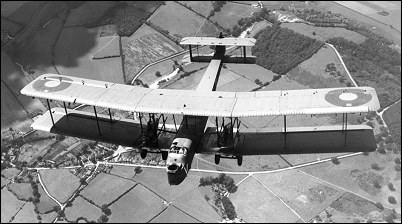 |
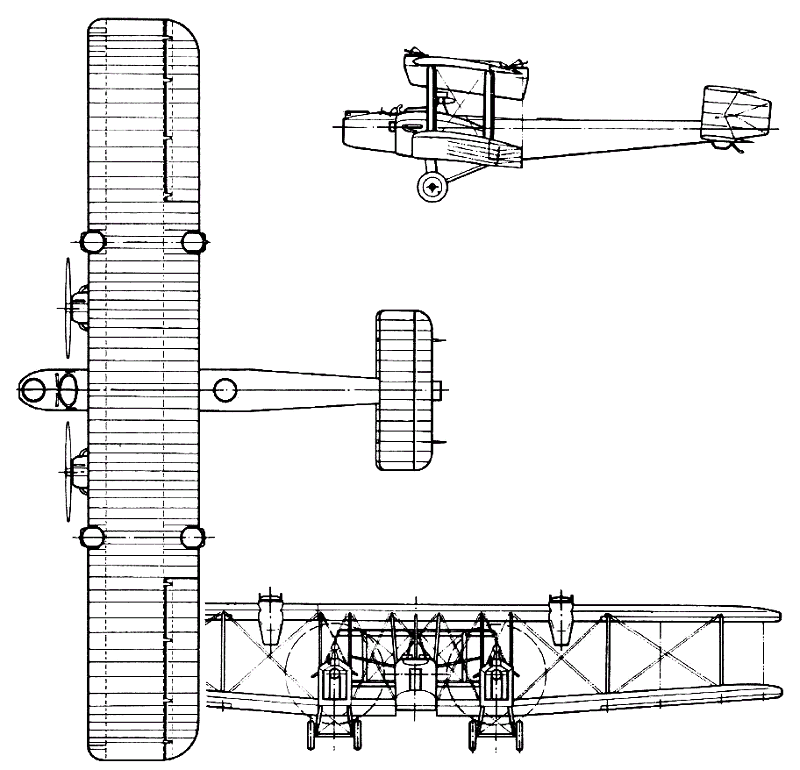
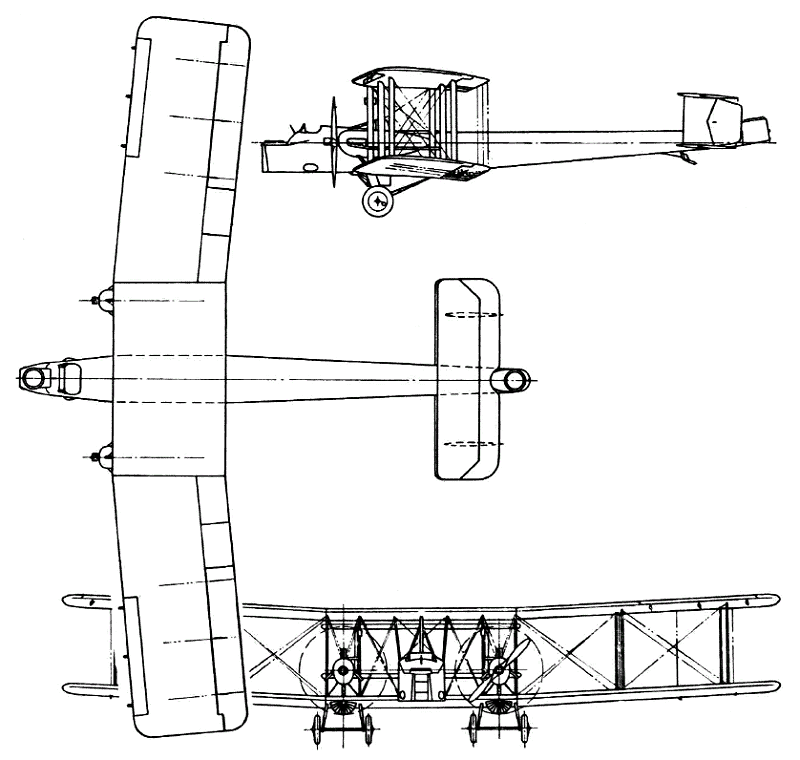
Designed to meet the requirements of Air Ministry Specification 1/21, the Vickers Virginia proved to be the backbone of the RAF's heavy night bomber force in the inter-war years. In fulfilling such a role from 1924 to 1937, this rugged and reliable aircraft made a considerable contribution to the development of the ideas and the experience of men who were the founder members of Bomber Command in World War II. Two aircraft were ordered initially, designated Virginia I and Virginia II. The former was the first to fly (on 24 November 1922), powered by two 335kW Napier Lion engines. It was basically an enlarged version of the Vickers Vimy, but had its Napier Lion engines mounted on the lower wings and enclosed in rectangular nacelles. Construction was mainly of wood and fabric with a fairly extensive amount of wire bracing. The second Virginia differed by having close-fitting engine cowlings; a Lamblin cooling radiator mounted between the landing-gear legs; a lengthened nose to provide more room for the bomb-aimer and, for the same reason, a slight decrease in intended bomb load; and a variable-incidence tailplane which could be adjusted in flight. Initially both the Virginias were unstable in flight, leading to modifications which included dihedral on both wings instead of on the lower wing only, introduction of larger rudders, an additional fin, and resiting of the engines further forward. The first production contract was for two Virginia Mk.III aircraft, generally similar to the Virginia II but provided with dual controls and changes in armament. Like the earlier prototypes, these were subsequently modified to later standards. Four additional aircraft were ordered in 1923. Power plant comprised two 349kW Napier Lion Series II engines. Again, these aircraft were later updated, being fitted with metal wings, and ended their lives as Mk.Xs. The two Virginia Mk.IVs which followed differed in electrical equipment and bomb load. First major production version (22 built) was the Mk.V, which had a third rudder, first test-flown on a Mk.IV aircraft; otherwise these aircraft were generally similar to the Mk.III. They were modified subsequently to later marks. Interestingly, Vimys were still being delivered at this time. The Virginia Mk.VI (25 built) was the first production version to include dihedral on both upper and lower wings as standard; design of the wing-folding mechanism was improved. It was followed by 11 Mk.VIIs, which introduced still further changes to improve stability - including introduction of Frise ailerons and sweepback on both wings. These represented such an improvement in flight characteristics that many earlier aircraft were modified subsequently to this Mk.VII standard.
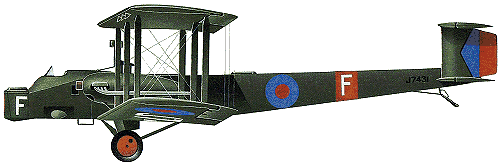 To provide adequate defence for these large and comparatively slow bombers there had been a number of experiments to locate gunners in 'fighting tops' - nacelles attached to the trailing edge of the upper wing. Apart from the aerodynamic problems, the gunners suffered from the cold and it was decided to introduce instead a gunner's position at the tail-end of the fuselage. This involved not only modification of the rear fuselage but increased tailplane span and a leng-thened nose to maintain good stability. These aircraft (eight built) became designated Mk.IX and some earlier aircraft were converted subsequently to this standard. Final version was the Mk.X, which introduced a metal structure with fabric covering (50 built). A large number of earlier aircraft were converted to include the more powerful engines, hydraulic wheel brakes, landing lights, and auto pilot which distinguished this, the last of the series. First entering service in 1924, Virginias remained in first-line deployment until 1937 and for four more years several remained in use, especially for parachute training
|  COMPANY PROFILE | ||||||||||||||||||||||||||||||||||||||||||||||||||||||||||

|


|