|
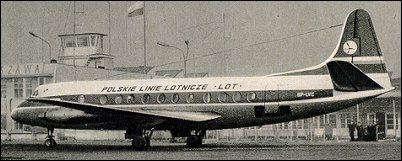
| During World War II the US had gained a considerable start in the design and development of long-range transport aircraft. To Britain the Viscount represented the belief and hope that its lead in the new turbine engine allied to the industry's enthusiasm would erode some of America's advantage in post-war civil aviation.
That this hope failed to materialise was due to a number of factors and space does not allow, for their discussion here. Suffice it to say that production exceeded 440 aircraft and orders from Capital Airlines of Washington for 60 aircraft represented a major triumph for the British aircraft industry.
The origin of the Viscount can be traced back to the war-time Brabazon Committee, which was charged with the task of steering Britain's aircraft industry in the right direction in the immediate post-war years. One of its recommendations was the development of a turboprop-powered short/medium-range airliner (identified originally as the Brabazon IIB), and in April 1945 Vickrrs were instructed to proceed with its design and development, then identified by the company as the VC2 project.
This was the first of the company's designs to be brought to fruition under the leadership of George (later Sir George) Edwards, following the death of Rex Pierson. The project undoubtedly benefited from the fact that Edwards was facing his first major design/production challenge, one which he met with tremendous practical ability and enthusiasm. As finalised, a circular-section pressurised fuselage was chosen with low-set monoplane wings, a Vickers-style tail unit, retractable tricycle-type landing gear and four of Rolls-Royce's new Dart turboprops.
Despite the efforts of Edwards, his design team and Vickers' engineers, interest in the project waned when BEA had doubts about the aircraft's economics in the autumn of 1947. Enthusiasm was at a low ebb when the Viscount 630 prototype flew for the first time on 16 July 1948. Its smooth performance and superb handling qualities left no doubt that the company had produced an exceptional aeroplane, and with BEA's co-operation a higher gross weight/increased capacity specification for 43 passengers was drawn up. A prototype of this new version was ordered by the Ministry of Supply in February 1949. By the time this flew for the first time on 28 August 1950, BEA had already bolstered Vickers' enthusiasm by ordering 20 (later 26) Viscount 701s on 3 August.
It was the beginning of a success story: the world's first turbine-powered aircraft to operate a revenue passenger service, and the first to demonstrate the smooth reliability of turbine power plants to a new generation of passengers who would soon be travelling across the face of the earth for both business and pleasure.
| MODEL | Type 810 "Viscount" |
| CREW | 2 |
| PASSENGERS | 75 |
| ENGINE | 4 x Rolls-Royce Dart RDa. 7/1 Mk 525 turbo-prop, 1566kW |
| WEIGHTS |
| Take-off weight | 32885 kg | 72499 lb |
| Empty weight | 18854 kg | 41566 lb |
| DIMENSIONS |
| Wingspan | 28.56 m | 94 ft 8 in |
| Length | 26.11 m | 86 ft 8 in |
| Height | 8.15 m | 27 ft 9 in |
| PERFORMANCE |
| Cruise speed | 563 km/h | 350 mph |
| Ceiling | 7620 m | 25000 ft |
| Range w/max payload | 2776 km | 1725 miles |
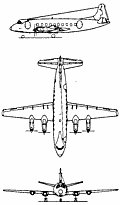 | A three-view drawing (800 x 580) |
| Ken Swain, e-mail, 23.03.2020 10:25 Flew both seats on this aircraft. Considered it a piece of junk but it was fun to fly. Very poor engineering by my way of thinking. Very unstable, underpowered electrically, turn the radar on and the air conditioning dropped off. Had to cross feed fuel on 8 min off to on legs. The only aircraft I’ve ever flown that you could get out off breath flying. reply | | William Bunney Jr, e-mail, 04.02.2015 06:02 My first commercial airline flight was from MSP-DTW. then on to DCA in 1959, to interview for a job with CAP, got hired as a ticket agent, then thru the "merger" with UAL...........retired in 1995, got the best out of the industry.......but, loved those Vicounts!! reply | | Jerry Dixon, e-mail, 13.02.2014 19:11 I was hired by Continental Airlines in 1959. As a new co-pilot it was my first four engine aircraft. I had a small of amount of time in DC-3's and CV-240's. Viscount was a dream to fly. We flew the A /C through about every type airport. Sante Fe, New Mexico, 6000 plus elev to sea level. Reliability was wonderful. Passengers loved it. I was co-pilot on a seven day campaign flight with Senator Lydon Johnson in 1960 and we had not a mx. write up the whole time. It will always have a special place in my heart. What a great machine. One of my favorite pilots too fly with was Captain Gordy Smith. When he retired at age 60, he flew a Viscount for legend singer Ray Charles for many years. My best to all Viscount lovers around the world. reply | | Lester Stenner, e-mail, 28.11.2013 11:55 Only flew in a Viscount twice with Airwork, who has two Series 700. Once to Salisbury, Rhodesia, stopping twice to refuel, and a 7 hour stint at Shannon, crew training. We had 8 first officers on board doing circuits and landings. Some pretty rough landings, but at least the food was goods at half time. reply | |
| | Ross Cameron, e-mail, 03.12.2012 16:10 Flew back from Gibraltar in '58 for demob. from National Service, great plane , but I was surprised when we had to refuel at Biaritz on the way home.The sound of the BEA turbine landing at Gib. every night always roused us from slumber,but it was a lovely sound. reply | | Dave, e-mail, 27.08.2011 19:44 My very first flight on an airplane was on September 1st. 1957 when I joined the US Airforce. We flew out of Buffalo, NY to Pittsburgh, Pa. and then down to Atlanta, Ga. on a Viscount owned by Mohawk Airlines. I can still remember that flight and how much I liked the airplane itself.
~ Dave. reply | | laozhu, 21.06.2011 05:18 for its day, a state of the art (if slightly eccentric) flight instrumentation system from Smiths. Great memories, thanks. reply | | Mike Clowes, e-mail, 28.04.2011 04:28 Trans Australia Airlines also flew the Viscount. I flew on them between Sydney and Brisbane a few times, and they flew over my home several times a day. The smooth whistle was so different from the buzz of modern turboprope. reply | | James Malone, e-mail, 18.04.2011 17:21 Ansett Airlines Australia (long defunct) operated Vickers Viscounts between Melbourne - Canberra - Sydney in the 1960s. I often flew in these aircraft as a passenger and enjoyed their quiet, reliable service. The rear facing seat immediately behind the cockpit gave a unique view during flight and often formed the basis of a happy, convivial meeting. reply | | James Malone, e-mail, 18.04.2011 17:20 Ansett Airlines Australia (long defunct) operated Vickers Viscounts between Melbourne - Canberra - Sydney in the 1960s. I often flew in these aircraft as a passenger and enjoyed their quiet, reliable service. The rear facing seat immediately behind the cockpit gave a unique view during flight and often formed the basis of a happy, convivial meeting. reply | | Ed K. Becker, e-mail, 30.03.2011 21:16 Flew on KLM's Viscounts as a kid in the late 50s and 60s. On a whim I took a trip to London in '73 to fly on one of BEA's before they were all gone. Caught G-AOHT from GLA to EDI, ABZ, WIC, and INV. Added treat was a Vanguard from LHR to GLA.
Those Darts were music to the ear, and staying at a hotel near the airport back then, all night long I could hear Darts and Tynes overhead--awesome. reply | | ROBERT SYMONS, e-mail, 08.12.2010 14:57 I was a small boy living near Webridge. I used to see the Viscounts on low level test flights from Wisley. The sound of those Dart engines was music to the ear. The only Viscounts I ever flew in were Air Rhodesia aircraft. The Armstrong Whitworth Argosy also had the Dart engines, and I always thought back to the Viscount when flying in the Argosy. reply | | 'paddy'ellison nee lowry, e-mail, 15.11.2010 02:02 I was a flight attendant on this aircraft back in 1959. We flew mainly out of Toronto. 44 passengers. Were some of the best times in my life. Loved this aircraft. reply | | Prof.Dr.Robert B. Heimann, e-mail, 15.10.2010 13:23 My first flight ever was on a BEA Vickers Viscount 800 out of Berlin-Tempelhof airport to Hannover in late August 1958. A few weeks earlier I had escaped from the DDR to West-Berlin after having been denied university education by the communist authorities.At this time of the Cold War East German refugees were flown out of West-Berlin to safety.I still vividly remember the elation I felt being high up in the air on my "maiden" flight to freedom.Thanks! reply | |
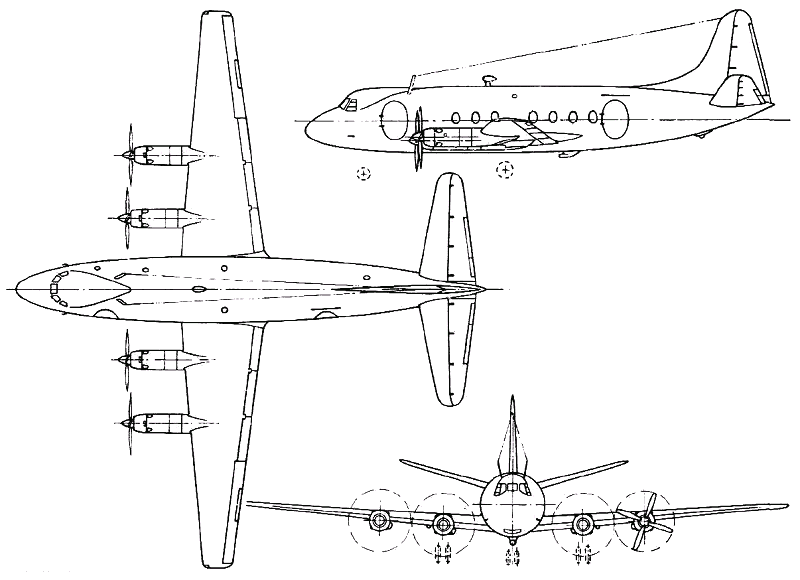
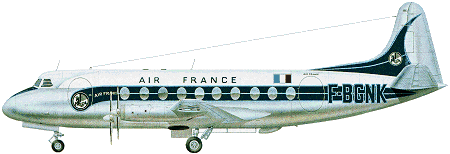
| | Geoff Blampied, e-mail, 14.10.2010 17:52 Our Virtual museum - the Vickers Viscount Network - contains thousands of pages of photos and information about this successful British aircraft. Have a look at vickersviscount.net and enjoy. reply | | David E. Baker, e-mail, 13.10.2010 21:45 What memories this brings back. I was a First Officer with British European Airways (BEA) in the early sixties and had many happy hours on both the 700 and 800 series. The most popular trip was the one week German trips based in Berlin and known as the "German Internals". In those days Lufthansa were not allowed to fly to Berlin only BEA and PanAm were allowed to do that! Such was the political skullduggery of those days. But we loved it, great flying, nice overnights and pretty German hosties. As a bachelor my cup ranneth over! Just a small nitpick if I may? The picture is of a 700 series (was Air France a 708?) and the data is on the 800 series. The 810 was BEA's ultimate model having bigger engines, longer fuselage (windows forward of the props is the easy recognition point)and seating more passengers. It also had what was, for its day, a state of the art (if slightly eccentric) flight instrumentation system from Smiths. Great memories, thanks. reply | | R. Morris, e-mail, 16.09.2010 23:43 My last flights on Viscounts were in the mid-80's. Air Zimbabwe from Victoria Falls to Bulawayo to Harare. And London European airlines from Amsterdam to Luton. What HUGE passenger windows it had! reply | | James Thomas, e-mail, 30.06.2010 01:18 I flew the Viscount both as First Officer (five years) Captain (three years) between 1957 and 1970 before converting to the DC9. The Viscount was a great airplane to fly, a little unstable on approach but easy to land. My Viscount high point was meeting my future and present wife who was an Air Canada stewardess on a flight from Toronto to New York Idlewilde airport in 1959. A Viscount is under restoration at Patricia Bay airport, Victoria BC. I recently sat in this aircraft's cockpit for the first time in forty years. reply | | James Thomas, e-mail, 01.07.2010 17:07 My wife of 50 plus years corrects me. She (a Yorkshire lass) was a Trans Canada Airlnes stewardess. TCA changed its name to Air Canada in 1965. reply | | Kamal, e-mail, 07.06.2010 22:51 Need help in figuring out the landing gear retraction geometry for a 96 inch span R /c model. Would appreciate any help in the form of description or drawings etc. reply |
|
Do you have any comments?
|
| 
COMPANY
PROFILE
All the World's Rotorcraft
|