|
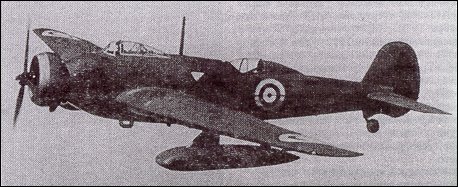
| The Wellesley evolved from Vickers' design for a general-purpose day and night bomber and coastal-defence torpedo-carrier biplane to satisfy Air Ministry Specification G.4/31, the company having decided to develop and build a monoplane aircraft to meet the same specification. When evaluated there was little doubt that the monoplane was superior, with the result that the Air Ministrv contract for the biplane was cancelled, being replaced on 10 September 1935 by one for 96 examples of the monoplane under a rewritten G.22/35 specification.
Named the Wellesley, it was the first RAF aircraft to utilise the geodetic form of construction devised by Barnes (later Sir Barnes) Wallis; offering a lightweight structure of great strength, it was adopted later for the Wellington. The other highly unusual feature was the provision of a pannier beneath each wing to serve as a bomb container. The low-set monoplane wing was also of geodetic construction, the main landing gear was hydraulically retractable, and power plant comprised a single Bristol Pegasus radial piston engine.
Wellesley Mk Is entered RAF service in April 1937 but by the outbreak of World War II most of them had been transferred to the Middle East, where they remained operational into 1941. The type is remembered especially in service with the RAF's Long Range Development Flight, which was established at RAF Upper Heyford, Oxon, in January 1938. Equipment comprised six Wellesleys modified by the installation of Pegasus Mk XXII engines installed in NACA long-chord cowlings, and driving constant-speed propellers; plus other changes which included strengthened landing gear, increased fuel capacity and the introduction of an autopilot. Between 5 and 7 November 1938, two of a flight of three of these aircraft (led by Sqn Ldr R. Kellett) succeeded in establishing a new world long-distance record, covering non-stop the 11,526km between Ismailia, Egypt, and Darwin, Australia, in just over 48 hours.
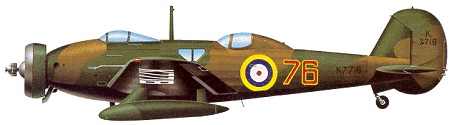
| MODEL | "Wellesley" Mk.I |
| CREW | 2 |
| ENGINE | 1 x Bristol "Pegasus XX", 690kW |
| WEIGHTS |
| Take-off weight | 5035 kg | 11100 lb |
| Empty weight | 2889 kg | 6369 lb |
| DIMENSIONS |
| Wingspan | 22.73 m | 75 ft 7 in |
| Length | 11.96 m | 39 ft 3 in |
| Height | 3.76 m | 12 ft 4 in |
| Wing area | 58.53 m2 | 630.01 sq ft |
| PERFORMANCE |
| Max. speed | 367 km/h | 228 mph |
| Ceiling | 10060 m | 33000 ft |
| Range | 1786 km | 1110 miles |
| ARMAMENT | 2 x 7.7mm machine-guns, 900kg of bombs |
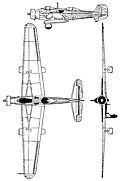 | A three-view drawing (1000 x 1510) |
| paul scott, e-mail, 12.05.2016 15:51 That's a nice story, Leslie Trottles, about the tissue-paper and balsa-wood kits, as far as I remember, they still made kits like that in the 60s-70s. I wonder if they make them still! Although plastic kits are obviously still around, I'm amazed at that, that anyone's doing it, what with kids /boys more interested in computer games! reply | | Jerry Steiger, e-mail, 13.05.2015 22:10 The first plane to fly over Everest was the Westland Wallace. reply | | Leslie Trottleslietrott@talkta, e-mail, 20.02.2015 13:22 In 1939 I was given a Frog kit to build a flying model of the Wellesley. Unfortunately I was then evacuated from London with my school, first to Kent, then to Sussex, finally to South Wales. I took the kit with me but I couldn't find the right glue, so it was never even started, let alone finished. I can't remember when I finally disposed of it. It was balsa wood and tissue paper with a rubber band for drive. I have never seen another, on Antiques programmes or elsewhere. Wasn't it the first aircraft to fly over Everest ? reply | | c bruce, e-mail, 27.06.2011 00:46 When I was a little lad during ww2 abandoned Wellesly bombers were all over the place at High Ercall airbase.
Me and my mates played in these and various other planes
which had been dumped in fields nearby.Local farmers would
use them as chicken houses etc.Good old days. reply | |
| | laozhu, 20.06.2011 06:33 It is all in quite perfect condition and the engineering drawings are really like works of art.Would any one be interested reply | | David Cockle, e-mail, 15.06.2009 00:23 Does anyone know where I can find drawings & photographs of the Wellesley Mk 2, if this version did actually exist?
I understand that this version had an extended cockpit `glasshouse'
I have been looking for evidence Wellesley 2's in RAF squadron service, in East Africa during the Ethiopian & Eritrean campaign reply | | Gerald Croft, e-mail, 20.03.2008 18:55 Please can anyone let me know how I can get hold of some good wellesley plans for a scale model and aslo plans fro rhe actual aircraft? I want to make a flying scale model to about 12th scale using geodetic structure. I sincreley want to make this as authentic as possible so I need as much info as possible. Please contact me on gerald.croft1@virgin.net reply | | A Foster, e-mail, 24.10.2007 00:11 J Richards - your book sounds interesting, please let me know the particulars. You can contact me at ccm46@yahoo.com reply | | V Phillips, e-mail, 18.06.2007 17:20 J Richards - I would be very interested in the Wellesley book. v.phillips1@btinternet.com reply | | C Reid, e-mail, 10.05.2007 14:41 J Richards. I would be interested in your Wellesley book. Contact chris@reidchelt.wanadoo.co.uk reply | | J Richards, e-mail, 01.05.2007 16:40 I have a hand written book which includes detailed plans and drawings on how to build a Vickers Wellesley Monoplane.It is all in quite perfect condition and the engineering drawings are really like works of art.Would any one be interested ?? J. Richards reply | | steve size, e-mail, 08.04.2007 21:39 Specifications should be shown in imperial measurements as these were used in the design & development of this aircraft reply |
|
Do you have any comments?
|
| 
COMPANY
PROFILE
All the World's Rotorcraft
|