|
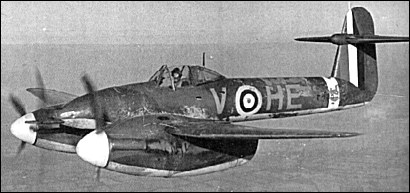
| The only Westland fighter to achieve operational status with the RAF, the Whirlwind was designed in response to Specification F.37/35 for a "cannon fighter" armed with four 20mm guns. As the P.9, the Westland design emerged as a low-wing monoplane with two Rolls-Royce Peregrine I 12-cylinder liquid-cooled Vee engines, each rated at 885hp at 4575m. The four Hispano Mk I guns were grouped in the nose, the pilot enjoyed a good all-round view from a fully-enclosed cockpit in line with the wing trailing edge, and radiators were buried in the wing leading edges inboard of the nacelles. Construction was of metal throughout, with flush-riveted stressed skins, a novelty being the use of magnesium rather than aluminium sheet to cover the monocoque fuselage aft of the cockpit. Two prototypes were ordered by the Air Ministry in February 1937, and the first of these flew on 11 October
1938. Despite delays in development and production of
the Peregrine engine, two contracts were placed in
1939, each for 200 fighters as Whirlwind Is, and the first
series aircraft flew in June 1940. In the event, produc
tion ended with 114 aircraft built, these serving with
only two RAF squadrons (Nos 263 and 137). Armament
problems and changing operational needs curtailed the
usefulness of the Whirlwind, which was enhanced in
late 1942 by the addition of a pair of wing racks to carry
two 113kg or 227kg bombs. Operational use of the Westland fighter came to an end in November 1943.
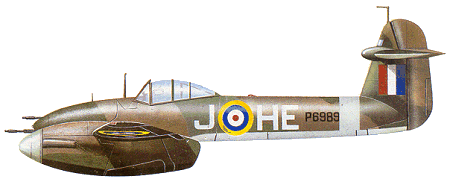
| MODEL | Whirlwind |
| WEIGHTS |
| Take-off weight | 5165 kg | 11387 lb |
| Empty weight | 3770 kg | 8311 lb |
| DIMENSIONS |
| Wingspan | 13.72 m | 45 ft 0 in |
| Length | 9.83 m | 32 ft 3 in |
| Height | 3.20 m | 11 ft 6 in |
| Wing area | 23.22 m2 | 249.94 sq ft |
| PERFORMANCE |
| Max. speed | 579 km/h | 360 mph |
| Ceiling | 9150 m | 30000 ft |
| Range | 1287 km | 800 miles |
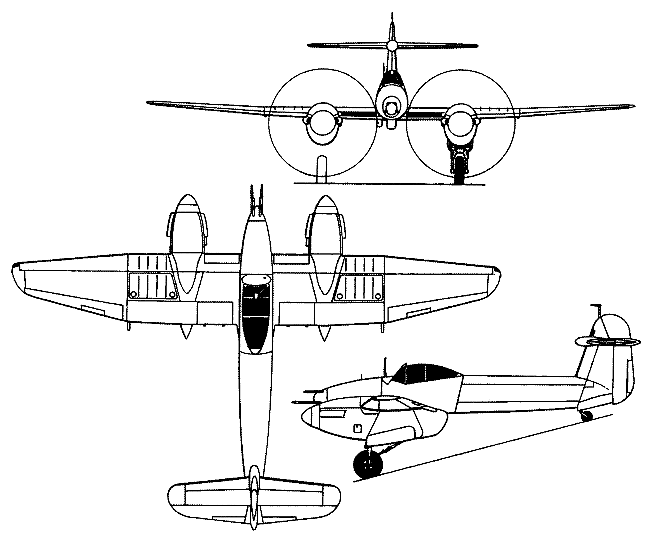
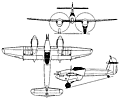 | A three-view drawing (650 x 539) |
| Erwin Stoerrle, e-mail, 12.11.2021 22:41 In my oppinion Westland Whirlwind was and still is the most "beautiful" Propdriven Aerplane.Thats why I'm trying to build one after plans from Sarik Hobbies in 65". What I'm looking for are some detailed drawings of the Main landinggear.I would like to make the model as true as possible. I don't care about the issues and problems about the engines, it doesn't take away her beauty. For any help I would be thankful.
With kind regards reply | | Anonymous, 11.10.2020 11:33 Merlin 20s were suggested for the Whirlwind. As the Typhoon was under development they thought that one engine aeroplanes would do the job. The pilots that flew Whirlwinds loved them. reply | | Steve Dovey, e-mail, 23.04.2017 18:54 And another thing. I keep seeing people suggest the Whirly could have been fixed with Merlin engines. Nonsense, the merlin was 33% bigger than the Peregrine and it would never have been practical at this time to completely redesign the aircraft to take it. The DH Hornet didn't last even though built at the end of the war (as a long range naval fighter) when navigation equipment made single seaters more practical.
It would be interesting to estimate from records, how many pilots lost over occupied territory due to engine failure from enemy fire or coolant leaks might have made it back had they had a spare engine (Whirlwind) or an air colled engine (Centaurus /Typhoon /Tempest) This certainly saved many Mosquito crews! reply | | Steve Dovey, e-mail, 23.04.2017 18:34 Can we finally lay this spectre to bed!,,
There was nothing wrong with the RR Peregrine engines other than effectively a limit on useful altitude due to less than perfectly designed superchargers (NOT reliability) they proved to be very reliable in service.
The main reason for cancellation of the aircraft was that the Whirlwind was the ONLY aircraft using this engine and Rolls Royce wanted drop it to concentrate on the Merlin. The Whirlwind should and would have been a great success story if the air ministry had got behind it and closed down the largely wasted effort on the Napier Sabre. The Bristol Centaurus was already in being and could have easily been put into service in 1941 in the big Hawker fighters as it eventually was. reply |
|
| | Barry, 18.04.2016 15:26 The last paragraph is rubbish. The reason the Whirlwind failed was the untried Peregrine engines. These engines were a failure not quite as bad as the Vulture but still not great. See Leo Rudicki's comments above. reply | | Richard, e-mail, 12.03.2016 17:58 I believe one of the prototypes had the four nose cannon arranged in one row, rather than the two pair arrangement fitted as standard. I'd like to modify a model kit to represent this a /c but can't find any further info. Any thoughts, or even a photo? Thanks. reply | | sven, 01.10.2015 19:38 Walt. Yes the whirlwind did have split flaps. The rear of the nacelle went down with the flaps ,if you look carefully at the line drawing you can see the joint. reply | | Walt, e-mail, 01.10.2015 07:07 I'm researching the Westland Whirlwind to see if it is feasible to scratch build a 1 /3 scale version for flying. Based on drawings I have seen on RC versions, I do not see flaps. The 3-view on this website appears to show flaps, but lines on an drawing could be misleading. Does anyone know if it had flaps. Also, any direction finding good documentation would be helpful. Thank you. reply | | Ron, e-mail, 06.03.2015 20:28 61 claims of victories and damaged against 22 pilots lost to all causes including accidents, isn't that bad for the RAF.
Tire blowouts should have been better addressed in my opinion. Surely larger flaps could have helped with hot landing speed. Then it wouldn't be limited to long airstrips.
For endurance, cross tank fuel access is a no-brainer as well as droptanks.
Too many were lost to lack of info. When 4 were outnumbered over 5 to 1 against all enemy fighters and only 2 more were sent unsuspecting to relieve them, what gives? Of course all were lost.
If destined for ground attack, why not try radial engines for added durability as well as reliability?
I like the idea of selective fire control to double firing time with such a limited ammo load. Even just 2 Hispanos (at a time) are still plenty potent in 1940. Granted, the pattern of fire will be less dense for dogfighting. So increase the load. With more wing and hp that won't hurt.
No need to jump to the Welkin for this. Something inbetween and compact, closer to the nimble 'Whirly'. reply | | Ron, e-mail, 06.03.2015 05:58 The trailing edge of the wing could have been straight for more wing area to adress the hot landing speed (like the wing of the Westland G.46 concept high altitude plane that followed). The Peregrines should have continued refinement until reliable or replaced with a Merlin since a new wing could take it's weight. The wing could add fuel tankage as well.
In it's day the Whirlwind could outclimb and outrun it's Spitfire escort! It could have kept pace.
When the Spit V got clobbered by the new Fw 190, the 'Whirly' could have challenged the Fw 190's success especially at lower altitudes where the Spit was overmatched the most.
I would prefer the Whirlwind over the Typhoon that replaced it. And with the larger wing of the G.46, it's payload would be improved too. reply |
| Ron, e-mail, 06.03.2015 01:12 Stewart,
I like the Welland idea.
The Whirly needed better engines and droptanks. I think the Welkin was too heavy! Something inbetween sounds good.
I don't care if it had radials as long as it's more reliable and faster. reply | | Paul Scott, e-mail, 26.01.2015 16:54 Great aircraft, potentially, a shame that Merlins couldn't have been used, with the unreliable Peregrines sealing its fate, though at that time, the onus was on single-engined fighters for priority production. Shame a mock-up couldn't be built anywhere. reply | | Jane Donaldson, e-mail, 01.09.2014 22:36 I certainly do. My hlate husband, Arhtur Donaldson DSO etc, told me that from all the many types of aircraft he flew he felt safest, strongest and ahppiest in in much loved Whirly. Je even christened his much loved Aberdeen terrior @Whitly@. And thereby hangs another tale! please do get in touch.
Jane Donaldson reply | | Jane Donaldson, e-mail, 01.09.2014 22:27 YeS. i Already in touch with the team working on the Whirlwind. I am Arthur Donaldson's widow and I am sure with personal aspects of his career. I do hae a copy of his service record, to which I would be prepared to divolve interesting facts, subject to the approval of MOD. Please get in touch if I can be of help.
Jane Donaldson
g reply | |
| | Reeve Martin, e-mail, 04.08.2014 16:55 My uncle George Martin flew with 137 Squadron (previously with 263 Squadron) and was lost in operation Fuller. I would like to hear from anyone associated with either squadron who might provide any detail. Many thanks. reply | | Redherringz, e-mail, 24.01.2014 11:03 I was given to understand that the Whirlwind was held in reserve as ground support /anti-armour, should Hitlers invasion of England proceed. reply | | JANE DONALDSON, e-mail, 02.04.2013 13:35 Just as a matter of interest, my late husband, G /Capt Arthur Donaldson, commanded 263 Squadron and smong msny exercises carried out a rhubarb on Morlaix airfield in Brittany. He was hit in the head by Akak fire, but managed to return safely to Exeter.
I am really interested in the replica project and also in the possibility of a film. Luckily I am in touch with both Jim Munro and David Gibbings, so I am being kept in touch.
Arthur considered the Whirlwind to be a wonderful aircraft. Having two engines gave him a lot of extra confidence.
In my recently published memoir, Plain Jane, I do record the event, and there is a picture of Arthur and also one of his helmet - riddled with holes! The book is available on Amazon if anyone is interested.
JANE DONALDSON reply | | derekhudson, e-mail, 14.03.2013 14:29 wear can i get a diecast model of this plane reply | | Krys Kingston, e-mail, 19.04.2012 04:58 Hello-my Grandfather was a Lt. Col. in the RCAF and he is an amazing and humble man. He is heathy and sharp as a tack (and been married to my beautiful and wonderful Grandmother for 67 yrs.) and I would love to find a way to allow him to sit in a replica of the plane that he so dearly loved and did such courageous things in.
His name is Lt. Col. John E. McClure. I can be reached at kingcastle_13@msn.com or 720-275-3676. My name is. Krys. Thank you. reply | | Doc, e-mail, 15.04.2012 18:18 Tracey,
Commiserations.
Your Dad Ray and I were in comms and it was with sadness I learned from your Mum he had had the fatal. He had appraised me his health was not quite as he would [?"Wood"] have had it. I appreciate the stuff he sent me, and would be interested to learn more of the paintings.
Best,eh,
Doc reply |
|
Do you have any comments?
|
| 
COMPANY
PROFILE
All the World's Rotorcraft
|


 Ron
Ron

Recent research suggests that the main reason for drop off in performance at altitude and engine damage / reliability, was due to propeller choice.
The Rotol prop of the original was thinner and more efficient than the production DH props.
The Peregrine was starved of development time, due to the priority given to the Merlin.
The cooling system overall was ropey to say the least!
If the aircraft had been built around the Merlin, chances are there would have been no Whirlwinds at all.
The Whirlwind was a way to utilize the peregrines as no other aircraft was designed to use it.
So stick with the known Kestrel engine, fit rotol props, sort out the cooling, maybe bigger flaps, and we may never have needed the Typhoon and that horrible Sabre engine
reply