|
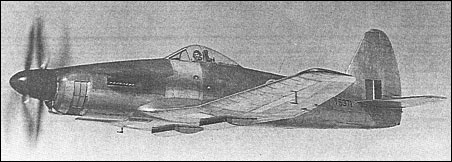
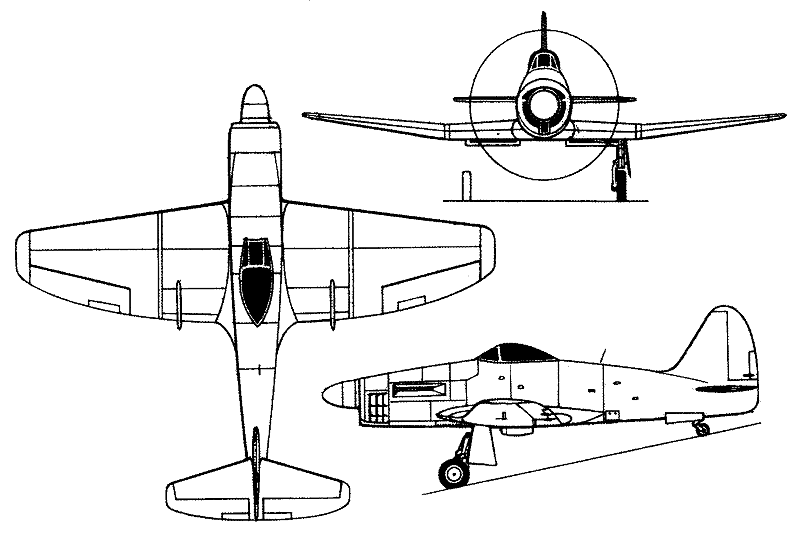
| Under the project designation P.10, Westland began to study early in 1944 a long-range shipboard day fighter for Naval use, with the added capability of carrying a torpedo, rockets or bombs for anti-shipping strikes. Around this proposal, Specification N. 11/44 was written, and, in November 1944, a contract was confirmed for six prototypes (including two in land-based RAF configuration to Spec F.13/44). Redesignated W.34, and subsequently named the Wyvern TF Mk 1, the West-land aircraft was a low-wing monoplane of relatively conventional layout, but larger and heavier than any previous British single-seat Naval fighter. It had upward-folding outer wing panels with hinged tips, and a 3500hp Rolls-Royce Eagle 24-cylinder liquid-cooled H-type engine driving eight-blade contraprops. Provision was made in the design for the later introduction of a turboprop engine, such as the Rolls-Royce Clyde. Basic armament comprised four 20-mm Hispano Mk V cannon in the wings, with the possibility of carrying an 46cm Mk VIII torpedo under the fuselage three 464kg bombs or eight 27kg rocket projectiles. In August 1946, an order for 20 pre-series Wyverns with Eagle engines was confirmed, but a planned batch of 10 for the RAF was dropped, together with the F.13/44 prototypes. Subsequently, the pre-production batch was halved. The first of six prototypes flew on 16 December 1946. However, a turboprop version with the Armstrong Siddeley Python had meanwhile been given the go-ahead and the Wyvern TF Mk 1s were assigned to various development tasks, never becoming operational. All six prototypes were flown, as were six pre-series TF Mk 1s, but the final four of the latter, although built, remained unflown as all development effort switched to the TF Mk 2.
 | A three-view drawing (800 x 539) |
| MODEL | Wyvern TF Mk 1 |
| WEIGHTS |
| Take-off weight | 9924 kg | 21879 lb |
| Empty weight | 7005 kg | 15443 lb |
| DIMENSIONS |
| Wingspan | 13.42 m | 44 ft 0 in |
| Length | 11.96 m | 39 ft 3 in |
| Height | 4.72 m | 16 ft 6 in |
| Wing area | 32.98 m2 | 354.99 sq ft |
| PERFORMANCE |
| Max. speed | 734 km/h | 456 mph |
| Ceiling | 9785 m | 32100 ft |
| Range | 1908 km | 1186 miles |
| CDR Phillip T. Moss, USNR, ret, e-mail, 29.01.2016 14:30 Made a simulated attack on British carrier operating Wyverns in the Med 1955 /56. I was flying AD-6 Skyraiders off USS Lake Champlain with the 6th Fleet. The Wyvern was a beautiful aircraft. reply | | Ross Mansell, e-mail, 07.02.2014 17:29 Letter J in aircraft for HMS Eagle 1st Commissioned Nov 1951 at Devonport. The Wyvern did not come into service until late5 in the early fifties so could not have been seen in 1946 reply | | John Keynes Phimister, e-mail, 17.09.2012 15:15 It is possible that the letter "J" as an aircraft carrier designation was H.M.S.Eagle.
Grandfather could have been a Royal Fleet Auxiliary officer as they all were, and still are, Merchant Navy. reply | | Matthew Kitchen, e-mail, 15.09.2012 10:16 Now this is a wonderful aircraft. It's a pity there's only one still surviving. reply | |
| | bill, 20.06.2011 14:23 I do have my grandfathers records including ships he served on but they are hard to read. One of these may be an aircraft carrier. Could you shed any light on this? Regards Neil reply | | Walter McGowan, e-mail, 07.08.2010 05:57 I worked as a leading design engineer on both types.
There was a tragedy one day.
The popular test Pilot and friend, Eric Garner tried to make an emergency wheels up landing. With contra props it cannot be done , as soon as the props tip the ground, they do not bend as expected but lock solid which tears the engine out.
Eric died immediately. reply | | Uwe Reitter, e-mail, 01.06.2010 11:27 as far as i know the latest wyvern concept was planned to have 2 turbines. kathegoric would have been a common gearbox to ensure the propeller syncing. reply | | John Dighton, e-mail, 25.02.2010 12:53 Another beautiful aircraft by Westland produced just too late. Aesthetically as pleasing as the Seafang, fast by any standards, but just too late! reply | | paul scott, e-mail, 18.08.2009 19:10 Another fine forgotten aircraft, especially as it's from Westland, more synonomous with the licenced-built US helicopters. reply | | Neil Johnson, e-mail, 12.08.2008 17:27 Hi. I have some photos of my grandfather on board what seems to be an aircraft carrier in 1946 with what appears to be a Wyvern crashed on the deck. My grandfather was Merchant Navy so it is a little confusing what these photos are all about. There appears to be in the background three more aircraft with their wings folded. The crashed aircraft does appear to have the profile of a wyvern and has a letter "J" on the tailplane. What caught my eye are strange additions to the front of the tailplanes that must affect the flight of the aircraft but did eventually lead to the idea the plane is a wyvern. I do have my grandfathers records including ships he served on but they are hard to read. One of these may be an aircraft carrier. Could you shed any light on this? Regards Neil reply |
|
Do you have any comments?
|
| 
COMPANY
PROFILE
All the World's Rotorcraft
|