|
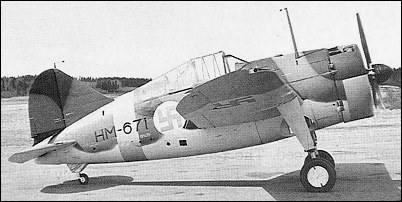
| One of the most extraordinary fighters built and flown during World War II was the Humu - literally "Reckless" - produced by Valtion Lentokonetehdas. It was not that the Humu was unconventional in any respect. It was a copy of a seven-year-old American design adapted to make use of locally-available materials and captured equipment, and built without benefit of licence or assistance from the parent manufacturer. The Finnish air arm, Ilmavoimat, had acquired 43 Brewster B-239 shipboard fighters that had been declared surplus to US Navy requirements. These had proved singularly successful in Ilmavoimien service, and, in 1942, it was proposed that an attempt be made by the VL to remedy a shortfall of fighters of this type by producing a copy. Because of shortages of metal, this was to make as much use as possible of wood and to embody so-called "war booty" instrumentation and power plant - equipment captured from the Soviet forces by the Finns themselves and similar equipment captured by the Wehrmacht and sold to the Finns. The task of designing an entirely new wooden wing was assigned to M T Vainio, who was also responsible for the overall project, and, in October 1942, an order was placed with the VL for four prototypes, the intention at that time being to build a series of 90 aircraft. The chosen engine was the 930hp Shvetsov M-63, which was flown on 5 June 1943 in a B-239. Static testing of the wooden wing was not entirely satisfactory. Nevertheless, in September 1943, orders were confirmed for five prototypes of the Humu and 55 production aircraft. The wooden wing was found to add 250kg to air-frame weight, however, and the transfer of the fuel tanks from the wing to the fuselage shifted the CG aft, adversely affecting manoeuvrability. Initiation of series production was, therefore, delayed pending results of prototype tests, and in the summer of 1944 the programme was terminated as it was concluded that the Humu would have inadequate combat capability by the time it achieved service. Only one prototype Humu was completed, and this, having an armament of three 12.7mm guns and a mix of Finnish and Soviet instrumentation, flew on 8 August 1944. The M-63 engine failed to give its full power during subsequent flight testing, but 19 hrs 50 min were flown before, in 1945, the sole example of this remarkable aircraft was placed in storage.
| WEIGHTS |
| Take-off weight | 2895 kg | 6382 lb |
| Empty weight | 2050 kg | 4520 lb |
| DIMENSIONS |
| Length | 8.03 m | 26 ft 4 in |
| PERFORMANCE |
| Max. speed | 430 km/h | 267 mph |
| Ron, e-mail, 30.07.2014 09:07 There are those who feel the I-16 was better than the B-239.
They doubtless met over Finland in combat.
I believe the Russians captured one and in their testing, it did a full circle in 14 seconds @ 1 Km altitude.
The late model I-16s could only do it in 16-17 seconds!
I think the performance of the I-16 was no better than the B-239 in any way except armor, and inferior in ceiling and range. The dive performance for the B-239 was faster too (575 mph).
The Finns had great tactics after studying what happened to the F2As vs Japan.
Their mechanics were resourceful too. They tweeked the engines and guns to get better performance.
It may be true that the Finns captured an I-16 and liked it,
but the B-239 was their favorite. reply | | Reino Myllymäki, e-mail, 23.11.2011 20:11 Once again, name "Humu" doesn't mean "Reckless" in English. My dictionary gives the following translations: bustle, commotion,flap, flurry, fluster, flutter, fuss & gust. So, "Bustle" ? reply |
| Reino Myllymäki, e-mail, 23.11.2011 20:07 Main differences between VL Humu and Brewster 239:
1. Wooden wing without fuel tanks and guns
2. M-63 engine (Russian copy of Cyclone G.5) with VLS.8003 /W.22 propeller (mechanism captured from Tupolev SB-2 and wooden blades)
3. 10 cm longer front fuselage
4. All guns (3 x 12,7 mm VKT LKK /42) in engine cowlings
5. No bottom window
6. No armour
Finland tried to buy licece to build Brewster spring 1940 but did not succeed. However, Finns got productions drawings of Brewster 239 with purchased aeroplanes (delivered 1940 but found 1942) and 1941 Air Force ordered big amount of spare parts of 239. So, VL Humu has been built probable at least partially from spare parts of 239 produced in Finland 1941-1943. reply | | David, e-mail, 07.11.2011 05:07 Well one of the the reasons why everyone but the Finnish hated the Buffalo was due to the engine which overheated frequently. Except in Finland due to overall lower temperatures. It also turned out to be fairly robust under combat conditions when the engine wasn't consistently on the edge of overheating. reply | |
| | luson, 18.06.2011 11:05 After that the production of VL Humu was terminated and the prototype building continued as "filling work". reply | | Klaatu83, e-mail, 06.04.2011 18:48 The principal Main difference between this aircraft and the B-239 was that the design of the plane was adapted so that it could be constructed as much as possible out of wood rather than metal.
The B-239 was designed as a carrier-based fighter for the U.S. Navy, and was used by the U.S. Navy and Marines, the British RAF, Australian RAAF and the Finnish Air Force. With the exception of the Finns, all of the above considered it a dreadful aircraft. The B-239s were shot to pieces by the Japanese in the Far East. Perhaps the success Finnish pilots enjoyed with the Brewster says as much about the state of Russian and Japanese air power during those days as it does about the Finns! reply | | Sgt.KAR98, 06.01.2009 23:59 Whats the difference between this plane and the B-239? reply | | Reino Myllymäki, e-mail, 01.08.2008 23:37 Some information about VL Humu:
1. The prototype of VL Humu (HM-671) is in The Aviation Museus of Central Finland in Tikkakoski, Finland. There is also the only one Brewster 239 in the world (BW-372).
2. The names of aircrafts of the State Aircraft Factory (Valtion Lentokonetehdas) since 1933 are different kind of winds. Therefore "Humu" means "Whirl".
3. The performance of VL Humu did not been measured. The information of maximum speed is based on tests of wooden wing and M-63 motor in Brester 239 (BW-392) October 1942. BW-392 was 350 kg heavier than VL Humu and those days Finns did not adjust M-63 right way due to lack of the instruction manual. Therefore M-63 did not give all power. Finns got the instruction manual from Germany 1943 and citation from book of Jukka Raunio (The History of State Aircraft Factory. Part 2: In Tampere and wars 1933-1944): "Performance was not tested but with M-63 which is in good condition, adjusted and breaked in right way, it would be as good as Brewster." Poor translation is mine ;-)
Btw, Finland bought 44 (not 43) Brewster 239 from USA 1939-1940. Basically 43 Brewsters were on sale (US Navy order was 54 and only 11 was delivered). But Finland bought 44 and 38 came from US Navy order and six from Belgium order. Since Belgium has ordered Brewster 339, the factory had to make rather big modification to front fuselage.
Jukka Raunio has supposed that Finnish Air Arm did not mean VL Humu to fighter squadrons but to reconnaissance squardons. Therefore moderate performance has been accepted. The production of VL Humu was in the best priority class until June 1944 when Soviet Union started the wide summer offensive to Finland: the capasity of State Aircraft Factory had to be focused on aircraft repairing and to VL Myrsky and Morane-Saulnier M.S.406 conversion to "Mörkö-Morane" (motor change from 860 hp Hispano-Suiza to 1100 hp Klimov M-105). After that the production of VL Humu was terminated and the prototype building continued as "filling work". reply |
|
Do you have any comments?
|
| 
COMPANY
PROFILE
All the World's Rotorcraft
|




20
reply