|
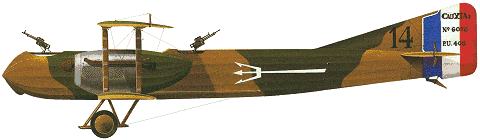
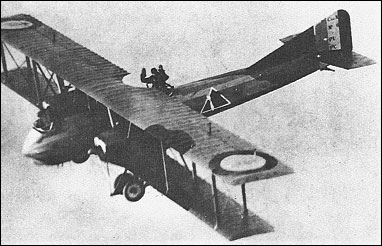
| Evolved by Paul Deville from the R.IV reconnaissance
bomber designed by Rene Caudron, the R XI three-seat
biplane was originally intended as a Corps d'Armee aircraft,
but was destined to find its forte as a three-seat
escort fighter. Powered by two 215hp Hispano-Suiza
8Bda eight-cylinder water-cooled engines, the R XI
appeared in March 1917, and entered service in
February 1918. Armament comprised five 7.7mm
Lewis guns on flexible mounts - two in the nose cockpit,
two in the dorsal cockpit and one firing downwards
and rearwards beneath the front gunner's cockpit - and
while initial models retained the HS 8Bda engines, later
versions were fitted with the 235hp HS 8Beb. The R XI
enjoyed considerable success as an escort for the Breguet
14 during the closing months of WWI and during
the summer of 1918. It also served in the fighter-reconnaissance
role. At the time of the Armistice, the R XI
equipped six 15-aircraft escadrilles of France's Aviation
Militaire. A more powerful version, the R XII with 300hp HS 8Fb engines, was tested during the summer
of 1918, but apparently failed to display significantly
better results than those obtained with the R XI. Prototype
trials with the R XII were completed in the autumn
of 1919, but no further development was undertaken.
| WEIGHTS |
| Take-off weight | 2167 kg | 4777 lb |
| Empty weight | 1422 kg | 3135 lb |
| DIMENSIONS |
| Wingspan | 17.92 m | 59 ft 10 in |
| Length | 11.22 m | 37 ft 10 in |
| Height | 2.80 m | 9 ft 2 in |
| Wing area | 54.25 m2 | 583.94 sq ft |
| PERFORMANCE |
| Max. speed | 183 km/h | 114 mph |
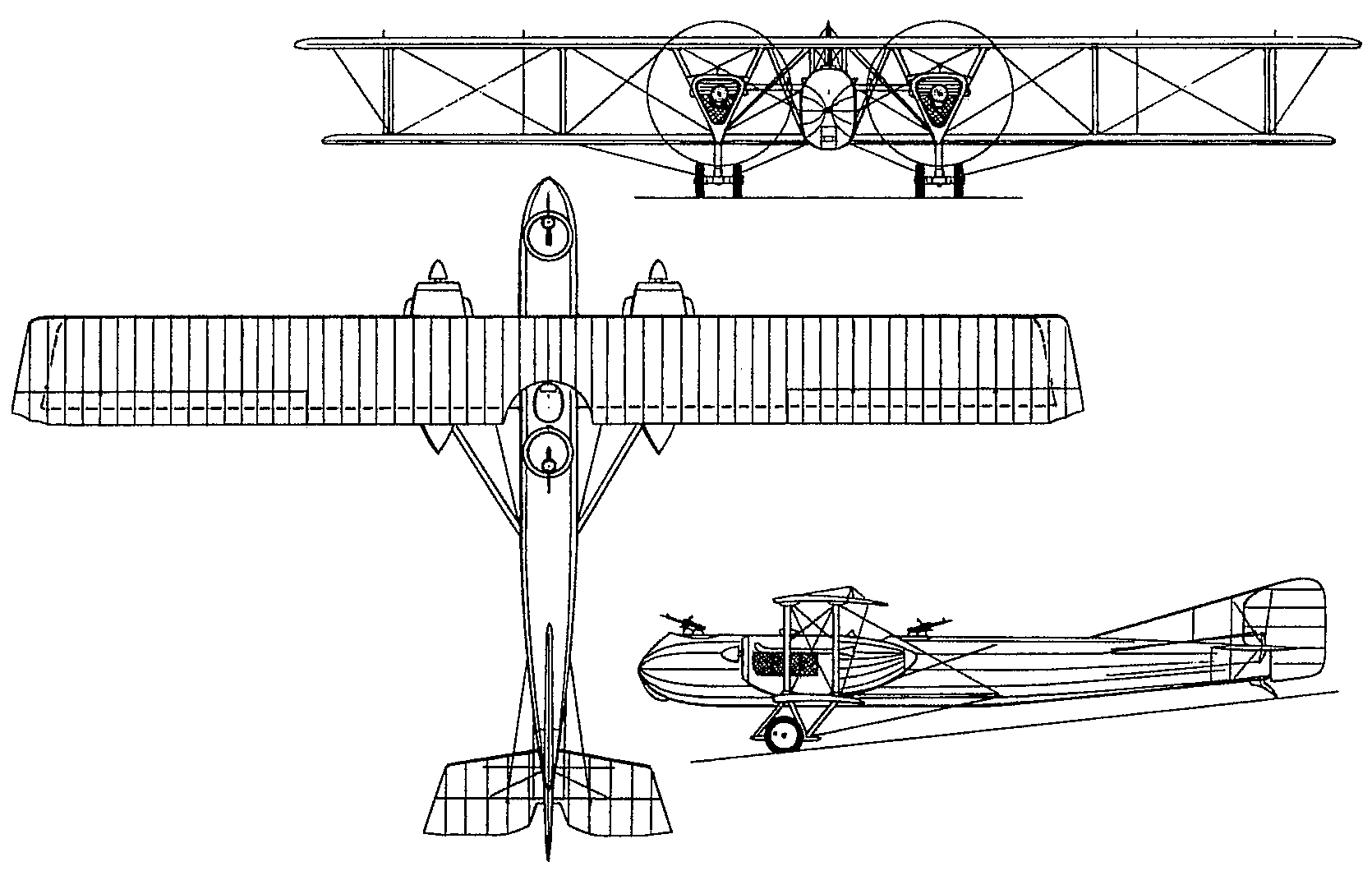
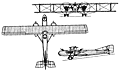 | A three-view drawing (1670 x 1060) |
| lxbfYeaa, e-mail, 07.11.2025 03:36 20 reply |
| Kevin OReilly, e-mail, 17.08.2013 04:12 I have a photograph of one of these taken in Egypt 1917 /18 & would like details.
Advise an address so I can send an image. kevin reply | | Barry, 28.03.2013 17:45 This was a good airplane with poor engines, that plagued it throughout it's operational life. Over 500 were produced and some estimates suggest as many as 1,000 eventually saw service. The armament consisted of two .303" Lewis guns in each of the front and rear gunnery positions, and the later addition of a downward firing gun in one or both positions in other words a total of 4 /6 guns. Furthermore, the R11 could carry a bomb load of upto 300k.g. (660lb) externally. reply | | Bob Gerlach, e-mail, 18.03.2012 08:27 I have an original WWI unpublished photo of this and several other WWI types taken by my great uncle in France in 1917-1918 and will be donating them to the NASM in the near future. They should be available for reference sometime this year. reply | |
| | Klaatu, e-mail, 22.05.2011 20:02 The successful use of these Caudrons as escort fighters established a French trend towards the development of multi-seat combat aircraft, a category that became known as the "multiplace de combat". The French continued to experiment with this category of aircraft throughout the 20s and 30s, and even influenced air forces in other countries to do the same. The U.S. Army Air Corp's Bell YFM-1 Airacuda comes to mind as a classic example of the genre. The last French aircraft of this sort to enter service was the Potez 63 series, which saw service in 1940. reply |
|
Do you have any comments?
|
| 
All the World's Rotorcraft |


 lxbfYeaa

20
reply