|
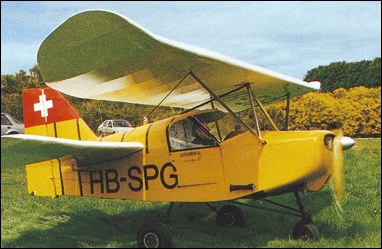
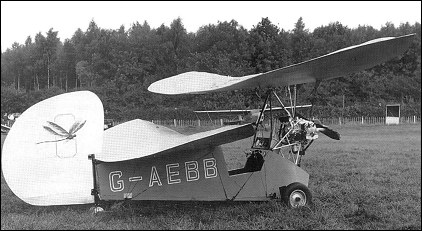
| The HM.14 'Sky Louse', or 'Flying Flea' (Pou-de-Ciel), the father of today's microlights, followed earlier unconventional designs by Henri Mignet. It had two wings, and the larger one in front of the pilot offered variable incidence.
Pilot control was via a single stick. During the mid-1930s the aircraft became popular in Europe and beyond, and it was licence- or home-built in the hundreds. The type was grounded by some authorities in 1936 after a number of accidents. Modifications eventually overcame this. Despite slipping into post-World War II obscurity, HM.14s are still home-built.
FACTS AND FIGURES © The main feature of the Flea was
its tandem wing layout. If the
wings were mounted too close
together the controls could reverse
when the main wing was at high
incidence. © The Flea was controlled by a single
lever, which moved the whole wing
up and down and the rudder from
side to side. There was no tailplane,
no elevators and no ailerons. © The original Flea, and many of its
successors, made use of commonly
found components such as motorcycle
engines and wheelbarrow wheels.
| MODEL | HM.14 |
| CREW | 1 |
| ENGINE | 1 x 26kW two-stroke automobile or motorbike engine |
| WEIGHTS |
| Take-off weight | 227 kg | 500 lb |
| DIMENSIONS |
| Wingspan | 6.00 m | 20 ft 8 in |
| Length | 3.60 m | 12 ft 10 in |
| Height | 1.70 m | 6 ft 7 in |
| PERFORMANCE |
| Cruise speed | 120 km/h | 75 mph |
| GrahamClayton, e-mail, 25.04.2023 07:52 The same effect that prevented a stall occurring made the Flying Flea a death trap - it was discovered that the air flow from the pivoted front wing when pulled back, to point the aircraft up, increased lift from the rear wing, pointing the aircraft inexorably down into a non-recoverable dive. reply | | Mike Evans, e-mail, 28.11.2015 04:54 Are there any plans for the HM 19-C? One day I hope to build a Pou de Ciel and the HM 19-C looks like a really nice version. reply | | John Mantova, e-mail, 12.03.2014 05:10 Cute but I wouldn't wantnto fly in one. Idid see ( but not flying )an R.C, model of "Un Pou du Ciel" made by a guy from Crewe UK. He passed away and it is now kept by his daughter as a memento. I think it may have been scratch built but a beautiful job. Any one got plans for one ? reply | | andre, e-mail, 06.01.2013 18:38 Hello
could you please tell me, when and where the picture from the HB-SPG was taken?
The SPG is an HM 19-C, was build in Switzerland by Louis Cosandey. 65 hp Conti- Engine.
It became G-BWRI and now she is based in Dresden (by Joseph Koch)as D-EPOU. reply | |
| | Barry, 05.04.2012 17:53 G-AEBB illustrated is still current with The Shuttleworth Trust at Old Warden. reply | | dan, e-mail, 19.11.2011 22:41 the correct name is Pou du ciel.
Du, not de. reply | | Dr. Duck, e-mail, 10.11.2010 23:33 A really beautiful and cute little plane... several charming models not shown in these photos... worth your time to Google Henre Mignet and the "Flying Flea"... reply |
|
Do you have any comments?
|
| 
All the World's Rotorcraft |