|
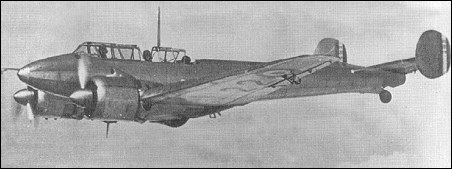
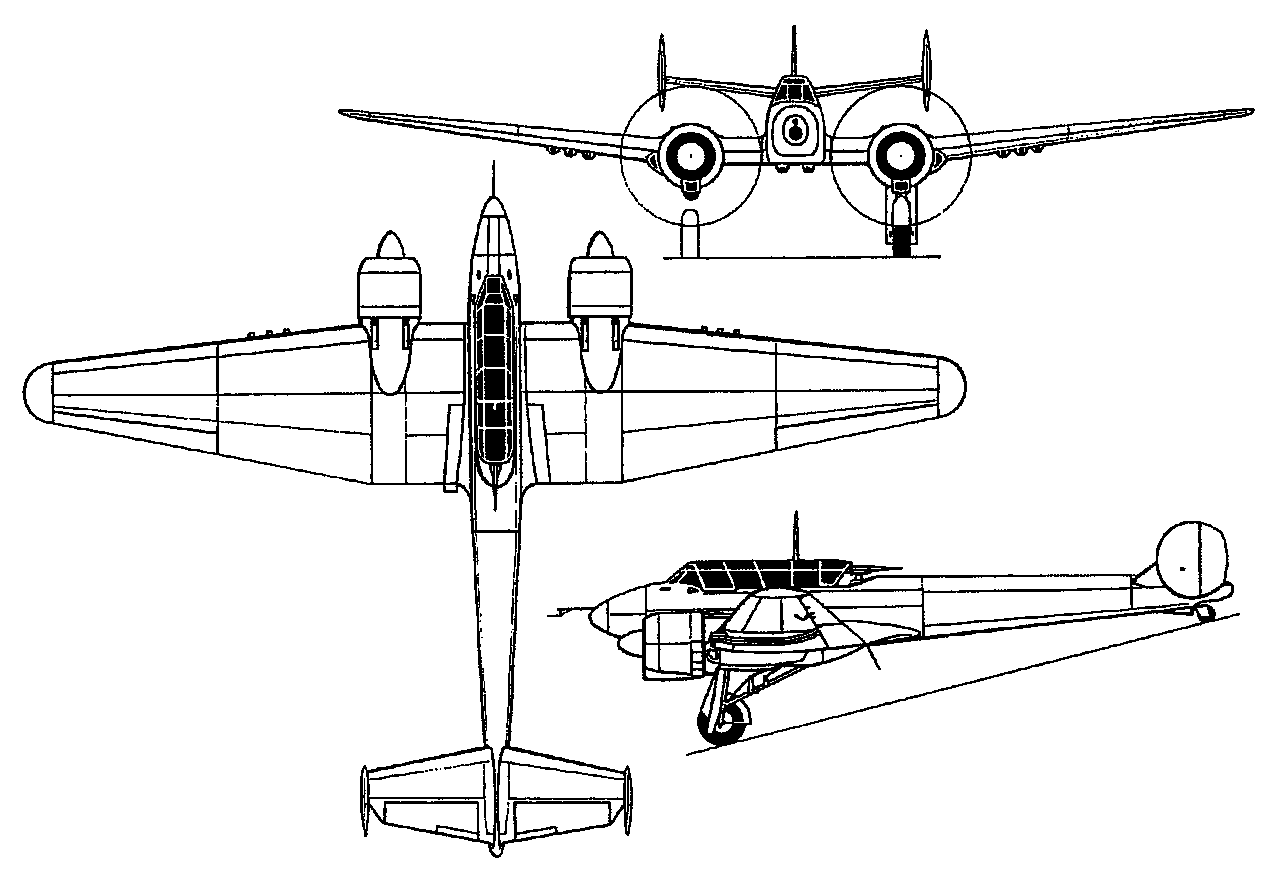
| The Potez 63 was built originally to a French Air Ministry programme calling for a 'Multiplace legere de Defense', literally a light multi-seat defensive aircraft. In practice the specification called for an aircraft to perform the three roles of fighter control (three-seat C3); daylight interception (two-seat C2); and night-fighter (two-seat Cn2). The first prototype flew on 25 April 1936. It was a pleasant-looking all-metal stressed-skin cantilever monoplane with a retractable landing gear. Ten further prototypes were tested before production orders were placed in 1937 for 80 Potez 630s (two 432kW Hispano-Suiza 14 radials) and 80 Potez 631s (Gnome-Rhone 14 Mars radials). The Potez 633 B2 was a light bomber version with a partially glazed nose, 40 of which were ordered by Romania and others by Greece. In the event only 21 of the Romanian aircraft were delivered, the rest retained by France. The Potez 637 A3 was a three-seat reconnaissance version with a ventral gondola for the observer, 60 of which were built. The final production version was the Potez 63-11 with an extensively redesigned fully glazed nose and a new short crew canopy. A total of 702 production aircraft was built.
Potez 630/631s served with day- and night-fighter Groupes and with 'Sections de Commandement' attached to single-seat fighter units from the outbreak of World War II. Armament comprised two forward-firing and one rear-mounted 7.7mm machine-guns. Potez 637s equipped five reconnaissance Groupes and during the battle for France suffered heavy losses. Potez 63-11s were delivered from November 1939 and served with 40 GAO (observation Groupes) and 13 reconnaissance Groupes by May 1940.
* * *
The French Potez 631 night-fighter
corresponded in many respects to the
RAF's Bristol Blenheim, being very
similar in size and performance
(though somewhat lighter) as well as
being conceived as a variation of a
light bomber. The French aircraft was
one of a family of design variations of
the Potez 63 which had originated in a
requirement issued in 1934 for a two/
three-seat 'multi-purpose' aircraft.
Although a night-fighter prototype had
flown in March 1937 as the Potez 631-0,
French re-equipment policies were
blurred by lack of purpose (being confused
by the likely form of warfare
being studied by Germany), with the
result that orders for development aircraft
included four-general purpose
two/three-seat day/night fighters,
three two-seat night-fighters, one light
bomber, one reconnaissance aircraft
and one close-support aircraft. Relatively
little importance was placed
on the Potez 631 night-fighter, and it
was not until June 1938 that production
orders totalling 207 were confirmed.
By 1 April 1939 the Armee de l'Air
had taken delivery of 88 aircraft, of
which 20 were in service; in May two
night-fighter units, Groupes de Chasse
de Nuit GCN III/l and II/4, and one day
fighter unit, GC II/8, were equipped
with about 30 aircraft; four other Potez
631s were serving at Djibouti. At the
outbreak of war a total of 206 aircraft
had been delivered, and the type had
also joined GCN 1/13 and GCN 11/13, as
well as seven escadres de chasse.
Some aircraft were later transferred to
the Aeronavale. When the German
attack opened in the West the various
Potez 631 units were in constant action
both by day and night, although lack of
radar prevented much success during
the hours of darkness. In the first 11
days of the campaign Aeronavale's
Flotille F 1C shot down 12 German aircraft
for the loss of eight, but the Armee
de l'Air night-fighter units were
ordered to assume day ground-attack
duties, losing heavily to enemy flak.
Moreover, losses were exceptionally
heavy to Allied guns and fighters as a
result of the Potez 631's superficial
similarity to the German Messerschmitt
Bf 110; it has been estimated
that as many as 30 of the French aircraft
were shot down in error. In all, Potez
631 night-fighters destroyed a total of
29 German aircraft in the Battle of
France, but for a loss of 93 of their own
number. Of the remainder about 110
were in the Free French Zone (Vichy
France) at the time of the armistice, but
their number dwindled quickly because
of a chronic lack of spares,
although ECN 3/13 moved to Tunisia
with a small number of Potez 631s in
June 1941.
| MODEL | 63-11 |
| WEIGHTS |
| Take-off weight | 4530 kg | 9987 lb |
| DIMENSIONS |
| Wingspan | 16.0 m | 53 ft 6 in |
| Length | 10.93 m | 36 ft 10 in |
| PERFORMANCE |
| Max. speed | 425 km/h | 264 mph |
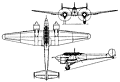 | A three-view drawing (1280 x 874) |
| Paul Scott, e-mail, 14.01.2015 21:02 Classic French aircraft along with the other twin-engined WW2 models reply | | Keith, e-mail, 25.01.2012 01:46 Potez 631 used two Gnome-Rhone 14M6 /7 14-cylinder air coled radial engines, each rated at 660-hp. While that is likely a take-off rating, airborne operational hp at altitude is likely to be @ 5-percent less. reply | | Klaatu83, e-mail, 17.03.2011 22:34 During the late 1930s the Germans, Japanese, British, Soviets and French all tried to develop twin-engine multi-role heavy fighter /reconnaissance light bomber aircraft of a similar concept to this one in the late 1930s (Me-110, Kawasaki Ki-45 "Nick", Blenheim I fighter, Yak-2 /Yak-4, Potez 63 series). Every one of them was a failure. It wasn't that the aircraft in question were necessarily bad, simply that the basic idea behind them was mis-conceived. reply | | Charlie, e-mail, 10.12.2010 21:57 Like the Me-110 and the Bristol Blenhein, the Potez was a product of the late 1930's infatuation with the idea of a "heavy fighter." All of these aircraft were failures in the fighter role because of a lack of speed and manuverability. The idea of a night-fighter before the advent of radar was laughable. reply | |
| | paul scott, e-mail, 08.09.2009 17:31 Neat little aircraft - it's a shame for France's reputation of not having any real fighting prowess, not cowardice, but no effectiveness. (I though we were bad at Singapore) ultimately, they did (As of the mirage later) produce fine aircraft /fighting equipment all the same. reply | | leo rudnicki, e-mail, 05.05.2009 20:41 Engines fitted were under 700hp. Had French engines developed more power, some of their mediocre performers would have been contenders. Had Klimov built Hispano-Suiza copies with output similar to the French, he would have been sent to camp. Gnome- Rhones weren't developed until they were powering Hs-129's and Me-323's. It still wouldn't have changed history since French Generals were mostly obsolete. reply | | Sgt.KAR98, 14.10.2008 05:02 A twist of Bf-110 and Pe-2? reply | | Outcast, e-mail, 17.07.2008 09:16 Very interesting and good-looking aircraft I knew nothing about. The article was a nice starting point for me to look for more info about it. reply | | Dave Crenshaw, e-mail, 28.11.2007 10:29 Nice article, but what were the engine horsepower of the various types?
Thanks, Dave reply |
|
Do you have any comments?
|
| 
COMPANY
PROFILE
All the World's Rotorcraft
|