|
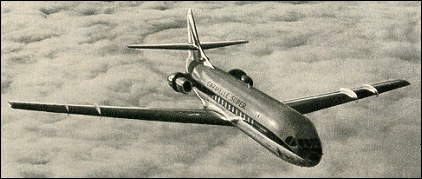
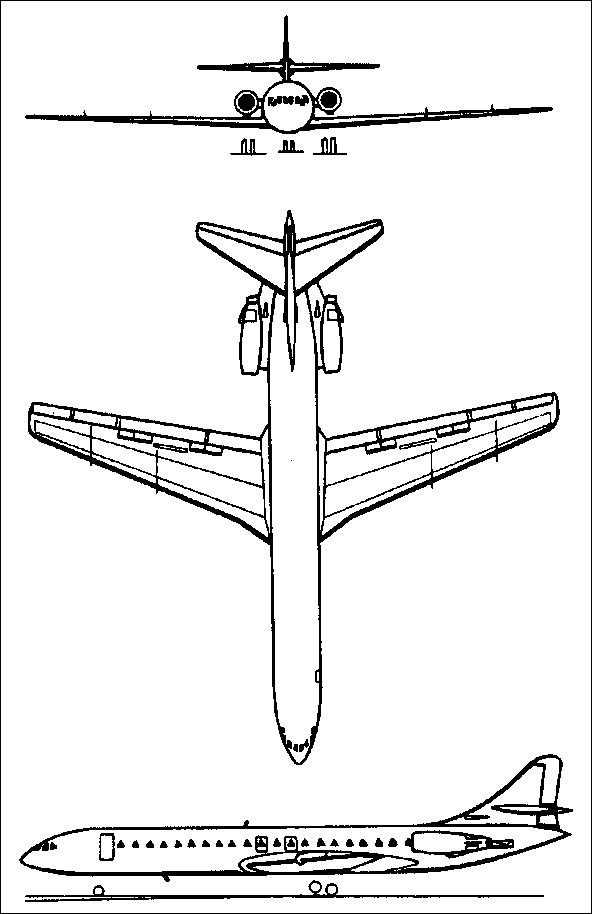
| Short/medium range passenger plane. The first prototype flew on May 27, 1955. Entered production in 1958. 280 built.
 | A three-view drawing (592 x 914) |
| MODEL | Caravelle 12 |
| CREW | 2 |
| PASSENGERS | 128-140 |
| ENGINE | 2 x Pratt & Whitney JT8D-9, 64.5kN |
| WEIGHTS |
| Take-off weight | 58000 kg | 127869 lb |
| Empty weight | 29500 kg | 65037 lb |
| DIMENSIONS |
| Wingspan | 34.29 m | 113 ft 6 in |
| Length | 36.23 m | 119 ft 10 in |
| Height | 9.02 m | 30 ft 7 in |
| Wing area | 146.70 m2 | 1579.06 sq ft |
| PERFORMANCE |
| Cruise speed | 825 km/h | 513 mph |
| Ceiling | 7620 m | 25000 ft |
| Range w/max.fuel | 11240 km | 6984 miles |
| Range w/max payload | 3465 km | 2153 miles |
| lxbfYeaa, e-mail, 17.01.2026 20:54 20 reply | | Fred, e-mail, 30.12.2012 19:44 I worked the Acft.as a line maintence A&P for United Air Lines at Detroit Mich. DTW It was a smooth ride. From a maintenance view the big problem was the multitude of hydraulic system's. There was also a nightmare servicing the main landing gear strut because of the dual piston design.(no quick fix on a thru trip) The AVON engines did not have enough power to fly the aircraft over the rocky mountains so it was restricted to routes west of Denver Colorado. reply | | pete, 02.03.2012 15:16 The Caravelle fusealage was greater than the Comet as it continue to expand ( looking front to back ) when the comet became parallel. An interesting fault with the proposed Comet 5 was that it retained the narrow Comet 4 fuselage.( this was about all dh kept, as it had new wings, tail & engines ). They could have followed aerospatiale and widened it, but the Comet ancestory would be negligable- only the extreme nose.
of course, it would have been a Vickers VC7 !
I only saw a few ofthe earier Avon engined "Carrot tops" and they were very noisy, but we were viewing them from about 40 yards through a chain link fence at Luton. reply | | pete, 02.03.2012 14:19 The Caravelle fusealage was greater than the Comet as it continue to expand ( looking front to back ) when the comet became parallel. An interesting fault with the proposed Comet 5 was that it retained the narrow Comet 4 fuselage.( this was about all dh kept, as it had new wings, tail & engines ). They could have followed aerospatiale and widened it, but the Comet ancestory would be negligable- only the extreme nose.
of course, it would have been a Vickers VC7 !
I only saw a of Avon engined "Carrot tops" and they were very noisy, but we were viewing them from about 40 yards through a chain link fence at Luton. reply | |
| | Todd, e-mail, 04.11.2010 03:51 The Caravelle was a very nice airplane and the French deserve credit for the inovation of tail mounted engines on an airliner. However the DC-9 was in no way a copy of the Caravelle. Having flown both, I can tell you that the Caravelle was a delight to fly, having very nice handling qualities, was easy to land gracefully, and was a good looking airplane. The down side is in its systems which were overly complicated and outdated. The DC-9 had a totally different wing and tail, and systems that were better designed and more modern. All in all I would slightly prefer to fly a Caravelle and much prefer to operate a DC-9. reply | | J,P, Rouland, e-mail, 06.10.2010 04:49 The main claim to fame of this aircraft, not mentioned in other posts, is that it was the FIRST jet (commercial), with the engines at the tail. All others of the time had them under the wings. The example made A LOT of babies, with dual and triple engines in the tail...... reply | | John Hancocks, e-mail, 21.04.2010 08:39 This was an old work horse I well recall as passenger on Al Italia, Air France, and Kingdom of Libya Airlines but most were literally worked into the ground - as the state of cabin interiors would testify. Excellent on the short haul routes I travelled though. Yes, uncanny when viewed on the tarmac, you could swear it was a DH Comet from the nose... reply | | jim lanyon, e-mail, 04.01.2010 21:46 Grate aircraft I frist flew on one from brussel Belg. to paris in 1960 loved the flight reply | | Nicolas V, 08.10.2009 01:23 Leo you are absolutely right, the Caravelle was a milestone of an aircraft. The issue is that the French were totally clueless at the time about how to sell an aircraft in the United States. They showed up with a prototype and their broken English and nobody took them seriously at first. They obviously learned a few good lessons. reply | | leo rudnicki, e-mail, 28.04.2009 18:46 Not much info on a milestone of commercial aviation. The nose and cockpit are from the DH Comet which defined the fuselage diameter. The rest is French genius. Douglas offered to handle all sales in the Americas until he could build his copy, the DC-9. American ingenuity. Naive must be a French word. All aircraft of this configuration from Learjet to VC-10 and maybe Warthog, are born from Caravelle, the original. Lots of kids, must be Catholic. reply |
|
Do you have any comments?
|
| 
COMPANY
PROFILE
All the World's Rotorcraft
|