|
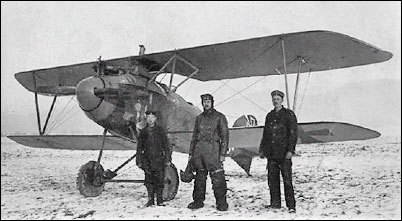
| Just after its combat debut, one of the sleek new Albatros D.III fighters
experienced a cracked wing spar, forcing the pilot to land in open country.
Manfred von Richthofen, the 'Red Baron' himself, was lucky to avoid
complete structural failure, unlike several other experienced German airmen.
As a result of numerous wing failures, restrictions were put on the diving
speed of the D.III, which was hardly satisfactory for a high-performance
combat aircraft. The cause was the weakness of the V-strut supporting the
lower wing, which permitted twisting under load. Another serious fault was
that the radiator was located under the centre of the top wing where any battle
damage would cause the pilot to be sprayed with boiling water. The radiator
was moved to one side for this reason, but still presented some hazard.
Jim Winchester "The World's Worst Aircraft", 2005 FACTS AND FIGURES © The radiator for the water-cooled
engine was inset into the upper
wing. It was well sited to avoid
battle damage, but if it occurred
the pilot risked a scalding. © The D.III was a sesquipiane, with
a lower wing of the same span as
the top one, but half the chord.
The two wings were joined by
V-shaped struts. Unfortunately,
the single lower joint allowed the
lower wing to twist in flight. © The later D.V married the D.III's
wing and tailplane to a new fuselage
and fin. Of course this just transferred
the structural problems to the new
type. These were not corrected until
the strengthened D.Va model.
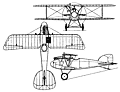 | A three-view drawing (1660 x 1273) |
| CREW | 1 |
| ENGINE | 1 x 160hp Mercedes D.IIIa piston engine |
| WEIGHTS |
| Take-off weight | 886 kg | 1953 lb |
| DIMENSIONS |
| Wingspan | 9.05 m | 30 ft 8 in |
| Length | 7.33 m | 24 ft 1 in |
| Height | 2.98 m | 10 ft 9 in |
| PERFORMANCE |
| Max. speed | 175 km/h | 109 mph |
| Sven, 12.01.2013 13:50 The sesquiplane wing layout is a drag reduction measure. The lower smaller wing is at a lesser angle of attack than the upper wing. At cruising speed and above it generates very little lift and therefore little drag.
As the aircraft slows the angle of attack increases the lower wing becomes effective and a lower stall speed results. Beechcraft used this to best effect in the beautiful Staggerwing. reply | | charlieman, e-mail, 08.01.2013 18:32 Interesting that same wing layout in Austrian D-III's did not seem to show same wing weakness problem. There is more to the story, I'm sure. reply | | Barry, 10.08.2012 14:38 Contrary to Jim Winchester's view above, and far be it for me to counter such a notable writer's opinion, but I do feel forced to do so (there's always a "but" isn't there!). The Albatross DIII and the subsequent DV held sway over the trenches in 1917. The formidable flying circuses of Richthofen and Boelke et al held sway to such an extent that April 1917 was known to allied airmen as "Bloody April". The life expectancy of the young RFC /RNAS and French pilots was only a matter of days. The Albatross reigned supreme. There was no doubt that there were wing spar problems and quite why the designer Robert Thelen decided to copy the French sesquiplane concept of the Nieuport and not the equal size wings seen on planes such as the SE5 is not known. However, over 3000 Albatross DIII's were produce and it was not until 1918 that the allies started to regain air superiority. A more than notable fighter. reply | | Klaatu, e-mail, 28.05.2011 05:06 The success of the Nieuport 11 and 17 scouts influenced Albatros to imitate the French airplanes' sesquiplane wing layout, in which the narrow lower wing had only a single spar. The result was improved maneuverability and a better downward view for the pilot, but at the price of a substantially weaker wing structure. Despite the structural problems suffered by the D-III, Albatros carried the sesquiplane design over into their subsequent D-V and D-Va fighters as well. reply |
|
Do you have any comments?
|
| 
COMPANY
PROFILE
All the World's Rotorcraft
|